Dirty, low down, corrupt and lush in the best possible way
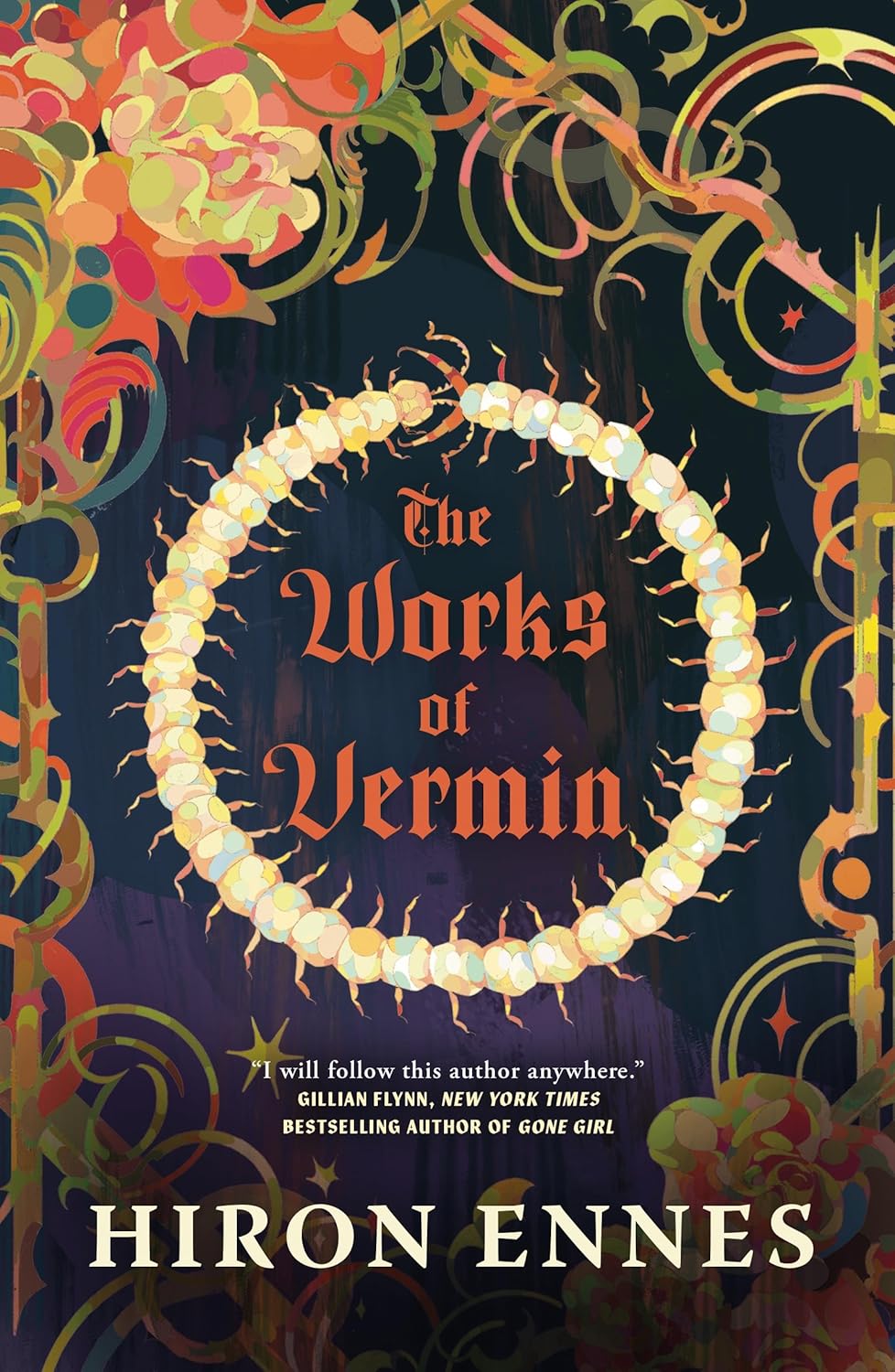 |
| Cover Art: Deb JJ Lee |
Weird is a category that exists for marketeers but because of that has come to mean some specific things. Personally I think that’s a huge shame because it seems to suggest that only stories with these tropes qualify as weird and, let’s be real for a moment, reading about elves and spaceships and enchantment and massive battles is absolutely weird. Perhaps it’s just me wanting to qualify as weird for being a run of the mill nerd.
Hiron Ennes’ The Works of Vermin is studiously in the marketing brochure as ‘weird’, probably even ‘New Weird’. It has a maddeningly bizarre city named Tiliard, protagonists that are overwhelmed by said city and its workings, branching stories, odd unexplained events, multiple factions all grappling with one another and the city itself, and a use of language that is the literary equivalent of a finely tailored silk shirt. In paisley.
Its closest comparators are probably Miéville’s Perdido Street Station and Vandermeer’s Finch with a side order of Noon’s Chronicles of Ludwich. As with each of those books, Ennes explains nothing, expecting the reader to pick up what they need to know from the story and its characters. A kind of ritual osmosis that, if your mental membranes are imporous, is going to leave you cold.
I hit the end of the first twenty pages both excited but also quite suspicious. In some ways it’s so consciously inspired by those comparisons that I was worried it was simply trying too hard, but I was excited because I love New Weird with all of my bones. If I could read New Weird every other book I would. That either makes me the wrong person to review this or exactly the right one.
This isn’t going to be for everyone – alongside the ‘catch up you dunce’ approach to exposition and context provision, Ennes’ writing is flowery and pretentious and consciously overwrought. These two facts, even and perhaps especially in the opening, are a hill the text demands you climb, an investment it’s asking you to make. All weird fic makes that demand (I’m thinking of Feersum Endjinns by Banks for example that does NO explaining at all) in a way that is, essentially, part of this micro-genre. It is its own gatekeeper.
However, there are reasons for this that I think Ennes largely succeeds in making work on the page and in the structure. The first of them is the language. It is gothic, full of neologisms and frequently full of the fantasy equivalent of milsim’s obsession with make and model of gun. Except here it’s about fungus and spores. And yet it works because of the nature of Ennes’ world which is one in which performance – opera, music, drama, dance and more are an essential part of the expression both of Tiliard as a city and Ennes’ world as a whole.
For example – when an opera demands a character dies in a duel? Well in Tiliard you’ll be looking for a new actor for that part after the show. When it calls for an orgy or a battle? You better believe that the boundary between performance and reality is blurred intentionally by Ennes but also by his characters. Everyone is an artisan. Everyone has a view about fashion and art and trends and acceptability based upon your artistry. That artistry might be drenched in violence but without poetry it is nothing and you are nobody.
It is a remarkable achievement to weave the concept of performance into the text and the world so thoroughly. It saturates not just the story but the structure and the world building too. More than that, it saturates the language. Coming back full circle – Ennes’ language is of his world; it is drenched in the performative flourishes that are in the DNA of his characters and the lives they’re leading. It’s a brilliant approach and this book would be something altogether more mundane without this commitment to gilding every leaf and illuminating every letter. At times it’s like a drug addled medieval monk has got his hands on the Voynich manuscript and I mean that in a good way.
It doesn’t always work – such ambition never lands consistently – but I’d rather this ambition than something more staid. In particular there’s a structural sleight of hand with the novel that is both incredibly ambitious and doesn’t quite stick the landing. When I say ambitious, it had me stop and put the book down to think through what it meant when the nature of the story is finally revealed. That’s immensely satisfying in conception but it’s not quite so good in execution. It’s pulling a rabbit out of a hat only for the rabbit to bite you and run away.
Regardless, Ennes’ work here is exciting and strangely comforting. It’s world in which people are strangely wrought but familiar enough we can follow along with their longings, their passions and their tragedies. And make no mistake, despite it all, this book is very much Shawshank with precious little Redemption although what it does offer is gratefully received.
Among it all is a world which, despite its despotism and casual disregard for human dignity is nevertheless sex positive in a way I really appreciated not simply with regard to the act itself but in regards to sexuality more broadly and gender specifically. There are some beautiful moments on this front and here Ennes is faultless in showing that love and passion do not discriminate.
The Works of Vermin is a story about performance, about the luxury of choosing to be someone, about the struggle of making that stick when the world wants something very different from you and how performance can be the making of not only us but the world too. It’s a literary opera that knows how to wield tragedy and triumph and sets it all within a deliciously weird and fecund world. I am very excited to see what Ennes does next.
--
Highlights:
- Theatre and fungus
- Revolution, cults, monsters and the weirdest tech immaginable
- A mythic cycle that is built around performance and decadence
References: Ennes, Hiron, The Works of Vermin [Tor Nightfire, 2025].
