Thursday, April 2, 2026

Video Game Review: Cocoon by Geometric Interactive

A world within a world within a world...


You may or may not have heard of Matryoshka dolls, those stackable dolls that can be nested within one another. What Geometric Interactive did with Cocoon was take that concept and turn it into an adventure puzzler, but instead of dolls, you stack worlds. That’s right, worlds (or, levels represented as worlds, to be more precise). Hard to imagine, but bear with me here.


Part of Cocoon’s beauty is its simplicity. You use the left stick to maneuver and the X button (on PlayStation) for everything else. That’s it. Want to pick something up? X. Want to activate something? Hold X. In doing this, Cocoon begins with no tutorial. You start the game and get to work. But what are we doing exactly?


Cocoon
is a clever adventure/puzzle game, novel in its approach. The protagonist is a little bug with wings exploring a weird set of worlds. It uses orbs to activate different events and solve puzzle mechanics to discover more about the universe. These orbs, when placed on a proper pedestal, can be accessed, a level within a level. The puzzles range from rudimentary to moderate. There were a few times I found myself stuck on a puzzle for more than a few minutes, and those were the moments where the game shone. They made me consider the game, the world, and the mechanics. I’d overcomplicate the solution and find myself running around with orbs for no reason, putting them everywhere and anywhere I could. When it clicked, the game was satisfying, and using the stacking mechanic set the game apart.


Besides the stacking, the game continues to introduce new mechanics throughout its short runtime. By keeping the game brief (maybe five hours), the game stays fresh, pushing the player forward. The new mechanics themselves are not anything earth-shattering, but within the evolution of the game’s progress, they help to maintain curiosity. Once you advance past a puzzle, the game locks off any unnecessary areas so you don’t waste time unnecessarily backtracking. That Geometric Interactive thought of the player in this regard is a significant treat. Even the music, which is serviceable for the needs of the game, tells the player when they’re on the right track to solving the next puzzle.


The worlds themselves are intriguing, if typical. A sci-fi desert world, a world with shifting phases of matter, and a biological world that looks like the anatomical innards of some creature comprise the main playable areas. The brilliance comes into play when you hop between these worlds to move forward, sometimes using one world to activate puzzles in another. Difficult to explain until you see it in action. Cocoon’s puzzles become even more enjoyable toward the end when the player has to juggle multiple orbs and moving components to proceed.


My primary issue boils down to the lack of narrative depth each of these worlds provides. Besides paring down the complexity, the game also completely shuns any sort of narrative above the base-level gameplay and discovery. As I mentioned, you play as an insect exploring the world. But why should I care? What is the purpose? Is this some kind of rite of passage for this insect’s species? The closest thing the game has to lore exists in the “side content”. Small puzzles in not so hidden areas that allow you to release a trapped entity. But there is no information about them, why they were trapped, or how freeing them impacts the world as a whole. It’s just something else to do, and doesn’t provide any challenge.

I am uncertain whether this was the intent of the developer. The game doesn’t provide any true challenge, and is interesting enough to keep you hooked through the gameplay and environment alone. Sure, backtracking can sometimes be a bore, but overall the game moves at a steady pace. There is no story here to intrigue, but there’s also not enough challenge to make someone quit. Is this the perfect balance for an adventure/puzzle game that does not want to include any story elements? Honestly, I think it is.

Depth does not guarantee fun. Sometimes maintaining someone’s interest for a short time is enough. Cocoon does just that. It’s a game that doesn’t impose. It doesn’t ask too much of the player and, in return, it provides an enjoyable experience that allows its novelty to pull you through to the end. Would I have liked more story? Sure. Was it necessary? Not at all. In fact, when I think of the term palate cleanser (regarding video games), Cocoon is an apt example. I may not come back to Geometric Interactive's darling in the future, but I still think it’s worth a play through. For those seeking a game that won’t eat all of your time, something a little different without too much of a challenge, an intriguing (if not deep) world, and some clever puzzles, Cocoon is a perfect fit.


--

The Math

Objective Assessment: 7.5/10

Bonus: +1 for world stacking mechanic. +1 for staying fresh.

Penalties: -1 for no lore. -1 for over simplicity at times.

Nerd Coefficient: 7.5/10

Posted by: Joe DelFranco - Fiction writer and lover of most things video games. On most days you can find him writing at his favorite spot in the little state of Rhode Island.

Wednesday, April 1, 2026

Book Review: Ode to the Half-Broken by Suzanne Palmer

Traumatized but healing mechas and humans building community in a ‘cozy’ post-apocalyptic setting

Cover of 'Ode to the Half Broken'. Features a large mecha and a small dog walking down an alley into what looks like a nicely lit area with trees.

Suzanne Palmer’s Ode to the Half Broken is, somehow, a cozy post-apocalypse near-future science fiction story about a former military mecha. And, unlike some extremely valid recent critiques of the ‘cozy’ genre in general, Palmer manages to take seriously the traumatic events in the past of her characters as well as what might be required for them to heal.

The story begins with the former military mecha, our protagonist [1], injured and awakening alone in a “highly degraded urban interior space”. It quickly becomes clear that they were attacked by mysterious assailants. A cyberdog named Atticus, who is an organic-mecha hybrid, becomes their sidekick and helps our protagonist begin to acclimate to actually talking to other beings, which they have not willingly done in nearly 20 years.

As we are introduced to the world, we learn that things are not great. Through flashbacks and some past Global News Feed alerts, we are shown glimpses of how most of the planet was destroyed: proto-fascist paramilitaries with nuclear weapons; storms with radioactive, toxic airborne particulates; misinformation tearing people apart; global pandemics, some of them human produced; and engineers creating sapient mechas which are being used on the battlefield. 

Some humans do survive, but the mechas created by humans thrive in various types of bodies: from trains to carts to gravedigger bots to humanoids like our military mecha protagonist. There are also a lot of single purpose ‘internet of things’ bots that are not necessarily intelligent, but have at least a basic sense of self, like, for example, a smart toaster. At some point in the past, the mecha declared their independence. Now, some live independently and some live cooperatively with humans. But something seems to be going wrong: there are reports of antisocial behaviour from some mecha and rumours of shadowy forces gathering in old abandoned shopping malls.

The plot of the book follows our protagonist, with their cyberdog friend, looking for repairs and finding out who attacked them. They are also looking for some long-lost sibling bots: other mecha that were built, along with the protagonist, by a past engineer named Dr. Milton. The plot is fun! Our protagonist is joined by excellent supporting characters, like a human mechanic named Murphy; a drone called Teal-A3-Charp (“Charp” for short), and eventually a train mind named 44-Mongoose that gets transplanted into the body of a vintage 1966 Volkswagen van that was retrofit with a steam engine.

I think this book falls pretty neatly into the cozy sci-fi subgenre. There has been some recent debate about cozy sci-fi. What even is cozy sci-fi? On a recent episode of The Coode Street Podcast [2], Jonathan Strahan and Gary K. Wolfe traced the origins of the term back to the 1950s and British science fiction author Brian Aldiss. Aldiss described works like John Wyndham’s Midwich Cookoos, as “cozy catastrophe” because they portrayed a disasters in a small village. Cozy fiction tends to focus on a small group of people, a manageable scale, not the whole world. On Coode Street, they contrasted this with “large management fiction,” like Isaac Asimov’s Foundation trilogy.

There seems to be part of a bigger movement towards ‘cozy’ as a reaction to The Times We Live In. John Rogers, well-known producer of the tv show Leverage, recently commented on Bluesky that, right now, “the biggest movie is about science bros and the power of friendship and sacrifice[;] the biggest TV show is about good people doing their best under impossible circumstances to help suffering people[;] even under our culture’s institutionalized greed and cynicism, people are desperate for fellowship.” I agree with this.

Cozy is not limited to science fiction, of course. It was probably a reaction to the popularity of cozy mysteries. But the focus on building community in the face of larger disasters makes a good story engine for sci-fi. I very much enjoy cozy fiction and I want people to be able to enjoy things! But I have also been convinced by some excellent critiques that I need to ask for my cozy fiction to do a bit more. If nothing else, it needs to take seriously the trauma done to the characters within the world.

Palmer absolutely does this. What might look like simply a fun story about some robots and humans working together also tells a deeper story about trauma, building community, and resisting the desire to demonize the other. Our protagonist mecha was so traumatized by events in their past that they literally hid out for twenty years doing research on insects and speaking to no one. Then, of course, they were forced out of their hiding because they were violently attacked. This is not a recipe for having a great relationship with the world! But we get them see them figuring out how to reenter the world. How to build trust. How to enjoy companionship. And how to heal. But Palmer also shows us that not all trauma victims can do this. We also get to see characters who are absolutely too traumatized to forge a new path.

In the acknowledgements, Palmer notes that she wrote this book during a period of personal grief. She wanted to tell the story of a near-future apocalypse, but needed that story "to still communicate hope and friendship, have humor, allow for light, without being crassly slapstick or flippantly dismissive of the days we are all now currently living in.” I think she succeeds in this; and it’s an approach where she’s excelled in the past. I am a longtime fan of her Finder Chronicles, which follows a character named Fergus Ferguson who travels the galaxy finding lost things. If you liked Finder, you will absolutely like Ode to the Half Broken. If you've never tried tried her other work, Ode is a good place to start.

[1] I am going to be referring to the main character as the protagonist throughout this review because, well, they declined to provide a name for themselves until nearly the end of the book. 

[2] Episode 716: Dystopias, Cozy Fiction, and Other Dilemmas

--

The Math 

Highlights

  • Found family with mechas and humans building community
  • Dealing with trauma and loss in a world of technological change
  • Sarcastic cyberdog sidekick for comic relief

Nerd Coefficient: 8.5/10 Well worth your time and attention edging towards very high quality/standout in its category.

Reference: Ode to the Half Broken. Suzanne Palmer. [DAW Books, 2026].

POSTED BY: Christine D. Baker, historian and lover of SFF and mysteries. You can find her also writing reviews at Ancillary Review of Books or podcasting about classic scifi/fantasy at Hugo History. Come chat books with her on Bluesky @klaxoncomms.com.

Tuesday, March 31, 2026

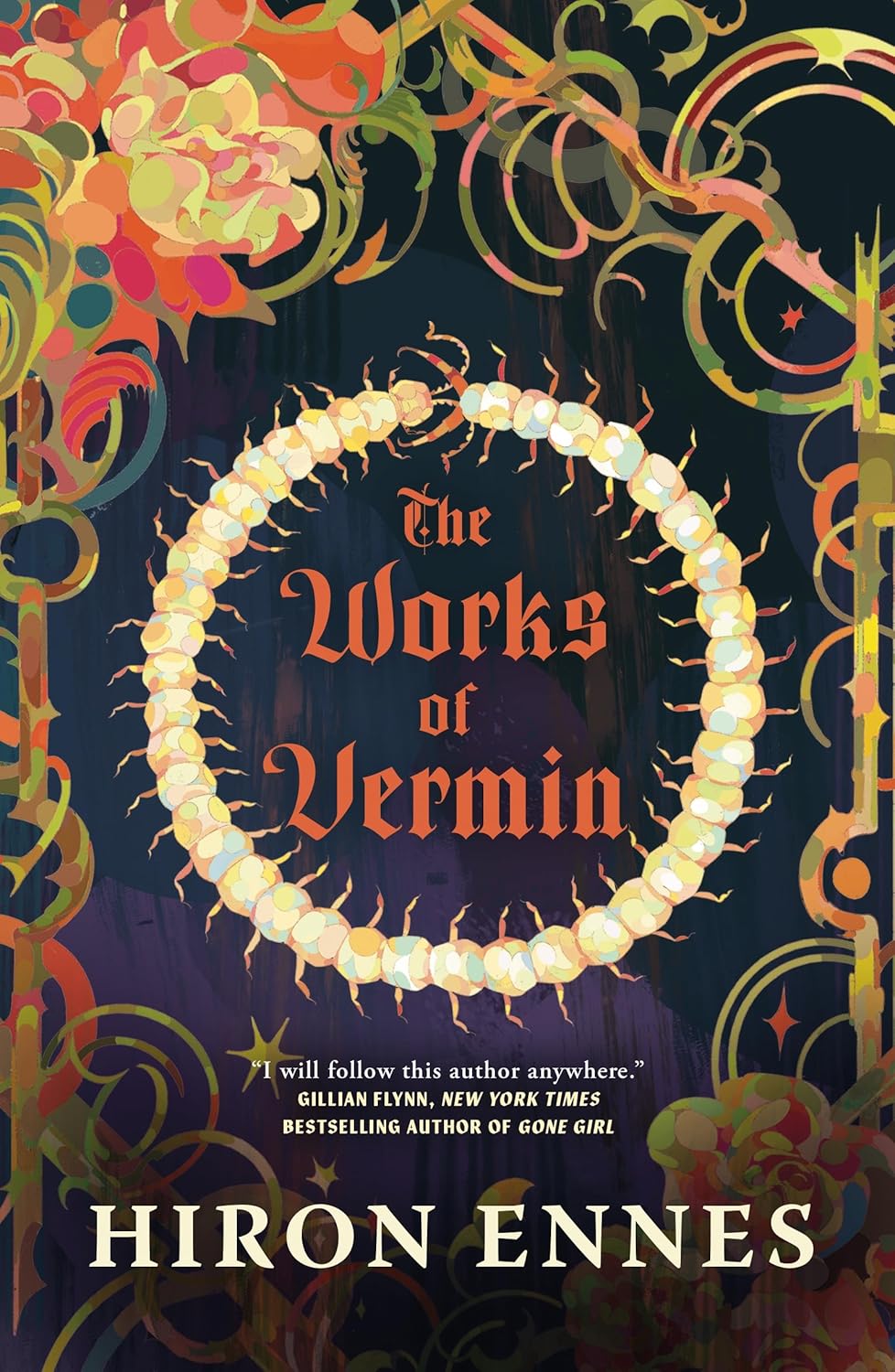
Book Review: The Works of Vermin, by Hiron Ennes

 Dirty, low down, corrupt and lush in the best possible way

The Works of Vermin by Hiron Ennes | Goodreads
Cover Art: Deb JJ Lee

Weird is a category that exists for marketeers but because of that has come to mean some specific things. Personally I think that’s a huge shame because it seems to suggest that only stories with these tropes qualify as weird and, let’s be real for a moment, reading about elves and spaceships and enchantment and massive battles is absolutely weird. Perhaps it’s just me wanting to qualify as weird for being a run of the mill nerd. 


Hiron Ennes’ The Works of Vermin is studiously in the marketing brochure as ‘weird’, probably even ‘New Weird’. It has a maddeningly bizarre city named Tiliard, protagonists that are overwhelmed by said city and its workings, branching stories, odd unexplained events, multiple factions all grappling with one another and the city itself, and a use of language that is the literary equivalent of a finely tailored silk shirt. In paisley.


Its closest comparators are probably Miéville’s Perdido Street Station and Vandermeer’s Finch with a side order of Noon’s Chronicles of Ludwich. As with each of those books, Ennes explains nothing, expecting the reader to pick up what they need to know from the story and its characters. A kind of ritual osmosis that, if your mental membranes are imporous, is going to leave you cold. 


I hit the end of the first twenty pages both excited but also quite suspicious. In some ways it’s so consciously inspired by those comparisons that I was worried it was simply trying too hard, but I was excited because I love New Weird with all of my bones. If I could read New Weird every other book I would. That either makes me the wrong person to review this or exactly the right one. 


This isn’t going to be for everyone – alongside the ‘catch up you dunce’ approach to exposition and context provision, Ennes’ writing is flowery and pretentious and consciously overwrought. These two facts, even and perhaps especially in the opening, are a hill the text demands you climb, an investment it’s asking you to make. All weird fic makes that demand (I’m thinking of Feersum Endjinns by Banks for example that does NO explaining at all) in a way that is, essentially, part of this micro-genre. It is its own gatekeeper. 


However, there are reasons for this that I think Ennes largely succeeds in making work on the page and in the structure. The first of them is the language. It is gothic, full of neologisms and frequently full of the fantasy equivalent of milsim’s obsession with make and model of gun. Except here it’s about fungus and spores. And yet it works because of the nature of Ennes’ world which is one in which performance – opera, music, drama, dance and more are an essential part of the expression both of Tiliard as a city and Ennes’ world as a whole. 


For example – when an opera demands a character dies in a duel? Well in Tiliard you’ll be looking for a new actor for that part after the show. When it calls for an orgy or a battle? You better believe that the boundary between performance and reality is blurred intentionally by Ennes but also by his characters. Everyone is an artisan. Everyone has a view about fashion and art and trends and acceptability based upon your artistry. That artistry might be drenched in violence but without poetry it is nothing and you are nobody.


It is a remarkable achievement to weave the concept of performance into the text and the world so thoroughly. It saturates not just the story but the structure and the world building too. More than that, it saturates the language. Coming back full circle – Ennes’ language is of his world; it is drenched in the performative flourishes that are in the DNA of his characters and the lives they’re leading. It’s a brilliant approach and this book would be something altogether more mundane without this commitment to gilding every leaf and illuminating every letter. At times it’s like a drug addled medieval monk has got his hands on the Voynich manuscript and I mean that in a good way. 


It doesn’t always work – such ambition never lands consistently – but I’d rather this ambition than something more staid. In particular there’s a structural sleight of hand with the novel that is both incredibly ambitious and doesn’t quite stick the landing. When I say ambitious, it had me stop and put the book down to think through what it meant when the nature of the story is finally revealed. That’s immensely satisfying in conception but it’s not quite so good in execution. It’s pulling a rabbit out of a hat only for the rabbit to bite you and run away. 


Regardless, Ennes’ work here is exciting and strangely comforting. It’s world in which people are strangely wrought but familiar enough we can follow along with their longings, their passions and their tragedies. And make no mistake, despite it all, this book is very much Shawshank with precious little Redemption although what it does offer is gratefully received. 


Among it all is a world which, despite its despotism and casual disregard for human dignity is nevertheless sex positive in a way I really appreciated not simply with regard to the act itself but in regards to sexuality more broadly and gender specifically. There are some beautiful moments on this front and here Ennes is faultless in showing that love and passion do not discriminate.


The Works of Vermin is a story about performance, about the luxury of choosing to be someone, about the struggle of making that stick when the world wants something very different from you and how performance can be the making of not only us but the world too. It’s a literary opera that knows how to wield tragedy and triumph and sets it all within a deliciously weird and fecund world. I am very excited to see what Ennes does next.


--

Highlights:

  • Theatre and fungus
  • Revolution, cults, monsters and the weirdest tech immaginable
  • A mythic cycle that is built around performance and decadence

Nerd coefficient: 8/10, an exceptionally ambitious novel with an eye on the weird and its heart in the right place.

References: Ennes, Hiron, The Works of Vermin [Tor Nightfire, 2025].

STEWART HOTSTON is an author of all kinds of science fiction and fantasy. He's also a keen Larper (he owns the UK Fest system, Curious Pastimes). He's a sometime physicist and currently a banker in the City of London. A Subjective Chaos, BSFA and BFA finalist he's also Chair of the British Science Fiction Association and Treasurer for the British Fantasy Society. He is on bluesky at: @stewarthotston.com.

Monday, March 30, 2026

Anime Review: Sentenced to Be a Hero

An intriguing fantasy premise that would benefit from deeper character development

The Winter 2026 Anime season was loaded with the return of major heavy hitters from the past including Jujutsu Kaisen, Frieren, Fire Force, and Hell’s Paradise. This powerhouse lineup made it hard for new shows to stand out. But, Sentenced to Be a Hero arrived as a debut anime with lots of promise, in both its premise and its animation style. The initial concept was unique and the character design was appealing. While the show is entertaining, it’s hard to say why this promising story doesn’t land as a mega-hit the way one would expect, especially since it seems to check the boxes for a fantasy adventure anime.

Sentenced to Be a Hero is set in a magic medieval like world where knights (soldiers), under the direction of the local military and religious leaders, battle hordes of monstrous creatures (demons) to protect civilians from destruction. The knights are periodically helped by magical creatures known as “goddesses” who have special powers. The series is primarily the story of Xylo Forbartz, a heroic knight who falls into disgrace when he is betrayed in battle and falsely accused of murdering his partner goddess. He tries to explain the circumstances of the goddess’s death but it’s clear the trial is rigged. Instead of being simply executed, he is sentenced to serve as a “hero.” In this culture, “heroes” are executed convicted criminals who are magically brought back to life and forced to protect the kingdom. Since they are convicted criminals, they are looked down on by other knights and by the local people. Each hero is sealed by a spell that grants them miserable immortality. In the event that they are killed they are brought back to life to continue fighting and suffering. However, each reanimation strips them of memories and their humanity.

Xylo is wrongfully convicted and sentenced to an eternity of servitude basically doing the kind of work he was doing when he was a holy knight. However, the heroes have minimal resources and are given the most dangerous assignments including suicide missions. Although they can move around and still exist as seemingly normal humans, they are controlled by seals around their necks and must comply with orders or face a painful death and reanimation. Xylo heads a ragtag team of other convicted heroes, including the fearful thief Dotta, the con-artist Venetim, the slightly unhinged killer Tsav, and the mentally unstable Tatsuya. There is also, Norgalle a strong, older fighter, who lives under a delusion that he is a benevolent king. Dotta stumbles upon and steals a box containing a new immature goddess Teoritta. Teoritta insists on forging a pact with Xylo despite his reluctance due to his prior bad experience with his previous goddess. However, when an attack by swarms of demons puts hundreds of military lives at risk, he capitulates and accepts her help. He and his ragtag team of enslaved heroes are forced to assist a squad of knights under the leadership of Captain Kivia, a woman who initially distrusts Xylo but eventually becomes a grudging ally. The rest of the series focuses on various battles and rescue missions involving the growing demon horde and the search for the various demon lords who control them. Along the way we are introduced to more members of Xylo’s team who apparently don’t always fight together, including dragon rider, Jayce and creepy, overly polite soldier Rhyno. Eventually, we learn the story of how several members of team became trapped as heroes. In almost all of the cases, the heroes are sentenced unjustly as part of a corrupt government cover up. Manipulating all of this drama are shady religious leaders, undercover demons, and local demon sympathizers who are happy to betray humanity.

Although each member of Xylo’s team has a distinct name and an overtly referenced personality type (thief, con-artist, killer, dragon-rider), I often found myself double checking who was being referred  when a name was mentioned. The supporting characters were conceptually interesting, but in the execution of the story, they seemed underdeveloped and not fully emotionally engaging. Unlike other anime where the side characters are essential to understanding the main protagonist, these supporting characters are mostly limited in terms of evoking emotions from the viewers. Even Xylo himself doesn’t reveal much about his backstory (family, upbringing, childhood trauma) and doesn’t meaningfully evolve over the very short season. Xylo is grumpy, understandably cynical, and pragmatic. He is paired with the newly birthed “goddess” Teoritta who is sunshiny, childlike, and egotistically optimistic. Even though she is called a goddess, Teoritta is basically still a person and vulnerable to being killed despite her magical powers. Teoritta is distinctly portrayed as childlike and not as a romantic interest. She is similar to Sylph, Yuno’s bossy, possessive, sprite-like wind spirit companion in Black Clover. Her personality is a contrast to the general serious vibe of the other characters. Teoritta and the other goddesses rely on praise to bring meaning to their lives and she is constantly asking praise from Xylo who is initially belligerent to her in a classic grumpy-sunshine trope. Xylo and the supporting characters are likeable but underdeveloped and the series relies more on the political plot than the interpersonal relationships to tell the story

Battling demons to save humanity is a story that has been done often, including in shows like Black Clover, Fire Force, Frieren, and even Bleach. Sentenced to Be a Hero revisits this popular story concept with a fresh premise of the forced sentenced heroes. But once the story gets rolling, the ultimate execution still feels like something we’ve seen before. As such, it is reasonably entertaining but not as innovative and uniquely engaging as it could be. Most major and popular anime have a moment that builds a surprising emotional connection with the viewers through a poignant moment, a tearjerker scene, a stunning moment of battle, a unique character introspection, or at least powerful and inspiring character camaraderie. Those elements are mostly missing from Sentenced to be a Hero. Fortunately, towards the end of this very short season, there are some big revelations and surprising developments that help make up for the intervening flat moments. Ironically, the person with the biggest character arc is the initially antagonistic Kivia, as she experiences a major shift in her worldview. Xylo primarily only evolves onscreen in terms of his treatment of Teoritta, as he gradually grows more protective of her when he realizes how many people want to hurt her. Surprisingly, one of the other best characters, is Frenci, Xylo’s former fiancé who is clever, cynical, and loyal to Xylo. Her status as fiancé also indirectly provides some abstract insight into Xylo’s prior life.

Beyond these small insights, Xylo, remains mainly stoic, vacillating mostly from annoyance to irritation. It’s not until around the seventh episode that we see him actually smiling. His perpetual baseline of irritation makes sense given the premise that the heroes are generally like inmates, not friends, and are not very emotionally connected to each other. That kind of emotionless presentation may make sense for the story concept, but it is hard to pull off without risking disconnect. Frieren is an example of a show with an initially stoic protagonist. However, over time she became a much more complex character. Solo Leveling is another series with little emotional content or fleshed out characters, but it still manages to be entertaining due to the intense and creative video game inspired action. The battles and victories in Sentenced to be a Hero are often overshadowed by the pervasive sense of injustice that are an inherent part of the corruption story. Fortunately, there are a few positive moments of inspiration where the townspeople show appreciation and even Xylo has a moment of surprise at being shown gratitude. 

Overall, Sentenced to be a Hero is a reasonably entertaining show that has a unique initial premise. But the overall plot feels familiar and the characters are underdeveloped in a way that risks disengagement, despite some dramatic moments in the series. Diving deeper into the characters in the future would be a risk that could be worth the payoff, especially given the short season.

--

The Math

Nerd Coefficient: 7/10

Highlights:
  • Unique and intriguing premise
  • Little character development or story energy
  • Complicated list of characters navigating a familiar plot structure in short season

POSTED BY: Ann Michelle Harris – Multitasking, fiction writing Trekkie currently dreaming of her next beach vacation.

Friday, March 27, 2026

Graphic Novel Review: Free Planet #1

A wildly inventive comic/graphic novel by Aubrey Sitterson and Jed Dougherty

The planet of Lutheria has been through a lot. However, after much strife and struggle, they have gained independence from a tyrannical interstellar polity that has exploited them and their resources for a long time. They have struggled mightily against great odds and have achieved a precarious peace and stability. But it is what happens now that freedom is won that is the real story of Free Planet, a comic by Aubrey Sitterson and Jed Dougherty.

Graphic novels and manga are not my usual medium to read and review. And I am not the usual person here at Nerds of a Feather to review such work. But, in the spirit of spreading my oeuvre and skills, I decided to give it a try. And I am glad that I did. I was drawn immediately to the complexity of the art style. The creators take full advantage of the medium they are working in and push the boundaries of the form in telling their story. How? Graphic novels and comics are a visual medium; they tell the story by using imagery to do the heavy lifting alongside the dialogue and text, but it is imagery that they rely upon to tell the story. Comics have a structure that is recognizable: issues, pages, panels. If you’ve read some comics, you know precisely what to expect. And while that superstructure is here in the physical sense, the authors do much more with it, and create a visual language and a graphical vocabulary.

This first panel is a traditional comic panel, easily recognizable to anyone who has read a comic:

But many pages go much further. Look at this second image and the information density here:

We have a tense standoff between forces of the revolution and a mercenary outfit. But look on the left and you also see the story behind the story, the consequence of the revolution on grain prices as well as orchaleum production (orchaleum is a material needed for FTL travel; Lutheria has an abundance of it). Many pages of Free Planet use infographics like this to enhance and enrich the story.

This is a story about how fragile a revolution can be, and how the aftermath of success can affect the characters and the world itself. Using the visual vocabulary, we get a full sense of just what the costs of victory have been. The infographics, maps, and charts such as the one seen above do the heavy lifting of worldbuilding that would be difficult to replicate in prose.¹ We get a sense of a revolution, a planet, and the characters who are all on the edge, all of them under stress in the aftermath of the revolution. The novel focuses on the disappearance of one of the leaders of that revolution, and in the process gives us a “tour” of the revolution, both in the present and in key moments leading up to its success. Free Planet is entirely effective in using its sui generis approach to tell its story.

As a result, for me, Free Planet did not seem like a traditional comic, and I did not read it like a traditional comic. This was a deep and immersive reading experience that I took slowly and carefully, lingering on details in the graphics and visual vocabulary. It was like reading a dense space opera novel, once you don’t batter through with speed to flip pages, but rather linger on, thinking about the word choice and the scene being set. And for all of its graphical use, Free Planet has as much in common with that dense space opera novel as it does more traditional comics. I can’t imagine the amount of effort and resources it took to create Free Planet; it has to be an order of magnitude harder to accomplish. The fact that it is done so well is a testament to the work that the creators have put into it.

Thus, Free Planet has immersed me and engaged me deeply into its story, characters, backstory and worldbuilding. There is something hopeful and scary and unflinching about the story here—revolution and change are possible—but there is no happily ever after, and it takes work, a lot of work, to handle what comes next. The story of what comes after the revolution is as complicated and messy and interesting as the story of the revolution. Through the imagery, characters, and graphics of Free Planet, I was able to get my head around the costs of that revolution. And to be clear, those costs are high. And we do see bits and pieces in flashbacks of the struggle, but just enough for context, for understanding what the characters and the world of Lutheria are in for, now. But the point and focus of the graphic novel, always, is “what now?” And of course, what the revolution means. Each of the characters wants freedom… but what that actually means is not a single thing. And those definitions of freedom can and do clash.

The comic itself proclaims touchstones to Saga, and to Dune, and those are good reference points to those wondering just what kind of world this is and whether you might like to immerse yourself into this story and its characters. Other touchstones connected for me as I read the story. One in particular I want to bring up is Andor, the series as well as Rogue One. The series and the movie are at their core about getting the revolution off the ground, about how resistance is not futile, and how opposing tyranny can have high costs. So it is set “earlier” in a cycle of resistance and revolution than Free Planet is. But what the Andor saga shows, as Free Planet does, and what the main line of the Star Wars movies do NOT, is the often uneasy and prickly alliances and pieces of that revolution. Luthen, in Andor, is trying to put together a whole host of different factions into the Rebel Alliance.² And those factions are often at odds with each other as with the Empire and have very different ideas on what freedom from the Empire’s tyranny would be like. Free Planet shows that those contradictions and tensions are still there after the revolution. Readers of history (or listeners of, say, The Revolutions podcast) see this dynamic again and again.

One final note. As you could see from the panels above, the cast and society and world of Free Planet is diverse along a variety of axes, ranging from a mostly POC cast to a wide range of genders and sexualities. Lutheria and its inhabitants are a world and a people trying to find itself among a riot of diversity, and trying to find those commonalities and find strength in that diversity is part of the story of the comic. There is a definite Spanish/Brazilian flavor to Lutheria, and we see that not only in the cast, but in the use of language as well.³

I look forward to reading more issues of Free Planet, and continuing this fascinating and engaging story.

NB: The work of Aubrey Sitterson has previously been covered at Nerds of a Feather in some of the Thursday Morning Superhero columns.

NB: Although I do not do a lot of Hugo Award Nominations for the category Best Graphic Story or Comic, Free Planet #1 is going on my nomination ballot.

Highlights:

  • Unique, enthralling and engaging format for visually telling the story
  • An important story: what happens after the revolution wins.
  • A diverse,queer and rich set of characters.

Reference: Sitterson, Aubrey and Dougherty, Joe. Free Planet Vol. I (Issues 1-6) [Image Comics, 2025].

¹ Ideas that come to mind include the use of footnotes, or perhaps the Dos Passos method of conveying information via metatexts, that has been since appropriated, adapted and evolved by authors like John Brunner and Kim Stanley Robinson. ² That is a bit of nice worldbuilding in Andor and Rogue One, isn’t it?  The core movies have the rebellion as a unified thing, with a unified command… but the name of the group is the Rebel alliance. Alliance of *what* is a detail that had to wait to be explicated. ³ And that, of course, makes me think of the Viagens Interplanetarias novels of L. Sprague de Camp.

POSTED BY: Paul Weimer. Ubiquitous in Shadow, but I'm just this guy, you know? @princejvstin.

Thursday, March 26, 2026

On Civilization (VII)

I have to preface this whole review with a little (lot?) of backstory. I am by no means a “gamer”—I play video games pretty casually, and as a certified Old Guy, I grew up when you bought a game on a series of discs that most people now only associate with the save icon. I certainly don't play enough to really enjoy a lot of online stuff—I lose immediately to people who spend far more time than I do (that's not judgement, just fact), nor do I have the time or inclination to keep up with tons of DLC, season passes or whatever. Red Dead Redemption 2 is pretty much my ideal game—I can play for as much as my time and ADHD allows, put it down for a while, and pick it up again and it's still the same game.

All of that is to say—your mileage may vary. But that's where I'm coming from.

Civilization—the first one—is the first video game I even remember playing. It hooked me instantly, countless empires rising and falling on that technicolor grid. Civilization II was even better. I missed III and IV mostly, as real life took over, and then I returned to put in literally thousands of hours in V (I prefer it to VI, overall, but VI definitely does several things better, but that's another story).

VII changes a lot—and that's pretty much the lens I have to write this review through. If you're new to Civilization, I don't know if VII is a good starting point—or not. It might be, but I can't speak to going into it with new eyes. On the off chance you're reading this and have never played it, my two cents is to grab a bundle of existing games and dive in that way. But don't shy away from VII, it has a ton of high points, but it doesn't exactly feel representative of the series.

All that being said, I'm going to break this up into sections, again—assuming you're familiar with the game.

Behold the might of my (current) empire!

The Good:

The first thing I noticed is that this game is gorgeous. Civilization is not a game that really even needs great graphics, but some older versions don't really let you see your cities, or the terrain, and in this iteration, being able to zoom in and see, say, the Pyramids sitting in the middle of your city is pretty darn cool. Same goes for rivers, mountains, etc. Settlements now occupy more than a single tile, and expand as they grow, and you can see the improvements you've made on the map itself. It's just a pretty game.

“Goody huts” and barbarians are my favorite change, in that they don't actually exist. Goody huts are replaced with narrative choices—they don't just grant you something free, they can start quests or make you choose between things. Sometimes they involve sacrifice of production, gold, etc. for something else, or choosing between them and a more immediate reward. Likewise, formerly simple, reductive “barbarians” are replaced with independent powers (this simultaneously replaces city-states, in a way)—some hostile, some friendly, and you can spend “influence” on them for a variety of reasons (including befriending, and eventually, incorporating them into your civilization). These are probably my favorite updates—it adds a ton of depth where it was severely lacking before. It's fun and engaging and educational.

Navigable rivers is another brilliant addition—you can now sail inland on wide rivers, and build ports, harbors, etc on them, giving you flexibility with where you place your cities. There's not a whole lot to say about it, but it is definitely a fun addition.

But let's talk about the big change—civ switching. In every previous Civ game, you picked your civilization and that was it. If you picked Mongolia, Genghis Kahn was the leader, and that was it. Now, you pick your leader, and, separately, you pick your civilization. Each has distinct attributes, and choosing different leaders and civilizations will result in unique combinations. At the end of each age, depending on what you've done, different civilizations are unlocked.

The idea is that “history is built in layers.” For example, Britain was once a small outpost of the Roman empire—and then became an empire of its own, which in turn gave way to America.

In my opinion, this is a very clever and deeper addition to the game. It makes for a more immersive game, and more reflective of actual history—while allowing for the “what if” factor that makes the series so engaging.

This necessitated (I think?) a change in the Age structure—previously, you progressed at your own pace, driven by what technologies your civ had discovered. Now, each age ends after a certain number of turns—which is driven by several factors, like conquering other settlements or discovering new technologies or civics (more on that in a sec). Each Age has several paths you can follow—economic, militaristic, scientific, etc. In all Ages except the last, these grant you advantages in the next Age (more on this in a sec as well, depending on how much you accomplished. In the final Age, these are the victory conditions. I'm a pretty big fan of this, because despite the fact that I'm pretty pacifistic IRL, oftentimes Civilization just turns into Genocide Simulator for me, and in every previous installment, to achieve a military victory, you have to defeat everyone. But sometimes those other civs are my friends! So I don't want to hurt their feelings by committing wanton acts of bloodshed against them. Now you don't have to! You can keep your friends close while you mercilessly slaughter Napoleon and win the game. It's wonderful.

Splitting off “civics” from “technologies” is another great move which deepens the game. Functionally, this just gives you two separate tech trees. Civics also comes with its own additional (much smaller) tree that is unique to your civilization—this is very fun all on its own, but can add a ton of flavor when you eventually switch civilizations and will result in very unique combinations. Most civics and technologies now also have the option to “master” them—instead of researching a new tech or civic, you can “master” an already discovered one for additional advantages.

Your leader (the permanent part of the game) now has “attribute points.” Most leaders start with a couple in the categories most suited to them (more on that below), and others can be earned with various narrative events. Depending on what you've accomplished along the previously mentioned “legacy paths,” you will frequently earn several at the beginning of each Age. It adds a decent RPG-style element to the game, instead of your leader simply having static attributes, there is now some dynamism to what they can do. Coupled with the civ switching mechanic, it adds flavor and customization that previous games didn't have. It's a shock, to be sure, but after several games, I like it.

But it's not without flaws.

The Bad:

One of the stated reasons for all these changes is because the developers looked at that data and saw that very few games of Civilization were played to completion. While I enjoy a lot of these changes/new features, it doesn't solve that problem, because, well, it's not solvable, and frankly, it's not a problem. Pretty much anyone who plays any game in the series with any sort of regularity will know by about 60-70% of the way through a game if victory is likely, or even possible. Am I going for a science victory and left my western settlements unguarded when Napoleon launched a surprise war? Did I not claim enough land early on and now have no income and am surrounded by larger civs with more resources? Etc., etc., etc. So if victory is out of sight, the “new game” button is right there. There still isn't motivation to play a losing game through to completion. Which is totally fine! So don't throw fixes at something that's not broken.

I talked about the Age system up there a bit, and overall it's… fine? I think? I don't think you have to have everyone advance at the same time. and each Age ends with a “crisis,” which makes for an interesting challenge, but is more of an annoyance, and it feels forced instead of organic like most of the narrative events in the game.

I also understand that they're trying to make the game “chunkable,” so you can just play one Age and feel like you've played an entire game—again, to try to get you to play all the way through—but when you're playing the whole timeline (which is the only way to play, don't @ me), it makes the game feel broken up, and actually provides a jumping off point where a player might not feel inclined to load a save that's at the beginning of an Age, so it actually works against the stated goal.

It also makes it super restrictive—for example, in the first Age, you cannot, under any circumstances, cross oceans. That's fine, it's ancient. But part of the fun was racing ahead of your competition, via science, or military, or whatever, and getting advantages that way (or getting pissed off that Napoleon did that before you). So now if you've researched every tech/civic available, you're stuck researching “future tech/civic,” which grants you attribute points for the next Age and hastens the end of the current Age—the more I write, the less I like how Ages are structured—which, sure, helps some in the next Age, but I'd rather be able to settle in the “distant lands” before everyone else.

For a game that is stunningly beautiful, no longer having cutscenes (or whatever) for great works of art or music is a massive oversight. We get a beautiful map, animations of wonders being built, but any great work is just a side note? Super weak.

Oh, and having religion limited to one Age is dumb and basically doesn't do anything outside of that? I feel like this should be its own victory path, or at least influential the way it was in V.

Conclusion:

I refuse to spend money on any new edition of Madden NFL or MLB: The Show. It comes out every year, with rudimentary updates, barely improved graphics, and just isn't very good. So kudos for not doing that here and not letting the series be stagnant and repetitive. The changes are certainly dramatic, and resulted in the predictable response from a lot of players about how horrible it is. I'm not in that camp; I like new and different things, especially in a series I've played my whole life. They're not all good by any means, but I don't think any of them are downright horrible. I've played several games all the way through (and bailed on a couple) and enjoyed them all. My only major complaint is that it feels… simpler? For all the layers which are added through leader attributes, having a separate leader and civ, separate civics and techs, as well as civ switching, it feels more simplistic than earlier iterations.

I'm still gonna sink thousands of hours into it.

The Math:

Objective Assessment: 7/10. It's definitely on the good side of average.

Bonuses:

+1 for being the prettiest Civilization to date
+1 for the leader/civ mechanic (sorry, I love it)
+1 for victory paths being better than before

Penalties:

−1 for trying to force players to play all the way through. Let me rage quit in peace
−1 for ages being simultaneous for all players

Nerd Coefficient: 8/10. Overall, I really like it. Apologies to all the people in my Haters Club. I'd be very curious to hear thoughts from anyone who has played it and never played any other Civilization games.

-DESR

Dean Smith-Richard is the author of 3204AD, loves to cook, play baseball, and is way too much of a craft beer nerd. He lives in the Pacific Northwest, and likes the rain, thank you very much.

Wednesday, March 25, 2026

Project Hail Mary pulls off a disturbing misdirection trick

Ryan Gosling’s pretty face and inoffensive goofiness will keep your mind off the billions of deaths happening offscreen

It’s the kind of clever switcheroo you only notice in hindsight. After leaving the theater with a spring in your step, feeling uplifted about the survival of a faceless rocky alien spider (a flawless masterpiece of puppetry that should get its own Oscar category), you start piecing together the plot pieces that Project Hail Mary frustratingly left scattered between flashbacks, and it finally dawns on you: Hey, the buddy comedy was fine, and Ryan Gosling is always a delight, but wasn’t the human species supposed to be facing extinction while we were having wholesome, family-friendly fun in space? Didn’t that mysterious German lady talk of losing something like a quarter of the world’s population in the best case scenario?

When the movie starts and our hero Ryan Gosling Ryland Grace wakes up with amnesia, his ship has already been traveling for several years since the discovery that the Sun was losing brightness; the wars over food must have devastated Earth in the meantime. The script merely alludes to the stakes and promptly shifts its attention to Grace teaching his new alien pal to dance and bump fists. The quick pacing of the scenes in space doesn’t give us time to reflect on the mass panic and the disintegration of society that must be going on while, a dozen light-years away, Grace sings karaoke. The movie is very effective at what it’s doing. It’s its choice of what things to do that lands as strange.

The problem Grace is trying to solve is that some strange microbes are eating the Sun, and with the diminished energy output, human agriculture is doomed to collapse. It turns out that other stars within the visible portion of the universe are being consumed too, except, for unknown reasons, the star Tau Ceti, which still keeps its normal brightness. The only hope (the titular “Hail Mary”) for the survival of life on Earth is to send a ship to Tau Ceti to figure out how it’s avoiding the plague of star-killing microbes. But while the ship gets there, which even with a miraculous superpotent fuel is going to take some years, Earth is left to fend for itself as best it can. This is a profoundly intense drama that the movie inexplicably insists on looking away from. Don’t think of the entire nations fractured by starvation—hey, isn’t this spider alien cute?

For roughly half of the runtime, we watch Grace deal with his amnesia and the unexpected presence of a second ship sent from a planet facing the same problem. Here we have potential elements for great character work, but the movie is so obsessed with making us feel good that we don’t see the full impact of the situation on Grace’s psyche. We eventually learn he was forced to come on this trip without enough fuel to return to Earth, effectively killing him in the hope that he’ll find a way to save the whole species. This could have provided a prime opportunity to explore important questions, like the universal human experience of disorientation at our state of thrownness into the world, and the comfort it brings us to find fellow travelers to figure out this mystery with, but this movie is too afraid of thinking sad thoughts. The unmissable allegory for the human condition (i.e. we open our eyes without any instructions, destined already for death) is swept aside for the good old art of visual spectacle.

On that front there’s nothing to complain about: Project Hail Mary looks breathtaking. But there’s a noticeable disconnect between the parts of the plot that desperately pull in opposite directions, the background tragedy of a world falling to pieces and the foreground coziness of a likeable guy learning to make a friend. There’s a bare outline of character growth, going from an initial state in which Grace was against going on the mission because he didn’t feel goodhearted enough to sacrifice his life for anyone, to a culmination state in which Grace has met someone he’s willing to sacrifice himself for. But the magnitude of that growth gets lost amid the movie’s anxious hyperfocus on vibes.

Project Hail Mary ought to carry itself with more weight, be more aware of the complex themes it has on its hands. But every time it starts getting too close to seriousness, it runs back to the reassurance of just having a good time at the movies. You’re not here to think too deeply about the obvious implications of the story; you’re here to watch the impossibly handsome Ryan Gosling give you one of his trademark comforting smiles. Here, have another joke. Forget about the hard truths of cosmic loneliness. Just gape at how gorgeous the stars look. Are you not entertained?

Nerd Coefficient: 6/10.

POSTED BY: Arturo Serrano, multiclass Trekkie/Whovian/Moonie/Miraculer, accumulating experience points for still more obsessions.

Tuesday, March 24, 2026

Book Microreview: The Blossoming of the Big Tree by Dilman Dila

A hopeful tale of a fight against hopeless odds

You know the failure modes that democracy can fall into: the formation of cliques that don’t share information, the hoarding of resources facilitated by positions of high prestige, the avoidance of accountability after decisions are made in secret. It’s a massive challenge to devise a system of full and equal participation, and a no less daunting one to keep it in healthy functioning condition. Multiply that by a whole order of magnitude if the geographical neghbors of your egalitarian welfare society are puppets of a warmongering corporatocracy.

In the future described in Dilman Dila’s novella The Blossoming of the Big Tree, while the great industrial and economic powers were busy fighting World Wars 3 and 4, a large portion of southern Africa has turned into a league of communitarian, decentralized polities with self-sufficient production thanks to an innovative technorganic method that involves hijacking a silkworm’s metabolism to turn it into a natural 3D printer.

In parallel with that invention, a blend of digital code and traditional divination has given rise to a whole new computing paradigm, which allows spiritual forces to be put into mechanical automata. With a horizontal model of governance, where via ubiquitous digital connection every single citizen is a member of Parliament with an equal voice, and every remote village acquires the productive capabilities to sustain a city-sized population, this new state has in-built mechanisms to make corruption all but impossible; and its technological development is quickly making it an indispensable provider of post-petroleum products to the world.

But things get complicated when an American weapons manufacturer, which operates as the de facto government of half the planet, orchestrates an invasion of this new state to steal the secret of its 3D printing process.

The unlikely hero upon whose shoulders it will fall to repel the invasion is Adita, an elderly peasant woman who would rather be left alone to keep growing her garden, but by a process similar to sortition she’s been given a position of leadership in her village, plus she’s the closest thing her country has to an actual Minister of Defense, so it’s up to her to lead the meetings and coordinate the efforts to save her nascent utopia.

One problem: by natural temperament, she has an intense dislike of social contact. So all the variables seem aligned against her mission: How do you get collective consensus when you can’t stand people? How do you win a war when you very deliberately refuse to have a weapons industry? And how do you protect national security when the structure of the state is designed to make official decisions open to all citizens?

There’s a sense in which The Blossoming of the Big Tree resembles classic hard SF, except this time it’s about finding a creative solution to a puzzle of political theory instead of rocket science. Just like in the pulp novels of old, we’re given the measure of the problem, the type of resources at hand, and the urgent stakes in pley, and then we watch smart characters reason their way out of an impossible scenario. So the plot proceeds almost like a thought experiment, a proof by example so cleverly constructed that its logical conclusion feels inevitable in hindsight.

To give only the tiniest of spoilers, it’s precisely the monolithic model of hyper-centralized power that turns out to be the enemy’s weak spot. The world that emerges afterwards is one where such large-scale military operations aren’t possible again. It may sound far-fetched to posit such an outcome in these times, but as the best of SF keeps reminding us, creating a future worth living in requires that we first dare to imagine it.

Nerd Coefficient: 8/10.

Reference: Dila, Dilman. The Blossoming of the Big Tree [Ododo Press, 2026].

POSTED BY: Arturo Serrano, multiclass Trekkie/Whovian/Moonie/Miraculer, accumulating experience points for still more obsessions.

Monday, March 23, 2026

Video Game Review: Ghost of Yōtei by Sucker Punch Productions

Let the wind gently guide your hand to the purchase button


Whispering winds carry upon them the golden leaves of the gingko tree throughout the waving fields of grass and rice throughout Ezo. There is wisdom in the winds, and alongside them comes Atsu, a young woman intent on attaining retribution for her long-dead family. Ghost of Yōtei occurs hundreds of years after the much loved Ghost of Tsushima, and though the story and all its characters are new, there is much that has been shared.

To begin, this game is gorgeous. The intro is enough to let you know the developers have taken care to infuse the spirit of this historical timeframe in Japan with their own art style. From the snow-capped mountains of Teshio Ridge to the multi-colored flora and fauna in the Yōtei Grasslands that open their arms to the player upon booting up the game, every aspect of the world feels beautiful and well crafted. The art design is not focused on hyperrealism, instead going for a specific feeling, one that captures an almost painted artistic aesthetic of what Japan would have looked like in the early 1600s. The small villages and towns feel lived in, the roads feel traveled (yet dangerous), and the castles and prominent landmarks (like Mt. Yōtei) all take on a life of their own. Exploration in Ghost of Yōtei never suffers from a lack of beauty.

It’s odd; I remember enjoying Ghost of Tsushima, but have trouble remembering many of the specifics outside a bunch of the story beats. I think it may have something to do with the game being a better version of a “Ubisoft clone,” much like the Horizon series. Unlike some of the more contemporary games (like Elden Ring) that eschew this approach to exploration mechanics, Ghost of Yōtei embraces the classic format. And like Horizon, it takes said format and makes it its own. Instead of using some sort of tower to unveil playable areas, paying for maps from the cartographer or accepting bounties will place markers on the player’s map that create a more natural sense of exploration. On the way to a particular place, you may run into a golden bird that may lead you to a hidden area, some new charm, perhaps help a wold in trouble, or relax at a hot spring that you can use to increase your health. Like I mentioned earlier, the world is entrancing, and it never felt like a chore to go from one place to another. Fast travel is instantaneous, and nothing feels too far away.


The game throws you right into the thick of things. With Atsu back in Ezo for her revenge against Clan Saito and the Yōtei Six, Ghost of Yōtei immediately places the player in combat. Traditional of more modern action games, the player can use heavy and light attacks, block, parry, and dodge, among other moves. The gameplay feels great, and taking on multiple enemies, or even taking on one specifically challenging boss, feels appropriately climactic and cinematic. While the duel showdowns are not as flashy as in Ghost of Tsushima, the sentiment still resonates with each intro; a battle to the death feels like it (even if the gameplay loop does not support that narrative for the player).

Swordplay feels great. Though I suppose I should expand to say combat feels great, as multiple weapons become available over the course of the game. Though the general play style is still the same, knowing when to switch and use which weapons against which helps with breaking opponents’ stagger gauges, making the challenging fights much more manageable on higher difficulties. In combination with the quick-fire weapons (like smoke bombs) and ranged weapons (like bows), the combat is engaging throughout the entire experience. Even while I was going around finishing up the non-combat related collectibles at the end of the game, I would still engage in combat to enjoy a bit of that Sucker Punch fun. Knowing when to use your spirit to heal or disarm an enemy comes with hours of experience (that I still did not always get right).

I occasionally had some issues with visibility, specifically when facing many surrounding enemies. Especially ones with longer-range weapons like the yari and the kusarigama. The developers made some accommodations for the player by showing a light from the direction a bowman was about to fire from (and simultaneously, any enemies around the player will duck to avoid the arrows). But sometimes the number of enemies is overwhelming. It would not have irritated me as much if there were no mechanic that relies on not being hit. Trying to build up your howl only to get hit by an unseen enemy was a tad annoying. Not a huge issue, but something I ran into quite a few times.


I refuse to speak for everyone here, but I have to say, I think the map is a fantastic size. It felt explorable while not being overwhelming. Many games try to cram everything (plus the kitchen sink) into their game to pad it with more content. Ghost of Yōtei feels like just enough. After fifty hours, I feel like I have unlocked almost everything, and yet, I still feel like I explored a pretty large game world. The side content feels good, albeit with a few underwhelming quests. I enjoyed learning music on my shamisen and would play some songs when I was walking around. The bounties are fun and varied, many with a story of their own that end in surprising ways. Sucker Punch took care to ensure that the side content felt meaningful, even if there are a few missed opportunities.

The story is great. It may not win any awards, but the characters are solid and their motivations sincere (though I believe Atsu’s motivation shifts a little too quickly toward the end). Voice actors are believable, and the animations that accompany them are fantastic. The voice acting done for some of the younger characters is done by adults, and it sounds terrible. Aside from that, the adult performances are spot on. Traditional revenge tale cut up into segments. Atsu is after the Yōtei Six for the murder of her family; she intends to cross each name off her sash.

While the gameplay loop works well, sometimes the desire for player choice impacts the believability of the world and story. For instance, early in the game, you can choose which member of the Yōtei Six to go after; upon completing whichever sequence you choose, some cutscenes will mention only the first member that you killed (which is necessary to advance the story right away), while others will incorporate every member you have dispatched. There is no order to it, and it would sometimes remove me from the world and remind me of the illusion of choice so elegantly debated in the gaming scene over these last few decades. While the facial and gameplay animations are fantastic, there are some minor animation issues throughout the game that are stiff or clunky, but they rear their heads so infrequently that when they happen, you notice.

Ghost of Yōtei
’s story, like the rest of the game, doesn’t shatter any boundaries, doesn’t reinvent the wheel by any means. What it does, however, it does very well. Set in Japan in 1603, the game can easily transport you through its beautiful world and complex characters if you let it. I never felt the game falter for very long whenever it did (a boring side mission here or there), and I never felt the need to put it down for long. Coming from the superhero-charged Infamous series, it’s impressive to see what Sucker Punch has done in representing the Edo period in Japan’s history. I have yet to try the Kurosawa mode because I feared missing out on the vibrancy provided by the developer’s aesthetic, but it is an option for those seeking a more authentic black-and-white samurai experience with Japanese voiceovers. While some of the supernatural side quests push the boundary a little more than I’d like, the game feels grounded overall, something I much appreciated.


Those who like samurai/shinobi style games with a good story are in for a treat. If you have not played Ghost of Tsushima, it is not a necessary experience. As I’ve mentioned, this game occurs three hundred years later. There are references to the past, but they aren’t anything significant and wouldn’t hinder one’s enjoyment of the title. For those of you who have played the original, I believe this title is superior to Tsushima in most ways. With Ghost of Yōtei: Legends (a free multiplayer addition) on the horizon, the game will offer even more bang for your buck.


The Math

Objective Assessment: 8.5/10.

Bonus: +1 for beautiful authentic aesthetic. +1 for focused content.

Penalties: 1 for occasional visibility issues. −1 for story layout/cutscene implementation.

Nerd Coefficient: 8.5/10.

Posted by: Joe DelFranco - Fiction writer and lover of most things video games. On most days you can find him writing at his favorite spot in the little state of Rhode Island.

Friday, March 20, 2026

Book Review: Hell's Heart by Alexis Hall

Horny and intellectual by turns, this sapphic, spacefaring adventure is Moby Dick for the digital age.

I'll freely admit that a lot of things in this book are jokes, because I have a very short attention span and like kid myself that facetiousness is the same as satire.

So says I, the cryptically-monikered narrator of Hell's Heart, a sapphic reimagining of the story of Moby Dick, set on a ship out to hunt leviathans in the roaring storms of Jupiter. And on one level, this is a perfectly accurate summation of the novel. It's absolutely jam-packed with jokes. They range from the subtle, the referential (if you can read Latin, there are a number of sometimes apt, sometimes rather less so quotations that you may recognise, more on this later), through a Muppets gag, all the way to a long-running repeated bit about "sperm" being a funny word. It would be very easy to read this book and read it light, to skim across it with the glib, flippant tone the narrator offers, and be content. The narrator, as characterised, often seems to want you to do exactly that. It would be a perfectly good reading, and a great time. And, yes, conceivably both facetious and satire.

But it would be an incomplete one. Because Alex Hall is doing a heck of a lot more in Hell's Heart, and that is both its strength and its weakness.

To be clear before I dig in too deep, I've never read the whole of Moby Dick, and even my partial encounter with it was a time ago best measured in decades. But I have the cultural awareness of it as a novel that many do, so my perspective on it comes from a place of rough familiarity, but without the detail for a full comparison.

To start with the weakness, it's quite a long book. Not as much as its inspiration, but my copy clocks in at 464 pages, which is still relatively chunky, and more to the point long enough to start feeling long. In that time, while Hall packs in a lot of content, a lot of themes, a lot of angles (and less sex than might be expected, but still plenty), by the end, it starts to feel like there are a small number of major pieces that are being proffered up to the reader on rotation. Around page 370 or so, all of these were feeling just that little bit too familiar, so I was very glad once Hall finally got around to the dramatic end piece. And think to some extent the length is a product of doing all those different things all together and at once - they have to keep circling around and getting their various turns to make sure they're all covered off before the big finale. And just for that little while, for a short span of pages... it did get a tiny bit stale. Everything just became that bit too familiar. They hadn't quuuuite paced it right.

Which is a real shame, because in nearly every other way, that packed in variety was what made the book so enjoyable.

Starting with the religion stuff, of which there was quite a lot. In the space future Hall envisages for the setting of Hell's Heart, there are three major and a number of minor churches, but the ones that figure most into the story are the Churches of Liberty and Prosperity, and a cult referred to as the Church of Starry Wisdom, or just Wisdom. The first two are clearly based on Christian textual traditions (based on quotes, names and various pieces of information dropped across the book) but with radically different intents, both to each other and to my (admittedly weak and very Anglican-focussed) understanding of modern Christianity. Living up to their names, they preach a doctrine of radical personal freedom and profit respectively, and how those tenets interact with life in a solar system of dispersed exocolonies and habitats is deeply threaded through much of the story. The protagonist herself is a semi-lapsed Prosperity disciple, and she keeps coming back to her personal upbringing and relationship to money, profit and belief throughout the story. Which makes sense on a voyage where a captain is going to start prioritising vengeance over bringing in the goods that everyone signed on to hunt to earn their pay.

Meanwhile the Church of Starry Wisdom has a very different theology - they believe we're all going to succumb to the great beast, devourer of worlds, but that some are destined to be devoured before others, and those last-to-be-eaten are the chosen. Great beast, you say? In a monster hunting book? Yes, exactly. You see where that's going.

On the one hand, all of the religions are inherently parodic. Not necessarily of real world faiths, but certainly of strands within modern belief. It is hard to read a section in which the rich man and the camel passing through the eye of the needle story of the Bible is canonically interpreted as a mandate to be rich, and not see that this is poking fun at capitalism as we know it right now. And when that sits alongside pay-to-pray church services... well, it's not subtle. But it's also actually quite effective, and a lot of that is because the main character is really ambivalent about the extent to which she believes it all. There's a fair amount of musing on what it means and how it figures into her life, and that doubt makes it more than just a funny poke at the real world.

Instead, it's part of how Hall is drawing a hypercapitalist space future hellscape, from which space-whale hunting is a legitimate escape for those with few means and debts to pay.

Part of this hellscape is a medical one - several characters throughout the book are shown to have biological amendments, upgrades or replacements in their bodies, and a number of them are in perpetual debt to Aphrodite Corp. because of it - healthcare being extremely proprietary. There's even a throwaway line about someone being punished for inheriting copyrighted genes. And yes, this too is obviously satire, but it sits in that good and fuzzy zone of obviously satirical while also real enough to be effective worldbuilding. Because I is one of those characters with debts - hers being for unspecified body mods that I was interpreting as something gender-related but which is never made wholly clear in text - and the way that that is emphasised by her, and by the world around her in text makes her decision to run off to this incredibly dangerous, gross and difficult career make a lot more sense than it might otherwise do.

Another part, and this is something that only comes up in a few small lines but which nontheless made a deep impression on me, is the way Hall envisages art in this horrible vision of the world. This is a world with a divide between human-produced and procedurally generated art, it seems, and that is such a horrible, biting window into a possible future that I had to pause for a minute when I got to it. I've read a number of stories about and full of AIs in the last couple of years, and yet this little tiny glimpse in a book about space whales somehow grasped it all the better.

I suppose it's because the book is very much about, among all the other things, inequality and desperation. And that is so real, so graspable, that all the SFnal trappings around it work all the more.

That desperation is also part of what makes the narrator work so well, because it undercuts and grounds her sometimes... well, as she says, facetious tone. In some ways, she reads very similarly to another Hall narrator, Puck from Mortal Follies and Confounding Oaths. Both of them are incredibly cagey about real names, for one thing. But where Puck starts and ends with that light, mischievous tone they share, that fey nature, I is just as much defined by her wants, her humanity and her seriousness as by her rejection of it. Over 464 pages, the lightness might have worn thin without something substantial to be glimpsed underneath it. It comes in fits and bursts, but it's there, and it turns the lightness into something darker than just a person with a certain approach to life. The humour becomes coping mechanism, tied up into the darkness to which it offers a contrast. I is simultaneously comedic and tragic.

Outside of I, most of the other characters don't get an awful lot of depth. There are short portraits of key figures, but they take something of a sidebar to her main interests - digressions and sex jokes. Some of them are, themselves, jokes. Many of the ones that aren't are obvious parallels to characters from Moby Dick, especially the mates, and the Ahab figure, genderbent and referred to only as A. Her madness - characterised in part by a wholly different register of speech than the rest of the crew, archaic and formal and itself calling back to the source text - is made compelling. We can see why I loves her, just as we can see why that adoration (possibly infatuation is a better word, given how one-sided it all is) is absolutely toxic to her.

The other part of her madness is another thing that made me do a big "oof" and put the book down for a little while, for that sudden face slap of too close, too real. The captain has in her quarters a "networked machine intelligence", a computer programmed to provide advice, data processing and predictions, but in a chatty, colloquial manner. A machine with which she develops an unhealthily codependent relationship as it gives her the information she wants and the answers that best reinforce her existing priorities and intentions. Horribly familiar, isn't it? It's a damnably good take on that kind of obsession, updated to the modern world, and I sort of hate how effective it is.

The other character who gets genuine page time and development is... less easy to sum up. Her name is Q, and she is obviously a reflex of Queequeg from the original. In this multiplanetary (and more) future, however, her home is old earth, rather than Queequeg's South Pacific Island origin. In this future, Terrans, with their strange tattoos, are seen as backwards and barbaric compared to those in the habitats and expoplanet colonies. They are strange, insular and possibly cannibals, and don't have the same religions or priorities as the "exodites".

Given the obvious racial dynamics of the original, this is an interesting choice of update. And one I'm still not entirely sure how to take. Because on the one hand, Hall has taken a number of the stereotypes included in the original text and just shifted them over wholesale, but on the other, he's given them some aspects and accoutrements that point in opposite directions. My understanding (as above, incomplete) of the original text is that Queequeg is heavily othered and given a strong desire to visit "Christendom" which... brings up a whole bunch of associations. So to pivot that othering into a character who is from the most familiar place in this setting for us as readers seems to me a very deliberate choice to engage with the problems of the original.

Likewise, while Q in Hell's Heart speaks mostly in a language none of the other characters understand... that language is Latin, which comes with a bunch of assumptions about prestige and worth for a lot of readers. And if you either can read Latin or fancy googling it as you go through the book, you discover that Hall has cheekily used this as a way to pull in quotations from a wide, wide pool of sources. Some of them are Biblical, which makes a lot of sense for this retelling and the direction they choose to take most of the story. But some are drawn from Classical authors like Cicero and Catullus. Indeed, there is a phenomenally effective sex scene early on where Q speaks to I only in quotes from Catullus' erotic poetry. So again, Hall is taking a racist portrayal and making some very deliberate choices about how to mess with it, how to hold it in conversation with the original.

Q is also one of the very few seemingly altruistic characters in the book. While all the exodites are busy being out for profit (or worshipping an embodiment of entropy that just so happens to have white supremacy baked into its hierarchy of the universe), Q operates on a moral compass more easily comprehensible to the reader (even as it's opaque to I). Which on the one hand reinforces that she is the familiar one, not the Other. But on the other plays into ideas of the noble savage.

Does it work? I'm honestly still not sure. The Latin does, and there are moments where they deploy it brilliantly, where the quotes are exactly perfect for that piece of dialogue, and where I's uncomprehending response is a humorous dissonance. But as a whole thing? Maybe?

Despite my above complaint about length, I think possibly Q needed more page space in order to fully work through her character and its relationship to Queequeg. It's a big thing to grapple with, and while it's clear Hall is grappling with it, I think it's not quite clear what the actual thesis of it all is. It's just sort of all... there, in a jumble, not quite sorted out. And for something so messy, there does need to be some sorting.

Even aside from the Latin, Hall does like to play with language and quotation quite a lot throughout. And that? That is successful.

I mostly speaks a very modern vernacular - and one that screams "excessively online millennial" to me, an excessively online millennial - which is extremely informal and irreverent. Most of the exodites speak a slightly less sex-joke-laden version of the same. But some characters are marked out by their dialogue, and every time Hall does this, it's interesting. In the Captain, it's a sign of increasing madness, as she slips past modern formal right into "hast thou". In one of the Wisdom followers - who suffers an accident that either is making him hallucinate or given him access to the voice of something numinous, depending who you ask - it is likewise a sign of madness, but of a different kind. He speaks in riddles, taken as prophecies, but I think every single one is a Shakespeare quotation. Certainly I spotted a lot of them in his dialogue. Given I's resonance with Puck in a previous Hall work, this felt like a slightly elaborate, subtle joke. But it also worked really well because he feels immediately distinct from all the other speakers, and from the self we met at the beginning of the book. In a sea (so to speak) of mostly indistinct background characters, it gives the reader an instant cue that this one needs attention and that this one is, now, different.

And indeed, offers a stark contrast to I's dick jokes. Because Hall didn't pick the dick jokes bits of Shakespeare.

It's those contrasts, more than anything, which are the heart of Hell's Heart. Between modes of speech, between humour and tragedy, between the old text and the new. So much of the story feels like a homage to or an argument with Moby Dick, even to someone not familiar with the original text. There are long digressions about whale physiology and the logistics of hunting, of the realities of a long journey spent cooped up together with a limited number of people in a small space, surrounded by an environment that wants to kill you, which is itself full of monsters. It feels, in those, stunningly close to its predecessor. And then up comes the irreverence, the absolute refusal to take some of the core premises seriously, and that contrast brings it to life. Just as in real-world whales, the resource being hunted in the gassy seas of Jupiter is "spermaceti", or "sperm" for short. And I did not count how many times I comes back to this, to teehee about it being a funny word, but if I did I would run out of fingers and probably toes as well. And yet it's also doing some serious thinking about capitalism and religion. Hall keeps you coming and going, never quite settled into one thing, one feeling, throughout the whole of the story. I is by turns a philosopher, a slut, a pilot, a girl, a problem - and those in her own words - and it is her effervescent changeability that sustains the story most. She speaks directly to the reader, always chatty, always lively, often metatextual, and creates a sense of conversation and relationship between herself and us for the duration of the story. She takes us by the hand and leads us through the ups and downs of her life and self.

She - this complex, quixotic, messy, terrible, excellent character - is what makes the story sing. And because she, and it, are so many different things, she makes it a rich text. Where I found myself focused on the capitalism, I'm sure someone else would linger elsewhere. That someone else might be me, on a future reread even. Yes, it's a long book, and yes, it might be overstuffed. Yes, that's even a problem. But it is also a strength, and one that makes this book worth reading, despite and because of its faults.

--

The Math

Highlights:

Nerd Coefficient: 7/10

Reference: Alexis Hall, Hell's Heart, [Tor Books 2026]

POSTED BY: Roseanna Pendlebury, the humble servant of a very loud cat. @chloroformtea.bsky.social