Thursday, June 19, 2025

Review: Manchukuo 1987 by Yoshimi Red

Holding on and fighting on when your society is falling away

Mainstream Western alternate history fiction has a tendency to view Imperial Japan as a sidekick to the Nazis. This is doubtless because most writers in that tradition are Western and as such are more culturally comfortable writing about Germans rather than Japanese (and it’s not like the Italians get much devoted to them either). In Axis victory works, the Japanese are vaguely mentioned as ruling the Pacific most of the time when the action is set in America or Europe; the only major narrative alternate history about this that comes to me is Peter Tieryas’s trilogy beginning with The United States of Japan. That trilogy is very much influenced by anime, and has an accelerated pace of technological development to allow for mecha. Here, on the other hand, is what I believe to be the first instance of published alternate history involving a relatively realistic victorious Japan: Manchukuo 1987 by Yoshimi Red (published on Itch).

The novel is set somewhere between the fourth and fifth paintings of Thomas Cole’s The Course of Empire. In this world, Japan has waged a number of costly, bloody, and ultimately pointless wars as it tries to hold onto its empire, which has only lasted as long as it has by virtue of never having to fight the Americans. Korea has already wrested its independence. Now, understanding that this last vestige of empire is now a sunk cost, the puppet state-cum-settler colony of Manchukuo is now about to be handed back to the Republic of China. But, of course, something goes wrong, and the wrong people end up in the wrong place.

This is a very grotty novel, and by virtue of its grottiness it refuses to engage in the common allohistorical trope of giving losers of a war in our world technology beyond our own. The novel is the story of a community and a way of life, that of Japanese settlers in Manchukuo, that is rapidly becoming superfluous. They are now encountering the fate which has encountered pied-noirs or Ulster Loyalists or Russians in the Baltic in our world: they love their imperial masters far more than their imperial masters love them back, and their identity is falling out from under them. What is the point in your way of life, when the object of your devotion openly views you as a drain? The Emperor becomes the butt of jokes and the segregation laws are now laxly enforced. Japanese youth now eat McDonald’s and pepper German slang liberally into their spoken Japanese. What is to be done, when their whole worldview is imploding?

This novel, in one sense, does something very common in mainstream alternate history, and it is in making a good chunk of its plot a detective novel. This only makes sense; the whole point of reading alternate history (and, let us be frank, the whole point of writing alternate history, as I can personally attest) is to poke around in another world, peeking in nooks and crannies for odd little details. On the novel’s Amazon page, Robert Harris’s Fatherland is openly cited as an influence; I can also detect more than a whiff of Michael Chabon’s The Yiddish Policemen's Union, which likewise involves a political order that is about to end for good. Our investigator, a Japanese settler, a soldier-turned-Kempeitai investigator with skeletons in his closet, is a bit more Xavier March than Meyer Landsman. He knows what he has done is wrong, and is ever-so-slightly beginning to realize that the whole basis of his life, indeed the whole basis of his identity as a Japanese settler in Manchuria, is based on something atrociously evil. This is coming into conflict with his own basic sense of decency, and it is that conflict that drives him deep into the underworld of Manchukuo, where he meets powers both Japanese and Chinese looking upon the ever-nearer handover with trepidation and fear.

But to call this simply a detective novel is to reduce a sprawling panorama of a society about to be liquidated to merely one of its several parts. It is a crime story, with a complex criminal underworld. There are the remnants of the military, who show up mostly as Kempeitai officers, who are dragging the embers of war with them wherever they go. There is the portrayal of a small teenage social circle whose life is upended by something shocking. There is the Chinese underclass that interacts with great trepidation with their Japanese overlords, and looks forward to the day that the Japanese will simply no longer be overlords. This novel takes the intimacy of a few characters, a few situations, and a whole little world slipping away and turns it into an epic of a time that never was. What makes this so compelling is that the novel’s characters feel both universal, with broadly equivalent situations throughout history, but also very of their world. Murakata could not exist in our world, even if he resembles a jaded French policeman in Algiers on the eve of Algerian independence; this novel is a very good demonstration of K. S. Villoso’s argument about how the best characterization and best worldbuilding in speculative fiction are deftly woven into one another.

Another thing that struck me about this novel is just how rich it is, on a literary level. There are plenty of little details that concatenate into something astounding, of course, but just on a prose level, it is striking. I expected this book to take me three days or so, but it ended up taking me four. I have a hard time pointing my finger at exactly what makes the prose like this (one user on a forum I’m on attributed the effect to run-on sentences that work surprisingly well), but I found this novel’s prose to be a rich, immersive experience, one that can’t be wolfed down too quickly. It has to be savored. It has to be taken a bit more slowly than other novels like it.

Thematically, one could say that the core of this novel is striving, or struggling, or enduring. Everyone here is looking towards the future with great anticipation, some positive, some negative. Criminals want to rule more, as does the Japanese ascendancy in Manchukuo, whereas the regular Chinese folk simply want to live free as the masters of their own destiny. Imperial Japan promised Asia a ‘co-prosperity sphere,’ but there are too many holes in the sphere that have, by the time of the setting of the novel, made themselves glaringly apparent. The Japanese, in particular, are facing the fact that all is vanity, that everything is temporary, that all empires fail. To quote a song about another historical empire: “what’s the point of it all/when you’re building a wall/and in front of your eyes it disappears?” The novel seems to make the case that there is a profound narcissism, a profound vanity, in trying to maintain an empire, a theme that is quite poignant as America lashes out to stave off obvious decline, as Russia turns Ukraine into a charnel house in a desperate attempt to remain relevant, and Israel razes Gaza to the ground and drags the Middle East into a conflagration in the search for an ever-more elusive permanent state of security (and we ought to remember what A. Dirk Moses said about ‘permanent security’).

I have not felt this way after reading an alternate history novel since I read Arturo Serrano’s novel To Climates Unknown back in 2021 (a series of events which culminated in Serrano becoming a good friend of mine, and me joining the staff of this illustrious blog). I have seen in Manchukuo 1987 what I want the genre of alternate history to be in the coming decades: a genre more human, more willing to see that history is not merely the province of stultifying, dreary, power-worshipping history books. I for one would look forward to a sequel to this book, and I certainly want to see more by Yoshimi Red.

Reference: Red, Yoshimi, Manchukuo 1987 (self-published, 2025).

POSTED BY: Alex Wallace, alternate history buff who reads more than is healthy.

Wednesday, June 18, 2025

TV Review: Bet

A live-action version of the quirky anime

Gambling as a passion, an addiction, or as a means to an end is the theme for the new Netflix series Bet. Bet is a live-action version of the quirky anime Kakegurui, a story of an elite private school where intense gambling is encouraged and the results are dangerous and cruel. However, new arrival Yumeko is serenely and eerily comfortable with the wild atmosphere. She fearlessly engages with the most sadistic opponents while building a bewildered crew of friends who try to avoid becoming collateral damage. The original show is a psychological thriller—creepily intense and substantially deranged. The live-action adaptation has a similar vibe, especially initially, but eventually evolves into a traditional Mean Girls-style teen drama.

In Bet, Yumeko (Miku Martineau) is a new student at St. Dominic’s, an elite private school where wealthy families send their children to learn cutthroat leadership skills via nonstop gambling. Yumeko’s sweet and seemingly friendly nature stands out in sharp contrast to the other cynical students, who range from terrified or cautious to lethal and cruel. But beneath her charming exterior, Yumeko is also a fearless and consummate gambler. At St. Dominic’s the top winners financially earn a spot on the manipulative student council, while those with the highest losses and debts become degraded servants known as “house pets.” Shortly after arriving, Yumeko gains an ally in Ryan—Ryoko in the anime (Ayo Solanke), a house pet she is kind to and for whom she uses her gambling winnings to free from his bondage to the cynical and cruel Mary (Eve Edwards), who also becomes a reluctant ally and frenemy. However, in Bet, unlike the anime, Yumeko is more than a gambling addict: she is driven by revenge. Despite her talents, she is opposed by the colorful characters on the student council, including violent Dori (Aviva Mongillo), dramatic Suki (Ryan Sutherland), self-absorbed Chad (Dorian Giordano), mysterious Riri (Anwen O’Driscoll), and her sister, the dictatorial Kira (Clara Alexandrova), the president of the council. In her quest for revenge, Yumeko secretly enlists the help of a loner classmate, Michael (Hunter Cardinal), much to the dismay of the now lovesick Ryan. Michael becomes a confidant in Yumeko’s true strategy, even as his own motivations remain unclear.

Unfortunately, the story takes a turn, moving from a quirky, engaging character study to a straightforward assassination plot that feels strangely superficial and decidedly juvenile. As the series progresses, the plot requires a willing suspension of disbelief as the story drifts towards hijinks rather than more abstract psychological intrigue.

Recreating an anime for live action is always a challenge due to pressures of fan expectations, the difficulty of creating believable visuals in a real-life setting, and the challenges of executing an appropriate acting style. Bet does a nice job of capturing the essence of the original lead characters, including the confident and mysterious Yumeko, insecure but loyal Ryan (Ryoko in the anime), and cynical and pragmatic Mary. Miku Martineau’s Yumeko is particularly appealing with her thoughtful portrayal of a consummate manipulator. However, although the premise of Bet remains the same as Kakegurui, the plot has some significant changes. Michael is a new character who adds additional complications to the story. Yumeko is addicted to the rush and danger of gambling, but in Bet, she uses gambling as a specific tool for revenge for the murder of someone she loves. Having this new layer of motivation would normally be a great way to create more emotional investment and suspense, but the execution would have been better served by leaning into the subtlety and psychological thriller elements of the source material. Instead, the live-action version descends into direct and less suspenseful assassination attempts. The initial edginess of the show’s adult language and sexual inuendo is eventually undercut by the PG nature of the crimes that occur. Additionally, Kakegurui uses fantastical effects to explore the inner workings of the characters’ thoughts and their intensely passionate responses to risk. In Bet, this visual technique is mostly omitted, so the fantastical elements of the story are primarily displayed through the unusual character visuals.

Despite these changes, Bet is still a better adaptation of Kakegurui than prior versions. The acting and creative casting of Bet makes the series reasonably enjoyable. However, fans of Kakegurui will likely be disappointed by the shift from the edgy, disturbed, magical realism elements of the anime. Instead, we have an interesting premise that ultimately abandons psychological terror in favor of a more direct and traditional murder. By playing it safer with the writing, Bet ironically avoids the risk of telling an unusual story in an unusual way.

Nerd Coefficient: 7/10.

Highlights:

  • Creepy academic setting
  • Disappointing stylistic shift midseason
  • Engaging characters

POSTED BY: Ann Michelle Harris – Multitasking, fiction-writing Trekkie currently dreaming of her next beach vacation.

Tuesday, June 17, 2025

Film Review: The Phoenician Scheme

This is a solid, well composed entry in the Wes Anderson canon, though it lacks the emotional depth of some of his older films

Critiquing Wes Anderson films, in all their symmetric and stylized glory, has become similar to critiquing genre films—you have to understand and at least appreciate them to make a fair assessment. If you hate gore, spooky nonsense, and final girl tropes, you probably won't like a new horror movie. Similarly, if you despise Anderson's twee and color-saturated aesthetic sensibility, you'll probably never jive with an Anderson joint. And that's okay! We just have to know what we're getting ourselves into.

All this to say, of course, that I'm an O.G. Wes Anderson fan. I've been chasing the high of seeing The Royal Tenenbaums for the first time ever since I was 19 years old. Over the years, I have looked forward to whatever new and weird thing he's doing, resting assured that he's maintaining his style and peculiar sensibility.

The story

2025's The Phoenician Scheme is the latest entry in his oeuvre, and it centers on a ruthless business magnate named Zsa-Zsa Korda (played by Benicio del Toro). After a failed assassination attempt, he reevaluates his life, reaching out to his estranged daughter, Liesl, a novitiate nun played by Mia Threapleton (a nepo baby, I recently found—Kate Winslet's daughter!). As they reconcile, they hit the road to acquire some investors, accompanied by a Swedish entomologist named Bjørn (played by Michael Cera, but more on this development later). Traveling around the world, we encounter classic Andersonesque bit characters, from the elderly-yet-spry Sacramento Consortium to the classic Frenchness of Marseille Bob.

Like in Anderson's other films, there's a very strong Dad element to the plot. In this case, Liesl is coming to terms with her less-than-moral, long-missing father, who for some reason wants her back in his life. It's very clear throughout the movie that Korda is trying to make amends, though it comes across as a bit heavy-handed. Case in point: showing that he's growing as a character by saying lines like, "Fine, I won't use slave labor."

As you'd expect, there is the usual treasure trove of running gags, from Liesl's bejeweled corncob pipe to the dainty basket of artisanal hand grenades that Korda offers to everyone like fine cigars. These small bits absolutely scream Wes Anderson, and their inclusion helps make the world more whole. (The artisanal hand grenade bits reminded me of my love for Portlandia and the sketch with Jeff Goldblum selling handmade decorative knots.)

The characters

Del Toro's Korda just doesn't do it for me. It may be because I don't think he has a sense of humor. The entire time I just wished that Gene Hackman or Owen Wilson was steering the ship as Korda. Also, it could be something to do with portraying a selfish, Art-of-the-Deal-type protagonist in the current climate that makes it hard to escape into a fun movie.

The best characters that appear on screen are Tom Hanks and Bryan Cranston as two business brothers from California. Korda challenges them to a game of basketball/HORSE with the winners fronting money for the scheme, and the resulting 5-minute scene is hilarious, charming, and almost surreal. The two brothers, sporting '50s-era Stanford and Pepperdine workout shirts, go to town on Korda and his associate, talking smack and taking names.

Because of Korda's near-death experience, he dreams often of heaven, God, and judgment, and in these brief black-and-white sequences, you can occasionally spot a silent Willem Dafoe, an enjoyable task kind of like finding Waldo in an artsy movie. In my screening, people were literally laughing and pointing every time he appeared.

Michael Cera's big Anderson debut

Just as Voltaire once said, "If God did not exist, it would be necessary to invent him," so too, "If Michael Cera didn't exist, Wes Anderson would have invented him." I can't believe it's taken nearly 30 years to get him in an Anderson movie, but to be fair, in the early 2000s he was only a teenager.

In The Phoenician Scheme, he does a lot of heavy lifting, playing first a heavily accented, bespectacled Swedish tutor, then, it's revealed, an American spy, complete with a manly swagger and cigarette. He's an absolute delight, even when he's just standing awkwardly around in the background of different scenes—an anthropomorphic set piece expertly curated like so many other parts of the movie.

The music issue

Alexandre Desplat is (as usual) in charge of the music in The Phoenician Scheme, but his score and picks skew more classical than modern pop. I know this was probably done intentionally, but when I think back to my favorite moments from Anderson films, they're tied irrevocably to absolutely cinematic and top-tier needle drops, from Nico's "These Days" in The Royal Tenenbaums to the plaintive chords from Seu Jorge's Bowie tributes in The Life Aquatic. Even Asteroid City has some classic Western bops to tie us into the setting's place and time. The Phoenician Scheme lacks all that—and consequently a firm grasp on the exact time period, as well, again most likely on purpose—resulting in much less emotional heft for me.

Overall

It was perfectly fine, though I didn't laugh nearly as much as I was expecting to. There are so many characters and plot throughlines that nothing gets very much explanation—everything is a mile wide and an inch deep. To be fair, though, this movie does a lot.

The end of the movie sees Korda's Phoenician Scheme to completion, with him sacrificing his wealth to make it work. As as result, he's lost all his money, and he, Liesl, and his sons move to Paris to open a bistro. Honestly, I was way more into this tiny aspect of the story, even though it was only on screen for a few seconds. I'd love to see the misadventures of a titan-of-industry-turned-chef and his ex-nun daughter running a successful restaurant in France, like a Wes Anderson version of The Bear. Who knows? Maybe that's next.


Nerd Coefficient: 7/10.

POSTED BY: Haley Zapal, NoaF contributor and lawyer-turned-copywriter living in Atlanta, Georgia. A co-host of Hugo Award-winning podcast Hugo, Girl!, she posts on Instagram as @cestlahaley. She loves nautical fiction, growing corn and giving them pun names like Timothee Chalamaize, and thinking about fried chicken.

Monday, June 16, 2025

Rebellions Are Built on Hope: Andor S2E7

In "Messenger," we return to Yavin, where things have become much more official

Bix and Cassian shown from the waist up on a lush planet. They stand outside their home on Yavin 4, surrounded in greenery.

In episode 2, we have a final shot showing the famous structures of Yavin after watching what remains of Maya Pei’s rebels destroy each other—and put Cassian at risk—with their infighting. Somehow, out of that, we see Yavin 4 has grown into something much more familiar. The organized, rebel activity mirrors what viewers have come to expect from Rogue One and A New Hope. Even so, that history of infighting still remains, and the sharp hierarchy, while helping to organize an army as opposed to Maya Pei’s grungy fighters, chafes against Cassian and other Luthen operatives who have come to Yavin.

Cassian and Bix have settled down at Yavin even though both are still operatives. Bix is in a more stable place of mind after killing the root of her traumas a year ago, and she and Cassian have a beautiful home, which is one of my favorite aspects of the Yavin scenes. In comparison to the gloomy bolthole of Coruscant where Cassian and Bix spent the previous year, the lush greenery of Yavin feels welcoming and peaceful, even as they work to build an army. It’s a glimpse into the type of world they are fighting for.

Wilmon returns with a message from Luthen, asking if Cassian is ready to work. He’s been organizing with the people on Ghorman, and now has a mission from Luthen to assassinate Dedra Meero, the destroyer of their hometown of Ferrix. At first, Cassian rejects the idea. He’s separated himself from Luthen as he helps to grow Yavin, while Wilmon is still dedicated to Luthen’s cloak-and-dagger approach. He accuses Cassian: “You act like Luthen’s the enemy.” But Cassian has a more measured approach to Luthen and says: “That would be easier.”

As I continue to rewatch and write about Andor, Luthen becomes more interesting of a character. He’s not a one-dimensional hero, nor are his tactics portrayed as a warning or villainous. He is a path toward organizing against the Empire. Not the only path, as Cassian is pointing out to Wilmon, but a path that made Yavin possible, even if Luthen left bodies in his wake. As Luthen says in his excellent monologue in season 1: “I’ve made my mind a sunless place. […] I’m damned for what I do.”

While so many characters shine in season 2, I haven’t spent much time talking about Syril Karn, one of the most fascinating characters of this season. On Ghorman, he’s living his dream of being an ISB spy for the empire and working under his girlfriend, Dedra Meero. He’s successfully infiltrated the Ghorman Front, but his position is put at risk when a supposed rebel attack occurs. The Ghorman Front claims not to have done it, but every news outlet is reporting “another terrorist attack overnight” and a continued “terror campaign.” Of course, the use of this word “terrorist” brings to mind the previous episode where Krennic has the great line: “My rebel is your terrorist, something like that.” Of course, Krennic understands the power of propaganda as, in the first episode, he hired a media team to control the story around the Ghorman.

Indeed, Krennic’s plan is coming to fruition, and Pendergast alerts Dedra that they are moving forward with the original plan to mine the planet in such a way as to destroy it. The Ghorman people will be forced to relocate, as the planet will be destabilized.

Dedra and Syril’s relationship feels the strain of this situation. He’s being manipulated, but he doesn’t understand how much he’s actually being shut out as he has no idea the planet is going to be destroyed. His Ghorman Front contact slaps him when he tries to explain the situation, and he begins to realize more is going on than his girlfriend told him. Dedra tries to smooth it over by saying they’ll be rewarded, but his desire to know what is about to happen overwhelms his trust in her.

Meanwhile, the Ghorman Front is struggling. Mirroring the Maya Pei scenes from the first arc, the members are fracturing as they try to decide what to do. Their leader, Carro Rylanz, is only in favor of peaceful protest: “Peaceful resistance is not pretending. It’s the only thing that carries any dignity.” The younger members of the group are looking for more direct action as the Imperial occupation grows worse. Lezine ultimately brings the group back together, reminding them of their shared love for Ghorman.

We also get a quick glimpse of the bellhop, Thela (Stefan Crepon), from when Cassian came to Ghorman to investigate the Front. He’s now joined the group, and when Cassian returns to Ghorman along with Wilmon to take on Luthen’s mission, Thela recognizes him. He warns Cassian about a protocol they have at the hotel in terms of alerting the Imperial occupiers of new arrivals. Like Lezine, I love Thela’s character because he’s a regular person working a service job who still wants to stand up for what he believes in. These characters are powerful inclusions in anti-fascist storytelling because it gives the average viewer an entry point. Not everyone will be Cassian, but anybody can be the bellhop who doesn’t follow procedures exactly and keeps his mouth shut about seeing Cassian come in under a different alias.

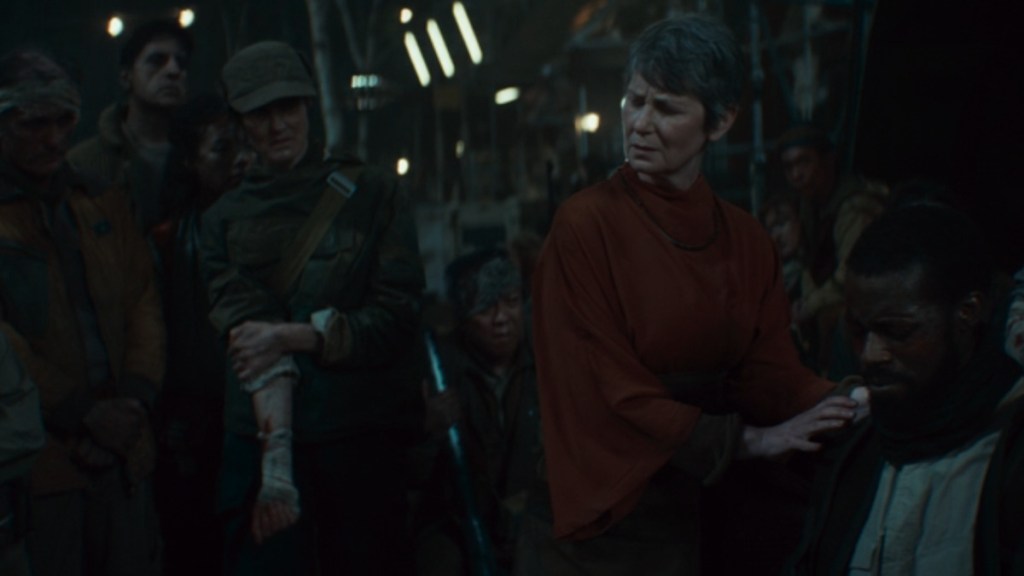
I’ll end on a small scene that, like so many of the quieter moments, not only builds out the world, but corresponds closely with leftist/organizing circles. At the beginning of the episode, Cassian is dealing with a blaster wound that isn’t healing properly. Bix tries to convince him to visit a “Force healer” (unnamed but played by Josie Walker), which he wants nothing to do with because he thinks they are all fakes. While they are arguing within the vicinity of the Force healer, she senses his presence and walks over. She offers to try to heal his blaster wound, and she successfully helps him. She also senses via the Force that Cassian has an important part to play in the rebellion and appreciates his clarity of vision: “All that you’ve been gathering, the strength of spirit.”

A group of rebels stand around a Force healer dressed in red. She is an older white woman with gray hair, and she has her hands on a person's shoulder with a look of concentration on her face.

What I enjoyed about this scene was how it recontextualizes the Force as an alternative or subversive spiritual practice. In many leftist circles, there’s this reach for something spiritual or holistic beyond Judeo-Christian beliefs. Sometimes, this takes the form of returning to older spiritual practices that have been destroyed by empire, such as Indigenous ways of knowing or pagan/heathen practices. Placing Force-sensitive people like the healer or Chirrut Îmwe (Donnie Yen) from Rogue One in this framework is an interesting addition to the worldbuilding in the way it mirrors actual leftist spaces.

The Force healer also has one of the most beautiful descriptions of Cassian when talking to Bix about what she felt through the Force: “Most beings carry the things that shape them, carry the past. But some, very few, your pilot, they’re gathering as they go. There’s a purpose to it. He’s a messenger.”

Of course, within the context of Rogue One, we know what message he has to carry, but this line also has much more immediate implications for Ghorman.


POSTED BY: Phoebe Wagner (she/they) is an author, editor, and academic writing and living at the intersection of speculative fiction and environmentalism.

Friday, June 13, 2025

Interview with Natania Barron

Today, Paul Weimer talks with his longtime friend, Natania Barron, about her Queens series.

1. Can you introduce yourself to our readers unfamiliar with you and your work?

I'm Natania Barron, a fantasy author and fashion historian who loves monsters, magic, and mayhem. My books are almost always historical in some capacity, unapologetically queer, and full of fabulous costumes, adventures, and found family. My background was originally in academia, primarily focused on medieval literature, but I'm a big fan of the 19th century as well. I read voraciously, garden enthusiastically, and love traveling. At present, I live in North Carolina with my family.

2. You've written a fair amount of fantasy before tackling the Queens series. Why the jump to Arthuriana? What's the appeal?

This is the funny part about publishing. Chronologically, I've been working on the Queens series longer than almost anything else. The first draft of Queen of None was written in 2010, but it languished with me for about ten years, living in a state of limbo. It was, in many ways, the thesis I wish I'd written in graduate school, resurrecting a character I'd found in Geoffrey of Monmouth--which is a 12th century quasi-history that features King Arthur--named Anna Pendragon. Anna was the full sister of Arthur, with the same parents (Igraine and Gorlois). So, in a sense these books have been with me all along. In fact, keen eyed folks will notice quite a few Arthurian nods in some of my other works, including in Pilgrim of the Sky and These Marvelous Beasts.

Arthuriana has always appealed to me, as I grew up loving fantasy and it was a natural progression in my academic pursuits. For me, it's about the tension of the Matter of Britain (the fancy term for Arthuriana) between the golden age and its inevitable fall, the strong king and the affair that shook the kingdom, the ever-changing characters who go from most renowned to reviled and back again. Courtly love itself is walking contradiction! I often speak of Arthuriana as an amoeba, and certainly as fanfiction. From the 12th century onward, it traveled across Europe and beyond, capturing imaginations right and left. And every time it was retold, it changed shape. I mean, truly, so much of what we know about King Arthur are not Welsh or English in nature, but decidedly French. This amalgamation of myth over the next near millennium has shaped so much about how we think about fantasy, kingship, and romance. And it's delightfully episodic, so you have the opportunity to zoom in or out in the story as much as possible, which is wonderfully appealing as a writer. I'd love to continue the series at some point in the vein of what Joe Abercrombie does with his interconnected novels, and I feel like the genre is absolutely built for it.

3. The central logline of the trilogy are three Queens. What prompted you to tell your take on their stories in the Arthurian Cinematic Universe

Women are both plentiful and invisible in much of the Matter of Britain. They are most often used as mediums for succession, or as political pawns. Mothers, in particular, are everywhere and yet nowhere. Once a woman has done her duty to have a child, typically by a knight or king, she is of no use in the narrative. But their stories matter, and they're all there in the margins. The three women in the story are all queens in their own right, or should be, but their queenliness is more than their genes. Anna surrenders her throne; Hwyfar learns to claim her own; Morgen's realm is not of the mortal plane. Anna is a mother, Hwyfar is a maiden (in that she is unmarried), and Morgen is the crone. They are all powerful, but in vastly different ways. And their actions and alliances shape the very foundations of the overall myth. That was one of the really joyful parts of writing the third book, which occurs 20 years after the first, being the ability for me to tie up all the loose ends. And usher in a new generation! Because that's one of the other fun things about writing in this genre: it takes place over a fairly long stretch of time, and there are different phases of folks involved.

4. The time frame of most fantasy novels is months, or even weeks. Having books that take place over years or lifetimes is rare. What models and inspirations in fantasy and mimetic literature did you have in telling the lifetime stories of your characters

Well, in-genre there is certainly T.H. White, who has a similar approach in The Once and Future King. Each section follows a different character or characters, and we begin with Arthur as a boy, and the story reaches all the way until his departure to Avalon. I think, if I'm being academic about it, it's sort of woven into Arthurian DNA to both expand and contract time as needed. In my approach, the first book spans about 10 years; the second is just a few months; the third is a few weeks. But there are breaks of time between each one, so I can zoom in and zoom out as needed. The timelines get more complex, though, even though the time spent is less. By the time we get to Queen of Mercy, there are even dual timelines to contend with, as Morgen's story is happening in the background of the story happening at Carelon with Gawain, Hwyfar, and the triad of Galahad, Percival, and Llachlyn. I don't think anyone does complex timelines as well as N.K. Jemisin, I'd say, outside the Arthurian genre.


5. Maiden Mother and Crone is an interesting alignment for your Queens. What other mythic models and frameworks might readers look for in the trilogy?

Oh, there's so much. In fact, there are so many mythological Easter eggs that I stumble into some I had totally forgotten about when I'm re-reading or listening to the audiobooks. A big theme in the stories is around the contradictions of chivalry and courtly love in the face of a world experiencing magic that is both vanishing and changing shape. I poke plenty of fun at Arthur's very simplistic view of Christianity, but show how well it molds to certain minds looking for straightforward answers. The magic of Avillion is complex, old, and very matriarchal--save that their king is a man. There are heroes, and there are anti-heroes, but there are very few true villains in the story. One of my favorite frameworks is the escape to the wilderness/descent into madness cycle that you see very often in the Matter of Britain. Both Lancelot and Yvain have moments where their minds, essentially, experience a psychotic break. The wood is both healing and challenging in their subsequent adventures. I got to work through Yvain's story a bit in the last book, which was quite the adventure.

I suppose, the biggest theme is the magical woman--the woman of both actual and perceived power. So often, especially Morgan le Fay is associated with seduction and sexuality, and I wanted to change that. In much of the Arthurian canon, powerful women are rarely revered. They are feared, othered, and often looked at as obstacles rather than healers or wise women. In the Vita Merlini, which is from the 12th century and her first large appearance in literature, she's a powerful woman who clearly comes out of the Celtic past, an herbalist, and respected for her work. She's not described as wily or difficult or hedonistic. That all comes later. So I wanted my version of Morgen, who appears within the first chapters of Queen of None, and conveys throughout, in a similar way. She chooses, when Merlin spurns her, to work as a midwife at Carelon. Her magic is not just the magic of Avillion, but blended powers she learned from Merlin as well as her own connection with Death itself. She is called the "midwife of souls" for that reason, and I pulled a lot of my inspiration from the triple-goddesses of death you see in some religions, and especially in Celtic lore.

6. Arthuriana is a vast place and perhaps daunting for readers to find their way in, at least beyond the usual ones. Where you do suggest readers who have read your trilogy wade in next?

Some of the books I suggest run the gamut from faithful retellings to general vibes, and I love that. There's a Palamades even in Gideon the Ninth and plenty of Arthurian echoes. Tracy Deonn's Bloodmarked series is a fantastic YA modern take on the Arthurian inheritance. Of course, Lev Grossman recently wrote The Bright Sword, which has a lot of the humor that I love in writers like T.H. White, but shaped in a way that is very much his own

7.  The sheer diversity of differences in the Arthurian mythos from book to book and story to story is breathtaking, and your works add to that tradition.  Why do you think that remixing and reinterpretation is so popular?

Given the time it was created, it's surprising to many how diverse and far-reaching Arthuriana is. As a medievalist, that's not shocking. The medieval world went far beyond the borders of Britain. And indeed, the West's "Dark Ages" were far from homogenous (or, as the quotes indicated, "dark" to begin with). Indeed, in the Middle Ages, people were asking many of the same questions we're still positing about gender, religion, faith, power, and patriotism. Because of all of this, and its historical context, Arthuriana is built flexibly, diversely, and with a great adaptability. In many ways it's similar to the adaptation and appropriation you see when the Catholic Church really sinks its teeth into the West, and you see all these Celtic and pre-Christian figures remixed as saints. It's deeply location-based and very personal. Knights, ladies, villains, monsters... these can all be absorbed into Arthuriana, as well. We like our own context, and the way these stories are written and shared really welcomes such remixing.

And what's fascinating to me, at least, is seeing it reshaped to either combat or acquiesce to current political, religious climates, etc. Courtly love was adored by the French, and during the 12th and 13th centuries, Lancelot and Guinevere's relationship was seen as sacred even though it very much lived outside the Christian marriage pact. But it shifts, especially by the time you get the Malory--and of course, it's primarily Guinevere who is demonized in that instance. Women are blamed for their power over men, rather than men given responsibility for their actions. So these changes aren't always for the better, but they do tell us a great deal about the cultures from which they're told. I'm curious to see what direction Arthuriana goes, considering the current political climate. Might vs. right has never been so essential.

We see it happening in real-time, to some extent, with comic books and superhero movies, film, and books, in the 20th and 21st centuries. They're, of course, building on thousands of years of myths, but given the acceleration of media production, we get remakes and retellings at breakneck pace. We no longer have to wait for the next minstrel hit to literally travel leagues, changing all along the way to better suit the audience.

8. What's next for you now that you have completed this trilogy?

The third book in my queer Regency witches series (Love in Netherford) is called The Game of Hearts, and that should be out later this year or early next. Then, well, I'm always working on something. I have a secondary world romantasy that needs some revisions, but I also haven't given up on Arthuriana yet. Lately, Palomydes, Tristan, and Isolde have been gnawing away at my consciousness. I've even been dreaming about them! And lots more of the Questing Beast. In addition, I have a few nonfiction projects I'd like to tackle. Ideas are never the issue!

9. (and the soft outro): Where can readers find you and your work?

My website is nataniabarron.com, and I'm @natania.bsky.social on BlueSky, @nataniabarron on Instagram, and @nataniabooks on TikTok. Both the Queens of Fate series and the Love in Netherford books can be found online, or at my publisher's website (Solaris/Rebellion - https://rebellionpublishing.com/)

Thank you, Natania!

POSTED BY: Paul Weimer. Ubiquitous in Shadow, but I’m just this guy, you know? @princejvstin.

Thursday, June 12, 2025

Book Review: Red Sword by Bora Chung (tr. Anton Hur)

A gut-punch in book form.

A while ago, Molly Templeton wrote a piece at Reactor about not needing to understand everything in a book that I vibed with so very hard - I am quite a "roll with it" reader in many ways, and it is lovely to have someone put good words around an experience you've had. It came back to me as I was reading Red Sword, the new novel from Bora Chung, because not only is it a story without a lot of handholds to find while reading, but is in fact one where the confusion is emphatically part of the point. It is a story that languishes in that feeling of ignorance, of lostness, and does something fantastic with it.

The story begins with ignorance - the protagonist is on an alien world, at a loss about most of the details, knowing only that she has been brought there by an imperial power who have violently coerced her into this place to fight. What then proceeds for a large chunk of the novel is action absolutely devoid of context. Things... happen. The protagonist endures and experiences. We the reader experience alongside her. We have just as little context as she does, must endure the bafflement along with her. The events that she experiences and endures are confusing, traumatic, violent and often horrible. The novel is full of sequences of fighting, of death. People - many of whom the protagonist knows by description rather than name - are forced to fight an overwhelmingly superior enemy without guns, and die horribly in the act of it, beginning in the first few pages with an unnamed man the protagonist has come to love during their mutual imprisonment on the ship that brought them to this planet to fight.

Her experience then is shaped not by understanding but by inexplicable bloodshed and death. For a cause she doesn't know, let alone support, in a place she doesn't know, with rules she doesn't know. But she keeps being pushed back into these violent encounters, suffering at the hands of the imperials who brought her here as well as the mysterious white aliens they fight.

Already, I think it's clear this sounds like a grim story. It is. It's apparently inspired by the stories of Korean soldiers who were sent to fight in Russia for the Qing Dynasty, and that sense of powerlessness, of being dragged into an outside conflict, comes through at every turn. But it's not just the events and the thematic resonances of this that reinforce it. It's the language.

This is a translated novel, so it's never going to be clear (particularly to me, who speaks no Korean), the extent to which the object that comes into my hands owes its phrasing to Bora Chung or to the translator, Anton Hur. But whatever portions they poured in to the alchemical pot that made this worked perfectly, and particularly in one specific way: the sparseness of the prose. Now I am normally a fan of ornate. Give me something deliciously overwritten and I will, like as not, go mad for it. But Red Sword goes hard in the opposite direction, and is just as brutally impactful for it as something embracing adjectival rococo. To the extent that... I don't even quite understand how it's doing it. How using simple sentences, direct statements, with flat tonality, somehow turns into an emotional gutpunch. There are brief moments that make sense - after a paragraph of text, the contrasting bluntness of a single, brief sentence character death obviously has the benefit of contrast. But it's not just those individual moments. It's the whole thing. All of it is in this almost detached, distant, plain language. And yet it manages to be some of the most emotionally affecting.

To give a specific example, there's a long section in the middle of the book, where the protagonist is thrown from violent situation to violent situation on a foggy field of battle. She doesn't know where she's going or what's going on, and she is simply trying to survive situation by situation. It culminates with a scene of her smashing a weapon into the body of an imperial soldier over and over and over and over again, before cutting to a section break, and then opening the next with her being distracted from almost a reverie by a female scream.

I put the book down after reading that section, hit with a sudden certainty that what I just read was a vivid depiction of someone in shock.

That's what Chung and Hur's prose does here - it situates you emphatically in this experience of living moment to moment, contextless and confused, and by doing so in such blunt terms, hammers home the reality of that experience. Like the protagonist, you are completely at sea in the horror of it all. Her emotions echo out to the reader through this sympathetic experience. The detachment isn't detachment; it's indicative of the real emotional toll being exacted by the horrors she faces. And it is so powerfully done, it cannot be quickly consumed. For all its simplicity, it is prose you need to sit with and digest. I can't quite figure out how its doing what it's doing, but I can absolutely revel in the experience of it.

As the story goes on, some context does leak in. There is some sense of clarity and closure by the final part of the story, but even then, that feeling of being lost never truly ebbs. The bones of the context are there, but we don't have the fleshing out of exposition that would be my expectation of the usual speculative novel. There's no grand speech laying out motive. Only snippets, and even they form a small part of a larger picture unseen, only speculated. But we don't need to have the architects of all this misery come to speak their peace. We see someone experiencing its effects. What does the context matter in the face of the facts? What do the explanations matter in the face of the suffering?

A lot of this, I think, also comes down to trust. Chung lays actions out simply and clearly, with short snippets of dialogue, and mostly expects the reader to infer meaning from how they interact, how those pieces of dialogue or the rare intrusions of meta interact with one another, or to infer that meaning is, at this point, unattainable. Explanations come predominantly at the granular level - how the protagonist got out of the river, how she broke her sword, how she shot the gun. Overarching plot theorising? Not so much. But these moments piece together into a whole, and that whole shows us those effects. We see what this empire is by what it does.

And so I think this is a novel that makes an art out of incomplete understanding. It would be a worse book if the underpinnings were explained at any point, and especially the start, because it would rob us of the chance to ride along with the protagonist and be lost with her, to flow with the story as she flows with it, in shared confusion. It is that shared experience that absolutely makes the story what it is, and allows for some incredibly powerful moments. I do not think I have read scenes of violence in a story - especially as someone who generally finds battle scenes and extended fights tedious - that have affected me quite so strongly, and I think it is precisely because I have to experience them situated in the moment with the character, rather than trying to fit them into a broader context, or seeing them as a moving part in a puzzle, a set piece hurdle to traverse. They're not. The violence is, the experience of that violence, is the point. The protagonist's experience is the point. When the story reaches its conclusion, a number of questions open up about personhood, about who gets to be real, and about the disposability of human life in the endless grind of the imperial machine. Those questions are better served by the time spent paying attention to the material consequences of those imperial decisions.

Red Sword is deceptively simple. Its simplicity is its power; its contextlessness is the point. By removing all the guardrails, it forces the reader to confront the brutality of the experiences of its protagonist, and reckon with them purely as they are, before coming to any kind of broader conclusions about the wider politics at play. The human first. The real, lived moment first. The consequences first. Only then context, a little, but even that ultimately serves that larger section of the text. Chung has turned confusion into an emotional weapon, and drives it home with every brief, brutal sentence. I may not have always understood it all, but I felt it.

--

The Math

Highlights: 

  • some of the best writing of violence I've come across in a book
  • vivid, clipped prose that shocks you into emotions
  • immersive perspective

Nerd Coefficient: 9/10

Reference: Bora Chung, Red Sword, [Honford Star, 2025]. Translator: Anton Hur.

POSTED BY: Roseanna Pendlebury, the humble servant of a very loud cat. @chloroformtea.bsky.social

Wednesday, June 11, 2025

Book Review: City in Chains

A well-executed fantasy story that is fighting yesterday's battles


I am going to be up front with the reader here and now: I cannot ever be fully objective about the oeuvre of Harry Turtledove. When I was an impressionable fourteen year old, I learned of his WorldWar series. For the unaware, that is his eight book series about an alien invasion that happens to land in the particularly eventful year of 1942. I inhaled those books, and then the eleven books of his Southern Victory (also called ‘Timeline-191’ or ‘TL191’ among online alternate history fans due to its point of divergence revolving around special order 191) series beginning with How Few Remain. I have read over forty of his books, as of writing, and he is the writer that gave me my enduring love of the alternate history genre. He is in a sense what I aspire to be as a writer, with several different speculative genres coexisting with a solid historical bedrock under all of them. I would not be the writer or indeed the man I am today without the hours and hours I spent reading his books, getting lost in his worlds. Not for nothing, his books consistently come with the blurb calling him “the master of alternate history.”

In the alternate history circles I frequent, the man’s work has something of a mixed reception. They say he relies too much on historical parallelism, such as his Southern Victory series quite clearly reenacting European history in the first half of the twentieth century in an American setting, or his Atlantis trilogy reenacting the early history of the United States on a landmass that consists of our world’s Nova Scotia to Florida, having drifted off of the mainland in prehistory. The man has had some deeply bizarre sex scenes in his work, some involving real people (although I will argue that Robert Conroy’s sex scenes are leaps and bounds worse). His work at points has had some very repetitive characterization (such as how often Sam Carsten is sunburned), as well as a few stock turns of phrase (“he said it with inevitability, like the sun will rise tomorrow”). As I have grown from an impressionable fourteen year old to a jaded twenty-eight year old, his books from the 2000s come off to me like the Star Wars prequels; with hindsight, I can see all the myriad flaws that others have pointed out, and many things could have been done better, but I still find myself enjoying the experience, and in awe of the worlds they opened up to me.

Much of the weaknesses of his big series are often connected to the fact that he had to pay for the college educations of his three daughters in quick succession, and writing is his sole source of income. He had to churn a lot out, and quickly, to give his children a future, and I can’t be mad at him for that. His work since then has been leaner, less dependent on well-trod periods of history, and with less bizarre weirdness (but plenty of fascinating weirdness). His book Three Miles Down (reviewed on this site by Arturo Serrano) is easily his most personal book, being a look at the Los Angeles the man himself grew up in, with plenty of wistfulness and added aliens. His Alpha and Omega is delightfully weird. Now, dear reader, I shall get to the point: his most recent novel, City in Chains.

This is one of Turtledove’s straight fantasy novels, with no direct textual reference to our history. However, those with familiarity with the periods that he likes to write about will see the inspiration, as the novel is rather clearly a pastiche of occupied Paris during World War II. The city is Lutesse (no relation to certain peculiar characters in the Bioshock series) in the Kingdom of Quimper, a name which it shares with a city in Brittany (mention is also made of a battle at a place called Carentan, which is also real, and I learned from the mission in the original Company of Heroes). This city, and this kingdom, are under the occupation of the villainous Chleuh, and the quotidian cruelties have become part of the fabric of life.

The exact aesthetic of this whole shebang is a little bit confused, or so I thought. There are trains, but the occupying forces are primarily still using crossbows. As such, the novel feels like an odd mishmash of the Middle Ages and the 19th century with some tropes of World War II fiction thrown in. Of the latter, the most obvious of these is a sort of magically-infused crystal that occupies the role of radio in the historical fiction that inspired this novel. Nighttime bombing raids are in this world nighttime dragon raids; there is a brief plotline where a dragon rider, having been shot down, is secreted away in the basement of one of the main characters and later handed off to the organized resistance (a plotline which, sadly, is ultimately underdeveloped). The whole thing is a mishmash, one with a lot going for it, but overall Turtledove neglects to really describe what this city looks like, smells like, sounds like. The entire project feels more than a little threadbare, abstract even, rather than something concrete.

The book does shine, however, in its two main characters. One of them is Malk Malkovici, a junkman of the minority Old Faith sect who is a refugee from persecution in another country now occupied by the Chleuh. The Old Faith is the target of genocidal persecution by the occupiers, who are sending them to vaguely described but clearly ominous camps in the east, territory occupied by the Chleuh and conquered (albeit apparently temporarily) from a strange monarchy that believes that the gods have declared that wealth needs to be shared. It becomes clear quite early on that Malk is a member of the group that is this world’s analogue for Jewish people under Nazi occupation.

What makes life more complicated for Malk is that his services as a collector of junk, including various types of metal, is in high demand by the occupiers who hate him and, on an ideological level, want to kill him. He and his family are complicit in the occupation and from there the mass murder and the genocide. He has rapport with officers who come to buy his wares, as well as a collaborating policeman whose beat is his neighborhood, and tries not to advertise his religious beliefs. He is wracked by the knowledge that he is, however indirectly and however reluctantly, complicit in evil, but he knows there is a huge price to pay if he were to stand up for himself.

The other main character is Guisa Sachry, a rich man, a great actor, the head of his own theater troupe, and the greatest star of the Lutesse theater scene. He has a much younger wife (his third) and had planned to keep his head down throughout the occupation with inoffensive slice-of-life plays until an officer of the Chleuh military came knocking, ‘asking’ him to appear as one of the Lutesse luminaries at a parade honoring the city’s new rulers. Knowing he stands to lose a lot, perhaps even his life, if he says no, he goes along with it. He is then asked by the occupation to write a play glorifying the occupation and demonizing the resistance. He does so, reluctantly (and the solution he devises to this is a very clever one on Turtledove’s part, one that he is capable of creating because he knows how people interact with the historical and cultural context in which they live), and from there is pulled head first down the vortex of collaboration.

Guisa Sachry is not a good man, and the narrative correctly emphasizes that fact again and again. He hires a dancing girl from another company on the condition that she have sex with him. He is deeply and profoundly unpleasant to his wife, with whom it is clear he doesn’t really love, and the feeling is mutual. He is ruthless to his underlings and sycophantic to the men who pay him off. But it is with that sycophancy that the novel really furnishes its theme, that of complicitness.

Both Malk and Guisa are men who are constrained by structural factors from acting free of the occupation. Malk dislikes working with the Chleuh out of his religious beliefs and his own moral principles. Guisa, on the other hand, has no principles whatsoever, and his own naked self-interest is what compels him to comply; even if he is the ethnic majority in Lutesse, the Chleuh would still make an example if he were to fall out of line. Both don’t want to collaborate, but both are forced into collaboration, their distinct characters and distinct paths nevertheless reaching the same destination.

As a longtime reader of Turtledove’s work, Guisa Sachry as a character reminded me strongly of another one of his characters: William Shakespeare, as portrayed in his novel Ruled Britannia. That novel is set in a world where the Spanish Armada succeeds, and England is under the cruel yoke of Philip II. This version of Shakespeare is a covert sympathizer with the English resistance who is coerced by the Spanish to write a play glorifying Philip, while simultaneously writing a play about Boudica, the ancient queen of the Iceni people who lead a failed rebellion against the Romans, and a thinly-veiled diatribe against the Spanish. Shakespeare, as portrayed by Turtledove, is a man with a strong moral conscience who is forced into collaboration, but takes covert action to resist. Guisa Sachry, on the other hand, is a man with no moral conscience at all, and his arc is almost that of a foil to Shakespeare’s in the earlier novel.

At its core, City in Chains is about collaboration. Many Americans in recent months have been beating the drum against collaboration with the new Trump administration, filled to the brim with neo-Nazis, technofascists, and a rogues' gallery of some of the most unpleasant, most boorish, most malevolent, and most stupid people on the planet. We have, rightly, been infuriated with the spinelessness of Democratic Party leaders in not taking a harder line against the wrecking of the federal government or the evisceration of trans rights in this country, to name but two examples (but a part of me thinks that Ta-Nehisi Coates was right in saying that you can’t really expect a party that had no spine to stand up against the genocide in Gaza to have the spine to stand up for democracy). We are in a moment where the moral imperative is not to comply, but to resist. Releasing a book like City in Chains in a time like this is an interesting decision, and one that is revelatory.

Harry Turtledove is an outspoken liberal on his social media; before he decamped from Twitter, his pinned tweet was “I didn’t mean to be topical” repeated several times. He is consistently good and well intentioned, if not radical, on racial justice and LGBTQ+ rights, and is blisteringly critical of the current administration. I remember that, in his novel Alpha and Omega, a novel set mostly in Israel (and released a few years before the current genocide), he states frankly, but does not dwell on, the the second-class status of Palestinians in that country. I do remember one particular interaction I had with him on Bluesky where told upcoming writers to share their new works, and I shared Broken Olive Branches, the anthology in which I have a story raising money for refugee relief in Gaza (and discussed on this blog here). He liked and boosted the anthology, for which I am grateful to him. In terms of his historical interests, he has been blisteringly critical of neo-Nazis and neo-Confederates.

But the man is not without his blind spots. His portrayal of race is very much that of an older white liberal; his novel Guns of the South has been taken to task by multiple critics in recent years, such as by Monroe Templeton on the Sea Lion Press blog (which, for full disclosure, I have written many articles for in previous years). As an Asian-American (half Filipino through my mother), I was more than a little irritated by the fact that his Hot War trilogy, a series about World War III breaking out over Korea, has no Asian viewpoint character; the only Korean character is the plucky sidekick of a white American soldier.

Ultimately, I think the core of the issue is that Turtledove’s view of World War II is very much that of old war movies, where brave soldiers fight for justice, and innocent civilians bear the brunt of the ultimate evil. The conflict becomes a great moral drama between justice and injustice (in fairness to him, Turtledove has always been frank about American racism both in that period and in other periods). In that regard, he glorifies the resistance fighter and denounces the opportunist, but fundamentally casts the thing that they are resisting as a foreign force, an invader.

This is a view of fascism that has been superseded in the historical literature by a view that situates fascist regimes in the broader context of the imperial world of nineteenth-century Europe. Aimé Cesaire, in 1950, published Discourse on Colonialism, which made the argument that colonialism made Europe a savage continent, one that had come to accept racial hatred and mass murder as de rigueur, a formulation that culminated in Nazism deciding to do those things to other Europeans. Cesaire’s English translator called this a ‘boomerang effect,’ an abstract but effective translation of the original French phrase ‘choc en retour,’ literally ‘return shock.’ Not long after Cesaire, Hannah Arendt argued in her magnum opus Origins of Totalitarianism that Nazism was the confluence of millennia of European antisemitism and the race thinking of imperialism. Hitler himself openly stated that the Nazi plan for Eastern Europe was explicitly modeled on the United States.

Here I shall analyze City in Chains as a critical work, in the manner that Phoebe Wagner on this very blog discusses Andor. In attempting to critique modern fascism, he falls into myths of the original fascism. Contemporary American fascism is not something that was imported from Europe; Trump is not merely the achievement of Russian propaganda, but rather a culmination of centuries of American bigotry. A president who is promising ethnic cleansing cannot be considered a break from a country that systematically expelled its indigenous populations from their homelands. A movement that is backed in no small part by violent militias cannot be considered a break from a country that has enforced slavery, white supremacy, and indigenous dispossession with heavily armed mobs, some of which called themselves militias.

As a narrative device and as abstract philosophy, the theme of complicitness in this novel succeeds. As a description of complicitness in today’s injustices, it falls flat. This novel has a model of the theme that could work perhaps most perfectly for Ukrainians under the Russian jackboot (and Lord knows they need it), but not in America or Western Europe. For the latter, the complicitness we face is different and in some ways more totalizing. Does the company that makes our food give money to pay tribute to Donald Trump? Is the fast food place we go to supporting the IDF as they raze Gaza to the ground? Is our laptop made in a slave labor camp in Uyghurstan? The complicitness we face now is our own convenience, our survival on a very basic level. What we are complicit with is capitalism, and capitalism gives us no choice. This is the essence of the phrase “there is no ethical consumption under capitalism.”

That is the sort of question that City in Chains has no answer for, as it is uninterested in probing the broader systemic reasons for why this occupation, this war, this genocide are happening in the first place. We only get broad descriptions of the prewar status quo, and most of that is a pretty clear parallel to interwar Europe. If Quimper is France, as its name will show, there is no Algeria, no Senegal, no Indochina, and from there no equivalent to the American insistence that the first Allied troops to enter a liberated Paris be white. According to this novel, the enemy is foreign, alien even, and it requires of us no introspection, no questioning of basic assumptions. In valorizing resistance to complicitness with a foreign evil, it leaves open the door to complicitness with a domestic evil, letting us be comfortable in satisfaction while continuing to play our own little part in keeping evil alive, be it through our purchases, our tax dollars, our employment, our voting, or our own personal conduct. The parallelism that is one of Turtledove's standard tricks works to the detriment of the broader moral indignation, and as such cannot even really be said to critique contemporary fascism.

As such, the basic narrative scaffolding of City in Chains is perfectly entertaining as fantasy fiction, but as an answer to the current moment it feels woefully out of date. The novel on some level feels like it’s fighting previous battles, not the current battle. Its portrayal of the struggle against fascism is what America of previous decades wanted World War II to be, and what modern white liberals want the struggle against contemporary fascism to be. It is a book that is fascinated by abstract questions of morality in years gone by, while not having much to say about concrete questions of morality in the present. It has nothing whatsoever to say about how the current moment is the compounded result of previous historical moments, and how the problems of today are deeply structural. It is a book I enjoyed very much, and it has some very smart moments, but on the whole the novel reveals the weaknesses of Turtledove’s worldview in an age of resurgent fascism.

--

Reference: Turtledove, Harry, City in Chains [Aetheon Books, 2025]

POSTED BY: Alex Wallace, alternate history buff who reads more than is healthy.