Thursday, August 21, 2014

Thursday Morning Superhero

The Con season is over for me and I am getting back into a groove here before the upcoming semester begins.  I am happy to report that Thursday Morning Superhero will be returning to its usual format and am looking forward to catching up on some titles as my schedule has slowed down significantly.  The highlight this week is the return of Gabe Rodriguez to comics.  It felt so good to pour over the beautiful pages he created for the fun new series Little Nemo Returns to Slumberland.


Pick of the Week:
Daredevil #7 - I have to admit that I have enjoyed Daredevil's attempt to find out why his mom left him so long ago.  I will also admit that I never thought I would read a mainstream comic that shed some light on an issue like postpartum issues that many women face.  My wife is a labor doula and I have learned more about childbirth than I ever thought possible.  1 in 7 new mothers have some sort of depression during their pregnancy and I love that Ellie Pyle, the editor, provided a list of great resources in the back of the issue and hopefully they will serve the mommas and papas that read this great book.  Readers of this blog can find more information here.

The Rest:
Little Nemo Returns to Slumberland #1 - After seeing some of the amazing preview tweets of art from Gabe Rodriguez, (@GR_Comics) I finally got to lay my hands on this stunning book.  Eric Shanower, who is no stranger to revisiting whimsical titles (Wizard of Oz for Marvel), reintroduces a generation to the world of Slumberland and the princesses playmate Nemo.   The first issue was a lot of fun that I plan on sharing with my kids.  I hope it remains an all-ages title and wonder if my daughter Zelda can relate to the new Nemo in regards to having a Dad who names children with pop culture references.  Very impressed with this debut.


The Fade Out #1 - Another impressive debut issue this week, a 40's crime noir from Ed Brubaker and Sean Phillips.  While it seems that all Brubaker and Phillips do is write noir titles that typically surround the death of a beautiful dame, each title is so well written and distinct that I will purchase them as soon as they hit the shelf.  The Fade Out sets the stage nicely for a 40's Hollywood drama in which all is not as it seems.


Wednesday, August 20, 2014

Friends of NoaF: Steampunk Kickstarter


Author-publisher S.C. Barrus, who contributed a guest blog post to Nerds of a Feather on isometric gaming, is also the author of the steampunk novel Discovering Aberration. You may remember this book as a top pick of our monthly Adventures in Indie Publishing correspondent D.E.S. Richard, and it appeared on my Summer Reading List (I'll finish it soon — it's long!). Discovering Aberration is the product of a successful Kickstarter project, and now Barrus is ready to release his follow-up.

Set in the same world, The Gin Thief is a serialized novel, which is just a super cool thing to be doing, and in itself pretty steampunk. Kickstarting a 19th-century publishing platform? Put some goggles on it and you're already 9/10 of the way to the Steampunk Hall of Fame. The project is already funded, and will only be online for a week, so it's simply a good opportunity to pre-order these books and get a copy of Discovering Aberration along with it.

So take a look, and become a backer if it seems interesting, tossing some support behind self-published authors who are delivering quality and outside-the-mainstream ideas.

Posted by Vance K — cult film reviewer, occasional book reviewer and general pontificator, and Nerds of a Feather contributor since 2012.

Tuesday, August 19, 2014

Microreview [book]: Lock In, by John Scalzi

An Entertaining Sci-fi Mystery Slightly Marred by Too Many 'What If' Departures from Today's Society

Scalzi, John. Lock In. Tor Books: 2014.


Buy it here starting Aug. 26th, 2014.

Seems like everything I read these days has some connection to locked-in syndrome. But in John Scalzi's futuristic mystery Lock In, there's a twist: technology has unlocked said individuals, in bizarre and interesting ways. Imagine a world where a pretty serious virus, Haden's, has killed many millions but left a few percent in what is essentially a permanent coma—but with fully functional minds. An even smaller minority, once ravaged by the disease, develop the ability to 'integrate' (that is, host) those locked in due to Haden's, essentially loaning their bodies to those trapped into permanent immobility. Additionally, technology has apparently advanced far enough to offer Haden's patients the chance to interface remotely with robotic bodies.

While you're still wrapping your mind around all these fundamental changes from the world we know, add in a murder mystery that a prominent Haden's FBI agent (or his robotic simulacrum, in any case) must solve before the entire fragile community of Haden's and Integrators is imperiled. Whew!

Is it exciting? You betcha, thanks to Scalzi's gift with snappy dialogue and no-nonsense narration of action sequences. Is it intriguing? Oh, yes—especially where Scalzi begins to speculate, via his characters' speeches and actions, on issues of legal and moral definitions of humanity and questions of ethics (particularly when Integrators are concerned). In Scalzi's vision of the future, for example, legally an attack on a robot body of a Haden's patient is considered attempted murder, even when the person's body is, of course, unharmed by whatever damage the robot suffers. Is that how I think such a future would develop, legally speaking? No...but it was certainly interesting.

Where the story feels less successful, to me, is in the sheer number of foundational changes from our own world of 2014. Call me a traditionalist, but I've always preferred a 'single tweak' model of science fiction, where things in the fictional world are pretty much like the present world, except for one giant 'what if' variable. Ursula Le Guin is the master of this mode of storytelling, as evidenced by her magisterial Left Hand of Darkness (cyclic changes in gender), or that excellent short story about a world with sixteen times as many women as men. A single change allows us, the readers, to focus all our attention on this aspect of our lives, and speculate how different things would be if that one aspect were different.

Scalzi, by contrast, has introduced a slew of what ifs, any one of which would have been more than interesting enough to hang a story around, but all of which together end up in a less thought-provoking jumble, to my mind at least. I can't say much more without ruining the mystery aspect of the story, but I can safely say that despite my reservations, Lock In is well worth reading, so you can decide for yourselves whether I'm being small-minded in not wanting so many huge variables.

NB: Just like I, Zombie, the last book I reviewed, this book should definitely be read while listening to Metallica's "One", if only for the liberating feeling of having 'solved' the problem of locked-in syndrome!


The Math

Objective assessment: 6/10

Bonuses: +1 for generally great dialogue, +1 for the awesomeness of unlocking those locked in

Penalties: -1 for having too many sci fi variables all a-jumble, when any one would have done

Nerd coefficient: 7/10 "An enjoyable experience, but not without its flaws"

[Let me stop you right there, objector: here at NOAF, a 7/10 is positively great!]

Zhaoyun, passionate lover of sci fi, fantasy, and speculative fiction alike, has been flocking here at Nerds of a Feather since 2013.

Monday, August 18, 2014

Retro-future Double-Take

I've been on a bit of a retro-future kick recently, and wanted to point you guys at a pair of books that are feeding my dorky obsession.I've been on a bit of a retro-future kick recently, and wanted to point you guys at a pair of books that are feeding my dorky obsession. Sure, I watched and read science fiction as a kid, but I think it was my deep and abiding love for The Jetsons that instilled in me my persistent fascination with the retro-future, or the future of the past, or, less pretentiously, what old, mostly now-dead, folks thought the future would be like while they were driving their lead-fume-spitting automobiles and gleefully testing atomic weaponry upwind of desert communities throughout the southwest. How's that for a run-on sentence?


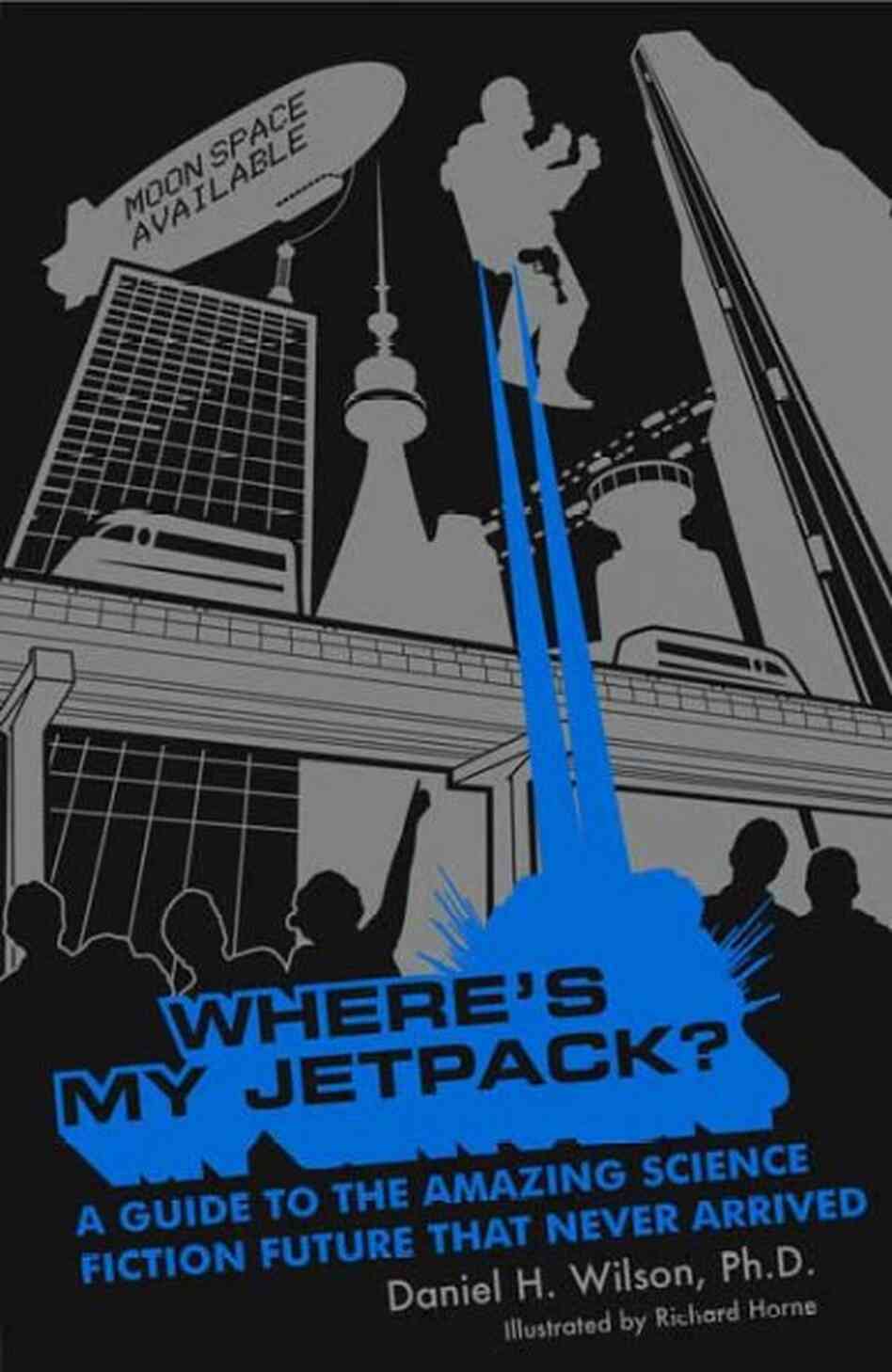
Where's My Jetpack by Daniel H. Wilson

This look at sci-fi mainstays like moon colonies, underwater hotels, robot helpers, flying cars, and the like is a brief, but very fun and surprisingly well-researched look at a wide array of futuristic technologies we were supposed to have by now, and where they're at now. Did you know Dubai is still trying to make the underwater hotel a reality? By now we all know that Google and others are close to perfecting the driverless car, but what about the countless other DARPA projects that still promise to make our world a terrifying technological wasteleand of automation that will one day become sentient and rise up to crush us?

I read this book when it was originally released five or six years ago, and just tackled it again our of a mix of nostalgia (of course) and to see how much of what seemed imminent then actually came to pass now. Driverless cars are one example. Daniel Wilson went on to greater fame as the writer of Robopocalypse, which Steven Spielberg picked up to adapt, but his early non-fiction books like this one, The Mad Scientist Hall of Fame and others are tremendously enjoyable and legitimately enlightening.


The Wonderful Future that Never Was by Gregory Binford and the Editors of Popular Mechanics

Despite an astoundingly bad proofreading job in the introduction, which had me shelve this book for a little while, it turns out to be exactly what is advertised, and a lot of fun. With a little bit of commentary woven throughout by Binford, this book is mostly paragraphs and blurbs taken from the pages of Popular Mechanics magazine since its inception about the world we may potentially live in one day. Many are hysterically wrong (like the synthetic homes stocked with furniture made of plastic, so you can clean your house simply by dousing it with the garden hose), many are eerily accurate, some manage to be both, and others are just cool (like the section on mega cities), providing innovative looks at problems that still persist, and I kinda wish we'd tried out.

One neat feature is that many stories are tagged as "True!," where the editors have pointed something out that actually came to pass, but savvy readers will catch many more that are not labelled as true, but are perhaps more obscure features of our actual daily lives. Take, for instance, the blurb from the 1950s that food may one day be made of sawdust. Laughable, right? Except that a lot of our food is actually made of sawdust now.

Posted by -- Vance K, cult film reviewer and resident Jetsons nerd at Nerds of a Feather since 2012.

Friday, August 15, 2014

AiIP: Do the Evolution

A few months ago, a service called Booktrack launched. I saw it come across the ol' Twitter feed and a few places, but I paid it little mind. If you haven't seen it, the short version is that it adds music, ambient noise and sound effects to the text, so you can read along with music and mood. I dismissed it as a gimmick of sorts, but then I received an email from one of the guys over there, he had read my stuff and asked if I was interested in doing one of my stories on there. I wasn't really interested, until he followed up (points for persistence), and I checked it out and kinda sorta fell in love. The process was way more fun than it has any right to be, and I am really pleased with the result.

This got me thinking about the overall state of publishing - ebooks aren't a revolution anymore; they are the norm, or, at least, part of it. But all the retailers are still selling ebooks like they're physical books. Not that this is any great crime, but between the issues surrounding price fixing, publisher/retailer conflict, lack of any manner of transparency, and to say nothing of the indie, self- and author-publishers that complicate that whole model, there is less room for an antiquated model.

That dude on the right should be holding a book
In short, the medium has evolved, but the method for getting it in customers hands has not. But where can it improve? It's not like it's complicated - you pay for something, you get the thing. So here's my wishlist (that's two Pearl Jam references in one blog post), which I have neither the resources nor the ability to make happen. But hopefully someone can.

1) Ebook bundles. This strikes me as painfully obvious. After all, movies have been doing it for years, but books can't follow suit. Find a way for someone who buys a physical book to be able to download an ebook. Please. Make this happen.

2) Pay what it's worth. Let's call this the New Author Pricing Paradox. That is to say, you're a new author with a good book to sell. You can charge what most publishing houses charge for an ebook, somewhere in the neighborhood of $5-$10. But you're unknown, with no publishing house to back you, so no one is going to spend their hard-earned cash on you (did you know I have a book out? I would love your hard-earned $5). OR you can price it super cheap, $2.99 (why $2.99? That is the least you can charge for a book and still get 70% royalties on Amazon - under $2.99 and you get 30%), but then you're mired in with everyone else who has done the same thing, including your Aunt Mable, the guy down the street who published his 9-11 conspiracy theory as a novel, and at least one third grader (really). Good luck.

But what if it wasn't a set price? What if someone could pay what they thought it was worth? They can download the book for free and hey this is awesome, I'm gonna give this person $10. Or, this is terrible, no money for you. Wouldn't that be better?

It will never happen, but it would make a hell of a lot more sense.

3) Better Bestseller Lists. Let's run with the above idea, and suppose that app exists. Instead of simply number of copies sold, there would be two lists: most downloads, and most money paid. So maybe a ton of people love the book, but can't chip in a ton. That would be reflected on the downloads list. Or maybe a few people really love your book, and that will bring it to people's attention despite lower download numbers. In any case, I see a lot of 'Kindle Bestsellers', which means they made it to #1 in steampunk or something (this is not to take anything away from these authors; just pointing out that bestseller doesn't carry as much weight as it used to, and even those lists are far from perfect).

Those are three things I think would improve digital bookselling (along with my omnipresent wish for integrating with brick-and-mortar stores). What do you think? Please share any ideas you have in the comments. Or, if you happen to be a programmer, feel free to make these a reality.

-DESR

Dean is the author of 3024AD and other stories, engineer, and geek about many things. He lives and writes in the Pacific Northwest. You can listen to him ramble on Twitter and muse on his blog.

Microreview [book]: Blackbirds

The Dead Zone meets No Country For Old Men, plus some Juno thrown in to annoy me


Wendig, Chuck. Blackbirds. Angry Robot Books, 2012.

From the outset, I’ll make it clear that I am a bit ambivalent about Chuck Wendig’s supernatural noir Blackbirds.

Miriam is a psychic of sorts, but a very specific one. She can foresee a person’s death by touching their skin. That’s it. Limited as it is, her gift has allowed Miriam to eke out a meager existence on the road: a chance encounter with a dude who’ll be dead in days can mean easy money, keeping Miriam in booze and cigarettes. (Because the book is part crime fiction, the protagonist must drink and smoke.) She’s been at it for a while until she meets Louis, a goodhearted giant of a truck driving man who’ll be horribly murdered in two weeks’ time. And Miriam will be the cause of his death. If that isn’t bad enough, she becomes entangled with a drifter con man named Ashley who blackmails her into scamming Louis out of his hard earned earnings immediately upon his death. And Ashley’s got some colorful psychopaths after him because of a large metal suitcase he stole. And Miriam, knowing she’ll cause Louis death, spends 200 or so pages working with Ashley—sometimes willingly, sometimes less so—ensuring that the poor bastard will die horribly before the novel ends.

Because of fate. Or because Miriam can be kind of dumb. Because of fate.

Here’s a quick recap of my Blackbirds reading experience: I immediately liked it a few pages in. Then I immediately didn’t after a few more, but I kept on. Then I was annoyed. Then I became intrigued. Then really annoyed. Then the last 75 pages were really good. The ending was great. Then it ended differently, but I had become fully ambivalent by then so I didn’t mind much.

Wendig is clearly a skilled writer. The book is well paced with sharp narration and exposition. The plot’s ambitious are wisely humble—it’s more or less an on the road crime novel with just enough of the unexplained, Miriam’s ability, to make the book not just another on the road crime novel. But, the brisk storytelling is too often weighed down by dialog that is far too clever—Miriam’s penchant for swearing; her Junoesque references, a generation or two out-of-date; her constant need to make a sarcastic comment about everything. While it didn’t entirely ruin the novel, it did annoy me. Ganted, Miriam is not a manic pixie. But she is more or less what nerds—myself included—dreamed of in high school: cute, smart, snarky, kinda punk, with psychic powers. And she talks how nerdy boys in high school imagine cool girls talk: like them but confident.

Miriam’s negligible pixiness cannot offset her agency problem. (Sorry, I’m an academic.) Initially, we’re introduced to Miriam as a protagonist. She drinks, she swears, she gets into fights—and handles herself well. But that’s for the first 50 pages. Thereafter, she’s pretty much either being led around by men or running to them for protection. It’s not until the novel’s conclusion that she actually takes any real action.

While this may superficially appear to be a problem of gender—yet another agentless female character—Miriam’s passivity is actually a philosophical, if not cosmological problem. She has tried in the past to change the future she foresees, to keep alive those who she know will die. And every time, her attempt to prevent a person’s imminent death ends up directly causing it. In a world so unequivocally determined by fate, why not sit back and make snarky comments that never land? I picked up on this quite early—Wendig does nothing to be subtle about Miriam’s cosmic predicament—but I nevertheless wanted her to try. To do something. Anything other than spew snark, smoke cigarettes, or think about wanting to smoke cigarettes. By signaling the dilemma she faced, Wendig seems to want the reader to be frustrated by her actions. He wants us to want her to act. In this, the author is a bit of a tease.

Keep reading. She eventually becomes the protagonist.


The Math
Objective Score: 6/10

Penalties: -1 for frustrating me, the humble reader

Bonuses: +1 for what is perhaps the single funniest chapter of a book ever written; +1 for the nice cover art (a specialty of the good folks at Angry Robot)

Nerd Coefficient: 7/10 That's an ambivalent 7/10

Thursday, August 14, 2014

Thursday Morning Superhero: Gen Con Edition

As you read this I will be either adventuring on the exhibition floor or playing in a ticketed event as I embark on my second Gen Con experience.  Last year was an absolute blast and, with one year under my belt, I feel better prepared to take advantage of all the Gen Con has for us gamers.  For my second dance I will be competing in a Munckin tournament, a Doomtown: Reloaded tournament, and am going to be one of the lucky few playing the Cones of Dunshire of Parks and Rec fame.  Throw in fighting the crowds to pick up exclusives, demo upcoming titles, and bringing home loot for the family, and it is going to be a great four days of gaming.  Today I am going to present the top five games that I am most excited about getting my grubby paws on.  Not all of them are releasing at Gen Con, but I will be able to play them and am looking forward to seeing if they are as good as I hope.  They are presented in no particular order.


1.  Machi Koro from IDW Games and Pandasaurus Games - Machi Koro sounds like it is going to be a streamlined, Catan-style game, that can be played from start to finish in 30 minutes.  In the game, players are assuming the role of a newly appointed mayor who is seeking to upgrade the town to keep the citizens happy.  This is done through the construction of building and dice rolling.  What is intriguing to me is that you are collecting only one resource, money, and that later in the game you can focus on buildings that would require you to roll two dice or only one.  It looks as if it is going to be one of those rare games that is both simple and complex at the same time.  The amazing art doesn't hurt either.


2.  King of New York from Iello - King of Tokyo is possibly my favorite game that currently resides on my gaming shelf.  It is incredibly easy to learn, difficult to master, and combines enough strategy and luck that it is fun for all involved.  When I am introducing a new friend to gaming it is one of the gateway games that I turn to.  King of New York adds new monsters, new abilities, and allows the monsters to invade one of multiple Burroughs in the Big Apple.  I am going to start my Con this year by rushing with the masses to the Iello booth to see the press event and hopefully purchase a copy of my very own.


3. The Battle at Kemble's Cascade by Z-Man Games- They actually found a way to create a tabletop version of a classic arcade shooter.  I want to say more, but the trailer has more impact than anything I can say here.


4. Sheriff of Nottingham by Arcane Wonders - The first title in its Dice Towers Essentials line, the Sheriff of Nottingham seems like it will be loads of fun.  Lately games that are more social and involve bluffing have found the way to our gaming table.  When we have enough people we always break out The Resistance and have been playing a ton of Coup.  Sheriff of Nottingham seems to up the ante on bluffing games as you attempt to smuggle in goods into Nottingham by either bluffing or bribing the Sheriff.  What I am most intrigued by is the fact that the role of the Sheriff changes as the game is played.  Sounds like a lot of fun as players lie, cheat, and bribe their way past the Sheriff.


5.  Samurai Spirit by Funforge Games - All I needed to know about this one is that it is a cooperative samurai game designed by Antoine Bauza.  Can you and your fellow samurai defend the village from the invading bandits?  The more you fight the quicker you unlock your beast abilities, but there is always a cost associated with your choices.  With a competitive 7-year old gamer at home, I am always looking for more co-op games to play with him.  Samurai that turn into beasts sounds right up his alley.

POSTED BY MIKE N. -- comic guy, proudly raising nerdy kids, and Nerds of a Feather contributor since 2012.