Tuesday, September 11, 2012

Cult Films 101: The David Lynch

Welcome back to Cult Films 101, where we are continuing our discussion about the three main types of cult films. Last week, we discussed the Guilty Pleasure -- films that are objectively bad, but nevertheless have something worthwhile that redeems them or makes them entertaining. This week, we will discuss the second type of cult film, the David Lynch, films that take an unconventional approach to narrative or subject matter.

This week, we'll be screening Joel and Ethan Cohen's 1998 film The Big Lebowski.

When we think of cult movies, many times we think only about films that are "gloriously bad" or "so-bad-they're good." The image of Edward D. Wood, Jr. comes to mind. The other side of the coin, however, has a picture of David Lynch on it. See, films made by folks like David Lynch are far from incompetent, like our Guilty Pleasures. They are in fact staggeringly accomplished in their execution. It takes an uncommon control of filmmaking tools and vernacular to be able to tell an utterly idiosyncratic story in a way that makes it comprehensible to a mass audience.
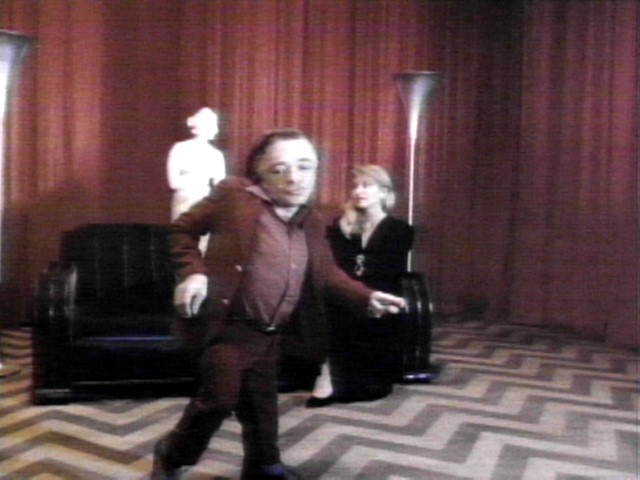
In the Black Lodge, you will probably see midgets, and they may dance.
But they'll definitely talk backwards. So you just need to deal.
For those of you who have watched the entire run of Twin Peaks (and for those of you who have not, what are you waiting for?), consider for a moment that the final episode, in which Agent Dale Cooper visits the Black Lodge with all of its midgets, backwards talking, and general level of Dali-esque insanity, aired in prime time on a major American network before most people had cable. Stop and really think about that. This is clearly a piece of art that is in total control of its mode of expression, and is not at all for everybody.

That brings us to this week's film, The Big Lebowski, which has spawned a festival, several books, a spike in the sale of White Russians (the drinks, not the humans), and at least one religion. In this film, which appropriately tanked at the box office (an unwritten rule of cult films), the Coen Brothers essentially remake the 1946 Humphrey Bogart/Lauren Bacall movie The Big Sleep, except with pornographers, Vietnam vets, feminist artists, cowboy narrators, bowling, pedophiles, In N Out Burger, and 20+ years of insider Hollywood stories. What about this doesn't spell "Box Office Goldmine"?

Clearly, we have strayed off the beaten path, here. But to put all of this stuff in a pot and make a gumbo that doesn't just immediately make you ill, the Coen Brothers required total command of their filmmaking faculties. They subsequently tried more straightforward remakes, like The Ladykillers and True Grit, which were substantially less effective films, so this is no mean feat they pulled off. What they were able to accomplish was to use Hollywood studio money to tell an extremely personal story (i.e., one that they found interesting with no assurance anyone else would), that eventually found an audience with which it could resonate.

And resonate, it did. The Big Lebowski is a David Lynch par excellence, and here are three keys to its success:
  1. It was made by competent, professional filmmakers, who
  2. Possess a clear and idiosyncratic vision, and
  3. Did not set out to make a cult film.
That last one is key. People love cult films, and sometimes they try to make them. This is usually a mistake. If you set out to make a cult film, you are almost inevitably doomed to fail, because:
  1. You don't know what you're doing, and
  2. You're spending your own money, and
  3. You're far more likely to make a Guilty Pleasure than a David Lynch, even if you're successful
These are problems. But fear not, next week we will discuss the kinds of films young filmmakers may hope to accomplish, given their own limited means.


Monday, September 10, 2012

RAIDERS OF THE LOST MEME: 2003

The year was 2003. The world was finally at peace. Some, though, continued to doubt the key role that outdated and redundant weapons systems had played in eradicating war and strife. Only a few were brave enough to speak out against them, yet did so with unmatched eloquence. Like this guy:


Friday, September 7, 2012

BIG IDEA: The Space Elevator

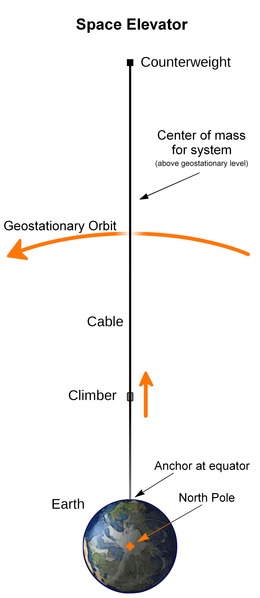
NASA Space Elevator conceptOne of my favorite theoretical ideas out there on the collective drawing board right now is the space elevator, and it was back in the news this week. Scientific American reported on the ISEC -- that's the International Space Elevator Conference -- which just took place in Seattle, and other happenings that are afoot in the realm of this science-fiction-to-science-fact idea.

Of the amazing breakthroughs that have defined human space travel and the countless innovations NASA has given us, what's never changed is the method of overcoming Earth's gravity and getting stuff into space: Rockets. But rockets are still phenomenally expensive and inefficient, since so much of the weight they have to move upon launch is their own (heavy and again, very expensive) fuel. Enter the space elevator.

Space Elevator distance
By attaching a long (estimated between 22,000- and 62,000-mile) tether to the Earth's surface near the equator and a counter-balance on the other end way out in space, we could transport cargo beyond the Earth's atmosphere without the need of rockets. The infrastructure cost is huge, but imagine the stuff we could build out in space if it were easy and inexpensive to get the materials up there. Visions of lunar colonies and actual space shuttles ferrying materials and supplies back and forth from the elevator terminal and the moon get the imagination working and suggest countless possibilities.

But this awesome idea remains science fiction at the moment because we don't have any materials strong enough and light enough to support their own weight at that length.

NASA explored this idea seriously starting in 2000, and Michael Laine, one of the people involved on the project, has persisted in his quest to see the space elevator become a reality. His company, LiftPort, has raised over $60,000 on Kickstarter to get their doors open and is discussed in the Scientific American article. On the horizon for them are plans to build a lunar elevator with existing technology in order to pave the way for the eventual Earth-based elevator, which they believe can be constructed using carbon fiber nanotubes that will be climbed by cargo-carrying robots (which you can name, as a Kickstarter reward).

Well, here's hoping.

(And if you're planning on pitching in to name the robot, my vote goes for "Gort." He's my favorite.)

Thursday, September 6, 2012

Thursday Morning Superhero

If it is Thursday, then it is time for another installment of Thursday Morning Superhero.  This week saw the launch of the DC #0 line and a great one-shot from Bill Willingham’s Fairest.  In a rare week I only scooped one Marvel title and continued to enjoy Harvest, a title I picked up originally based on an interesting cover.


Pick of the Week:
Harvest #2 – I picked up the first issue of this book based on a cover that seemed interesting to cover in this blog.  I thoroughly enjoyed the first issue and A.J. Lieberman continues the story of Dr. Dane, discredited surgeon who is caught up in the world of underground organ transplants.  We learn much more about Dr. Dane in this issue and his pursuit of what is right.  Colin Lorimer really draws the reader into this dark world with some of the most breathtaking panels in print today.  What began as a comic purchased on face value has turned into one of my favorite series on the market today.  Really worth checking out.

Runner-up:
Fairest #7 – Bill Willingham continues to take money from me.  The universe that he has created is rich with fresh takes on childhood favorites and he continues to develop the rich history that remains untold in Fables.  This issue, written by Matthew Sturgis, is a one-shot mystery featuring Beast and the devious Lamia. Using a film noir approach Sturgis tells the tale of Lamia and her pursuit by two competing detectives.  She has already killed once and will continue to do so unless she is stopped.  I would love to spoil a great reveal on a character in the Fables universe, but I will refrain myself.  Fans of Fables will gobble this story up but even to the unacquainted reader this one shot is quite enjoyable.  Well done Mr. Sturgis.


The Not as Good:
Batman Detective Comics #0 – While I enjoyed reading this book, it was a tale that I have read time and time again.  Does Batman really need any more details to his origin?  It was a fun read, but ultimately didn’t do anything for me.

The Rest:
The Phantom Stranger #0 – This was a blind buy and I quite enjoyed it.  The Phantom Stranger is a story of a man that is forced to atone for his sins to right the wrong of a friend he betrayed.  You see the birth of an interesting story and what could prove to be quite a good DC book.

Hawkeye #2 – Matt Fraction continues his unique take on Hawkeye and I am intrigued.  While Fraction’s Hawkeye doesn’t have me hooked, I have enjoyed his take and plan on continuing the ride.  This issue we meet Kate Bishop, a former Hawkeye stand-in, who I am looking forward to seeing more of.

What I missed:
Green Lantern #0 – It sounds like Geoff John’s stepped outside of the box and took the DC #0 promotion to look forward instead of a retelling of the past.  I like that he took a different approach to move the New 52 launch forward.

Before Watchmen: Silk Spectre #3 – This book sounds like it is an acid trip into the psyche of Silk Spectre in a good way.  Darwyn Cooke is a masterful storyteller who brings us to a world where the acid trip wears off.  This may be one I go back and pick up.

Wednesday, September 5, 2012

Microreview [games] - Cthulhu Dice


The Meat

Cthulhu + Dice + Steve Jackson Games = Fun

Horror master H.P. Lovecraft published the “Call of Cthulhu” in 1928.  Since his debut, Cthulhu has been slowly causing sailors and cultists to lose their mind.  The creature Lovecraft described as "an octopus, a dragon, and a human caricature” has been permanently cemented in horror and nerd culture. Recently, it would seem Cthulhu has been getting ready to wake from his not-dead sleep, with oodles of 'hulhu cropping up all over pop culture (ie, Facebook). 
An unconventional, but democratic,
way of restoring the Ancient Ones to power.

When you take someone with the pedigree of Steve Jackson (Munchkin, Zombie Dice, etc. – look at www.sjgames.com for a full offering) and add in the cosmic entity of bad mental hoodoo that is Cthulhu, you have yourself a pretty enjoyable game.  The rules are simple.  You battle other cultists in a contest to see who can remain sane the longest. 

Each individual starts out with a certain number of sanity marbles, and if Cthulhu causes you to lose all of your marbles then you go insane.  The last sane cultist wins.  On your turn you roll a 12-sided die and either roll Cthulhu himself (everyone loses a sanity marble), a tentacle (you steal someone else’s sanity token), an elder sign (you take a sanity marble from Cthulhu) or yellow sign (whoever you are rolling against loses one sanity marble to Cthulhu).

That’s it!  It is a game so simple a five-year old can master it.  No, seriously.  My five-year old son Henry has mastered this game and wins 80% of the time.  It is more fun with more people (up to 6!)  Games last anywhere from 2-10 minutes and are quite enjoyable

The Math

Objective Quality: 8/10

Bonuses: +1 for creating a Cthulhu game for kids!

Penalties: -1 for Henry constantly demolishing me in this game.

Game Coefficient: 8/10. Well worth your time and attention.

[See explanation of our non-inflated scores here.]

Tuesday, September 4, 2012

Microreview [film]: Near Dark


The Meat

A small-town kid tired of the tedium of a hum-drum daily life meets an attractive vampire, falls in love, and gets "converted," only to find peril when the other vampires aren't exactly welcoming. Maybe this sounds familiar. Maybe it sounds like Twilight. Because it's pretty much Twilight.

On almost every conceivable level, though, Near Dark is much, much better than Twilight. It marks the directorial debut of Katherine Bigelow (Oscar-winner for The Hurt Locker), and its Western-Horror-Romance genre mash-up remains effective 25 years after its first release, even though we've seen countless derivations of a similar formula since. You've got your young, sexy conflicted vampire that sucks a stranger into her world of darkness (pun intended), and grim consequences ensue. Local teenager and family ranch-hand Caleb meets Mae, a beautiful stranger he takes for a late-night drive. Mae is a vampire of relatively recent vintage, and doesn't feel much connection with the violent, vengeful gang of vampires that she belongs to. She converts Caleb without his knowledge, and has to prevent her gang (led by sci-fi staple Lance Henriksen) from immediately killing him, promising that Caleb will learn to hunt and kill on his own. But can he really...?

What's nice is the lack of any whiny teen-angsty stuff to color the proceedings. In its place is a genuine sense of loss, especially when it comes to Homer, the child vampire that longs for someone to relate to. That struggle presages the lovely work of then-unknown Kirsten Dunst in Interview with a Vampire a few years later. The sense of family feels true-to-life, Caleb's desperation and confusion after his transformation feels more legitimate than many other movies' handling of the same idea, and the tension in scenes where the vampire gang makes their kills is appropriately taut. The Twilight comparisons these days are inevitable when watching Near Dark, but what this movie has and I always felt that other saga sorely lacked is a real, human heart at its core.

And that's important. We're dealing with blood here.

The Math

Objective Quality: 7/10

Bonuses: +1 for one of Bill Paxton's more energetic performances; +1 for never once actually using the word "vampire."

Penalties: -1 for the dubious method of resolving everything at the end.

Cult Movie Coefficient: 8/10. Well worth your time and attention.

[See explanation of our non-inflated scores here.]

Monday, September 3, 2012

Microreview [book]: The Last Wish by Andrzej Sapkowski


The Meat

THE LAST WISH is the first book in Polish author Andrzej Sapkowski's WITCHER series, and centers on the monster-hunting exploits, romances and political imbroglios of one Geralt of Rivia, the titular "witcher" of the series. Originally published in 1993, THE LAST WISH  was long denied us Anglophones. But thanks to the good people at Gollancz/Orbit, we finally have access to these books in translation.

If this all sounds a bit familiar to you, it's probably because you've played or heard of the video games these books inspired. THE LAST WISH is a must-read for fans of the games, as well as anyone who likes character-driven sword & sorcery. As it happens, after only reading one installment in the series, I'm ready to pronounce Geralt as one of the great fantasy characters of all-time. He's a cynic with a moral compass, a killer with standards and has a way with the ladies, who are themselves similarly complex and interesting characters.

THE LAST WISH is also an overtly political book, set in a place and time where humans have nearly driven out the elves and dwarves, who face the stark choice of assimilate into human society as second-class citizens or try to fight back despite dwindling numbers and few resources. This is portrayed as tragedy, and is dealt with in an appropriately sophisticated and nuanced way.

Then there's the prose. Even in translation, it pops off the page--Sapkowski is particularly good with dialogue and voice. There's a playfulness in evidence as well, which reminds me of Fritz Leiber, though a bit less flowery.

All in all, the book is highly recommended to any fan of sword & sorcery.

The Math

Objective Quality: 8/10

Bonuses: +1 for the great characters; +1 for a unique, political take on elves and dwarves that goes well beyond Tolkein

Penalties: -1 for the "ties-it-all-together" story, which feels a bit tacked on

Nerd Coefficient: 9/10. "Very high quality/standout in its category."