Showing posts with label k j parker. Show all posts

Friday, July 3, 2026

Book Review: Sister Svangerd and the Not Quite Dead

The latest novel by K.J. Parker set in his Parkerland ‘verse

K.J. Parker has settled into doing novels set in his Parkerland ‘verse. For lack of a better term for the setting, since it involves a variety of locations, timelines, characters, and inconsistencies, it is a medieval world that isn’t our own, but rhymes and plays with that rhyme in a whole bunch of different ways. Be it the Siege (Sixteen Ways to Defend a City) Trilogy about the not-quite-fall of Byzantium to Saevus Corax, battlefield salvager who winds up trying to head off international conflicts, to various novellas involving the ubiquitous Salonicus, who is a con artist, inventor, playwright, and possibly also the most brilliant person in the entire timeline. The novellas and novels aren’t in any sort of sensical order, the very idea of a map is scoffed at, and just when things actually took place is not clear.

Sister Svangerd and the Not Quite Dead is the latest in these. This novel feels, from internal evidence, to be late in the timeline of events compared to the others. The church has been going along for quite a while and doesn’t have any competition anymore, and seems ready to have a schism of some size. The eternal threat of the Sashan Empire seems muted. Once again we have people lamenting lost manuscripts, writings and whole technologies.¹

And an impious monk and a female assassin/nun are dispatched to a synod where they have been tasked with killing a troublesome princess. But things get hot and hairy before they can even get there, and when they get to the synod itself, trouble erupts not of their own making, but definitely because they are there.

Despite the title, our viewpoint character is not the assassin/nun Sister Svangerd herself, but rather a more typical Parker point-of-view character: Brother Desiderius. He is a well worn and familiar archetype to readers of Parker’s work. A cynical, knowledgeable, brains-driven protagonist. He’s also an out-and-out atheist, even given that he’s a monk. He also has some other useful skills, and the classic Parker game of “I reveal this about the character and that changes what you just read” runs riot through his story. Sister Svangerd, for all that she is in the title, doesn’t hold a candle to our real protagonist, and that is a shame and a missed opportunity.

This novel’s theological debates about The Invincible Sun and the minutiae of its dogma are interesting if you want a debate over a religion in a fantasy novel. Parker, and to various extents his characters, are engaged with it. And there is a veneer of the idea that maybe there are supernatural forces using human agents here—or are the human agents simply thinking they are working for those supernatural elements—or is it all lies, delusions and half truths?

Take the Not-Quite-Dead from the title. Yes, this novel has a type of zombie in it. Or at least an undead. But there is a real fascination with Parker with the idea of people thinking they are supernatural, and regarding their presence as prima facie evidence for the truth of evil, versus the alternative. Our protagonist is from a country where this happens in families: naturally, there are families where, when people die, they come back as these undead. He’s an atheist and has a materialistic view of the entire affair, even if nearly nobody else does. It’s like this novel is having arguments with the more fantastical novellas such as Inside Man about whether the supernatural elements of Parkerland are actually real or not. Are they? Unclear!

And that is the thing about this novel, for better or worse. This novel is very much, absolutely meant as inside baseball catnip for people who have read a bunch of these novels and stories already and want to keep burrowing into this world and try to figure it out and see if there is a consistent design behind everything. Is there? Some days I think Parker is deliberately inconsistent just to mess with his longtime deep readers, and half the time I think he is just winging it and doesn’t have a consistent theory of worldbuilding. As I have read a number of books and reviewed them, here. Making History, for example, seems like a serious contemplation on the nature of history and its transmission. The Saevus Corax series, which this book resembles in some ways, does a lot of what this novel does, although with a somewhat different focus and at a different point in the timeline. I do think, especially given his academic focused stories, that it is all a game to Parker.

And that’s fine, but, and here’s the but. I might enjoy trying to figure out things here, trying to tease out where and when in Parkerland these events are happening and what it all means for the history and development of the world. I might enjoy the reading references, the aforementioned familiar archetype of a character. There is a well worn groove here in these novels.

The problem, the but, as it were, is that there is no way I would recommend this book to someone absolutely new to Parker. I am glad Parker is not writing solely for the inside baseball (the aforementioned Making History works pretty well for readers who haven’t read much or any of Parker). But a novel like this, although it is first in a series, really isn’t the first in a series at all. It’s a novel for a limited audience—deep fans of Parkerland.

I can hope, based on prior experience, that the next two novels will tie things together and get me to reconsider this novel and its merits. But then again, that’s once again something for the deep Parkerland reader, not for the casual fantasy reader picking up Parker for the first time. And so we come back to the original problem.

So in a real way what this review boils down to is: If you like and read lots of Parkerland novels, you get more of the same here. Other readers probably won’t derive as much enjoyment out of the novel as you’d hope. I think it’s not worth your time, frankly. I enjoy Parker’s tone and world, and his knowledgable protagonist, but this is down deep in that, and starting here won’t land well at all. There are better places to start, I think (e.g. Sixteen Ways to Defend a City).

Highlights:

  • A novel set late in the Parkerland timeline
  • A familiar protagonist despite the book title
  • Too well worn a groove for a limited audience

Reference: Parker, K.J. Sister Svangerd and the Not Quite Dead [Orbit, 2026].

¹ Inside baseball here. One of the things that make it hard to date and come up with a chronology of the Parkerland ‘verse is that technology and knowledge keeps getting lost. This world seems to be continually in a trap where no sustained technological development can take place without a war or other disaster knocking the sandcastle down all over again and regressing to an equilibrium. Even for a world with multiple organizations trying to preserve and extend knowledge, in Parkerland, it never *lasts*.

POSTED BY: Paul Weimer. Ubiquitous in Shadow, but I'm just this guy, you know? @princejvstin.

Friday, December 26, 2025

Book Review: Making History by K. J. Parker

Another novella set in Parker's mainline secondary universe, about a group of academics tasked with a seemingly impossible task by a tyrant. 


Uneasy lies the head of someone who is targeted by a tyrant for a special job. First Citizen Gyges, the tyrant of Aelia, has a plan for war but of a pretext beyond comprehension. The nearby Ana Strasoe is full of barbarians, and starting a war with them on the right pretext could give Gyges a chance to expand into their territory. That, once accomplished, could give him the power to go up against the regional power of Anticyrene. And if Gyges knocks them off, then Aelia would truly be in the heavyweight class and Gyges could contemplate taking on the biggest empire of them all, the Sashan. But it hinges on getting a reason for war that the Ana Strasoe, and his own people, will accept.

And so Gyges formulates a plan so that a few lead scholars, including our narrator, are to manufacture a false history of Aelis, complete with recently discovered artifacts and ruins, that will justify Aelia going after Ana Strasoe with a willing and eager populace. Gyges’ plan is as mad and grand as you might imagine--manufacturing a whole lost city and civilization that can be “discovered” and used as reason for the war to happen to recover lost glory. It has to be a bulletproof, fully documentable manufactured lost history.

This, needless to say, does not go to plan...

This is the story of the novella Making History.

Making History is set in the secondary world that Parker has, with often contradictory and twisty worldbuilding, been building for quite some time. Call it the Saloninus-verse, for the character he has alluded to, mentioned and referenced and written about the most. Or Parkerland, since that is what the author calls it. It’s a world based on areas of antiquity and medieval Europe from roughly the Mediterranean all the way to Central Asia, with lots of countries, polities and ideas that resonate with our world but aren’t quite our own. You can see the echoes and Parker has a lot of fun with that. The Sashan are very much in the mold of the Parthian or Sassanian Empire, except even more powerful. The Robur, who do not feature in this book, are the Roman stand-ins. And so on.

Parker’s trick and devilry for a reader who wants an organized timeline and the like is that his references are contradictory, mixed and tangled at best. Just where anything is in relation to anything else is often unclear, and when things occur in relation to other books is pretty dire to try and figure out, and that’s part of Parker’s joy. I’ve seen proposed maps and some time frames but they are all very speculative.

So figuring out when and where Making History takes place in this verse is tricky. We do have Aelia, and the Sashan and Anticyrene, so we have some basic ideas on when it occurs in the verse. It doesn’t actually matter when it occurs in the timeline and where. You don’t have to have to have read any previous Parker in order to enjoy this. Where it fits in a history that is unclear, contradictory and unclear doesn’t really matter to enjoy the novella.

And yet it does somewhat, given the plot of the story. The academics are trying to manufacture a history from scratch, a history that didn’t exist. They know the truth, mostly about where Aelia came from. They did not come from a fallen civilization that straddled the border of Aelia and the Ana Strasoe. They know that what Gyges wants is completely manufactured and unreal.

And yet they have to do it. The work is split up among these academics. Our narrator is tasked with an interesting problem, and that of language. A fair amount of the novella is concerned with our protagonist trying to reverse engineer a language that could be plausibly be seen as the ancestor of Aelian¹. Parker goes into a deep dive into a real historical subject but in a fictional context, something that he is awfully fond of doing. In this case, we get how to reverse engineer not only a plausible proto language that a high fallen civilization might have produced, but also its writing system as well. It’s a brilliant bit of worldbuilding backwards and forwards, which is ironic given Parker’s disinterest in presenting a coherent set of worldbuilding for his world.

In that way, Making History is Parker being self aware of what he is done in the universe, and having the opening of the plot having academics being tasked with making an articulate (if false) history of Aelia and making it all make sense and stand up to scrutiny and rigor. Is it a “take that” at the whole project of making consistent worldbuilding? Perhaps, because as the plot unfolds, the narrator and the other academics start to see echoes of their created past crop up in the present day, inexplicably. Artifacts that are clearly fake--they have to be, they weren’t made for the unearthed site but they are in the style. And then there are people speaking the language our narrator created. And documents as well...

And how and what is going on, unfolds the main plot of the novel. In classic style, Parker makes it clear that there are multiple answers as to what could be going on. The more fun and much more unlikely answer is the Borges answer. The academics hypothesize, that while their primary guess as to what is happening (redacted for spoilery reasons) is probably what is really happening, their alternate guess is even more fun and I will spoil that here: They think that by manufacturing such a large volume

Have you read Borges’ Tlön, Uqbar, Orbis Tertius? That is a short story where entries and information regarding a strange and seemingly fictional place start cropping up in the real world, and slowly and surely become real. It’s a horror story, in a way, that history and reality could be so weirdly warped as to have a fictional volume of an encyclopedia of a place that doesn’t exist start to intrude on reality and start to influence reality. In that story, artifacts from the titular Tlön, just like in Making History, start to appear. The false reality of Tlön becomes, in effect, real. The academics as their backup low-probability explanation think that the large force of their efforts to make a false history does, in fact, change the past and make it real.

And once again, it goes back to the theme I’ve looked at this novella through the lens with--the inconsistent and not defined worldbuilding of Parker in his Parkerland universe. There is no bible, no one set history of his world and the very act of him writing another book upsets and changes that applecart and the calculations of what has come before, all the more. It is all stone mirrors, all strange and invented languages, all Tlön.

The other book to tie this to is a book I’ve looked at over in Skiffy and Fanty, and that is All Roads Lead to Rome: Why We Think of the Roman Empire Daily by Rhiannon Garth-Jones. That book is a non-fictional look at the legacy and responses to Rome by successor civilizations and how they change and take slices of that history and run with it. And in so doing, often distort or change aspects of that history, culture and society for their own ends. Just as one example, have you noticed that the Neoclassical style, so seen in Washington D.C, is all white marble? That’s a misinterpretation of the originals, the paint on Greek and Roman buildings being long gone. The actual originals, in the time of Plato, or Cicero, or Emperor Trajan, would have been polychromatic, even gaudy, by modern eyes.Were any of them transported to the modern day, they would take one look at the Capitol building and wonder what happened to all the color.

There is much more richness and discussion and thought in the novella, about the nature of truth, information, society and history. There is the classic dark humor and biting wit that Parker’s work features. It’s a thinking piece in many ways, much along the shorter works in his oeuvre, as opposed to direct action. But I do think it gives a very good entry point into how Parker writes, especially in the shorter vein, when he truly allows his nerdery and deep interest in subjects come to the fore. In some ways, I think Parker’s efforts in novels aren’t quite as sharp, or strong or rich as novellas and stories such as Making History.

About the only thing missing from the book is not even a jot of a mention of Salonicus. Is it set before him, then? Unclear! (see above).

-- 

Highlights:

  • What is truth, anyway and can you manufacture it?
  • Deep nerdery dives, a classic of shorter Parker work.
  • Biting, dark humor.
  • No Salonicus references in this one.
Reference: Parker, K.J., Making History (tordotcom, 2025)

POSTED BY: Paul Weimer. Ubiquitous in Shadow, but I'm just this guy, you know? @princejvstin.


¹Given Parker’s strong interest in engineering, going into this novella, I had completely expected that it would be focused on the engineering aspects of the story. If you are going to have a lost city, it’s not as easy as burying a city and then, voila, uncovering it. There are some concerns that our narrator discusses with one of his colleagues tasked with that part of the project, but it is not the focus of this novella that I thought it might be.

Friday, November 8, 2024

K. J. Parker and the the Saevus Corax Trilogy

Now complete, the Saevus Corax trilogy shows the wit, cynicism, nuance and a comprehensive experience of K. J. Parker in the long form. And my favorite of his works.

Tom Holt contains multitudes as an author. In his given name, he is a prolific writer of comedic and humorous fantasy. He’s also written historical novels under his given name, and poetry as well. And then there is his pen name of K. J. Parker. Parker has two modes: the short story, often with supernatural elements, a crisp and focused affair; and then there are his novels, most especially his trilogies. Most of these are set in the same world as the short stories (as far as one can tell) but are relentlessly mundane fantasy, with no magic or supernatural elements whatsoever, and constructing larger, longer narratives.

And so we come to his latest trilogy: Saevus Corax (Saevus Corax Deals with the Dead, Saevus Corax Captures the Castle, Saevus Corax Gets Away with Murder). All three novels were released in a burst at the end of 2023, which reinforces the point that in all of his guises and facets, Parker is quite the prolific author.

As mentioned above, most of his novels and short stories are set in various times and places in the same fantasy world. Parkerland (for lack of any real defined name) is roughly, with a very few exceptions, based on an alternate Eurasia. There are some deliberately obfuscating and contradictory elements to Parker’s worldbuilding. There is no defined timeline anywhere in his novels and stories. We get plenty of references to events and characters (Salonicus, a playwright and con man who features in a few stories as a main character, has his work referenced in many other books, including here in the Corax trilogy). And maps? There are no official maps of Parkerland anywhere, and the very geography of the world feels fast and loose at times. It feels more than deliberate on Parker’s part.

I want to come to Corax directly on this last one, and discuss it, because it is at its heart a travelogue of a character who has been running away from his past his entire life. And so, while some if not many of Parker’s novels and stories take place in a relatively confined space (the City Trilogy, for example, mostly takes place in the titular Robur City), Corax is really different in that our main character ranges all across Parkerland. And where Corax doesn’t actually visit, he namedrops and has opinions on, or wonders what is happening as the overarching plot of the trilogy unfolds. So the Corax Trilogy is about a guy who roams a world where there are plenty of comparative references and places to go and things described, but is light on how everything is supposed to fit together.

Corax has a bigger problem than that. Even as he runs away from his past, a long simmering fight between much of the “West” (read: Western Europe) and the Sashan Empire (read: “Imperial Persia”) has been brewing. In point of fact, for more than two novels, Corax does his best to try and defuse and stop the conflict from happening with all of his wit, panache and machinations.. There is a deep irony in all this, but Corax makes it make sense.

For, you see, Corax’s main occupation for most of these three novels is as a battlefield salvager. Two sides have a battle, then leave, and firms such as the one Corax runs come in (having paid for the privilege), strip the armors, weapons, and other goodies, and take care of the dead bodies. Corax’s company is a second-tier outfit in this business, and his margins are crap, but he does the job anyway. It’s not his first career after he ran away from home, but he’s got a lot invested in it, so he keeps coming back to it, even with such weird diversions as becoming king of a rich island for a while. So you’d think that a big war between the Sashans and everyone else would be good for his bottom line, but you'd be wrong, and Corax is not shy in telling us why in detail. And yes, it is mainly the fact that hundreds of thousands or more people dead would be a tragedy. But even personally, it is also because no outfit, not even the Asphogel Brothers, the top-tier outfit, could handle a grand world war, much less Corax and his five hundred men.

So, for a trilogy about a guy who has run away from his past and finally landed on battlefield salvager after conflicts and wars, the trilogy is throughout rather against the whole idea of war in general. Corax is way too practical to think that war doesn’t solve anything; it's just that it's often a very bad solution to problems, and the collateral damage is frightful. He knows all this, and knows the reasons why the historical forces of commerce and need are driving toward war, but he tries to stop it any way he can.

So, in trying to stop the war (and spoiler, he is ultimately unsuccessful, and that itself is a tragedy on several levels, the more I think about it given events in the trilogy), Corax’s journeys across Parkerland make this my favorite of Parker’s works. Sure, I would like a definitive map, or even a timeline to make sense of when this trilogy takes place in relation to other works. We get some hints and signposts, but for all of the places we do visit and the things Corax sees and deals with, the lack of precision makes the trilogy, and Parker’s work in general feels somewhat more like M. J. Harrison than, say, Marshall Ryan Maresca in terms of the worldbuilding. A question I would like to ask Holt, should I ever get the chance: Is it at all straight and ordered and plotted out privately, for himself? Or does he delight in the contradictions and lack of certainty for readers?

But why would I want to read a book or a series of books where worldbuilding is frustratingly vague sometimes, especially someone like me, who likes consistency in such matters, and crunchy details? What else does Corax and Parker’s work hold for me? Glad you asked! First of all, there is the often mordant sense of humor, in the “another fine mess” school of humor, with dollops of Corax’s observations on his companions, life, the universe and everything else. There is a voice to a lot of Parker’s longform work that makes it feel like I am sitting in a tavern somewhere having a friend tell me about the improbable absurdities that have happened to him. And this comes up all the time in Parker’s novels, be it a Colonel of Engineers asked to defend a city with no resources, or a playwright winding up having to do a Prisoner of Zenda bit. Or Corax becoming king of a rich island on the eve of it being invaded. Or the time Corax met the real king of Sashan living in exile... with Corax’s ex-wife. And much more.

And there are real human moments in all of this, too. For all that Corax feels like a con man, rogue and reprobate, there is a real core question at the heart of the books: How and why did he really kill his brother? This is something that comes up again in the books, and there are several opinions on it, and even Corax doesn’t know the truth himself of the day his brother, the golden child of his noble family, died. Certainly his family (especially his father) has opinions... and a big price on his head (alive, not dead; Corax’s father wants him to *suffer*), and Corax does end up escaping from one capture plot after another. But for all of the “not again” aspects of these events, the central question of what set Corax on the run in the first place remains Rashomonian and there is a bit of a tragedy in that.

In addition, there is, in the trilogy, unexpectedly, a romance. It’s doomed and tragic, one that dare not even be thought, much less acted upon, for the greater part of two books. It’s part of the ultimate story, maybe tragedy, of Corax that he finds himself in a romance, or realizes he has been in one for years and never quite realized it (although it is clear his partner in the relationship has been far less clueless). The revelation of this romance, as well as other events in the third book, does do something Parker is good at in his trilogies, and that is tie the books together and get you to think about and reconsider the second, and especially the first book in the series and reinterpret events. And, for those who have the luxury and the will to do so, this also means that Parker’s longform work bears rereading.

And if you do read a swath of Parker, not only are there the teasing references here and there, but also the rhymes and repeats of themes played out in different ways. For example, there is the Salonicus novella “The Big Score,” which is his attempt to find the one job, the one con, the one weird trick that will let him retire to wealth and leisure. Corax and many of his companions are also looking for a Big Score, and while they look for ones very different from Salonicus’s too-clever-by-half plan, there is a resonance for those who read both works. Or consider how Corax’s efforts to stop a war at any cost are a dark reflection of the Engineer Trilogy, which is all about a man engineering a war for his own selfish ends, costs to others be damned (and an Engineer defending a city against all odds also ties into the Siege Trilogy).

I put K. J. Parker, in a narrower way, in the same class as Adrian Tchaikovsky, Elizabeth Bear and Walter Jon Williams. He not only bears rereading, but he is an author of a depth and a breath and a large oeuvre that means that a wide variety of readers of genre fiction can find at least one work in their writing that they could come to love. This also means, though, that there are works of his that you might bounce hard off of. But for me, while the City Trilogy is a lot of fun, and Salonicus is a fascinating character (playwright and con man all in wrong), I think for now my favorite Parker books are these three, detailing poor Corax’s misadventures across Parkerland. I look forward to where Parker goes next from here.


Highlights:

  • A Travelogue in a world without a map or even entirely consistent geography
  • Mordantly funny protagonist
  • Real human moments as the protagonist struggles hard against implacable forces.


References: Parker, K. J. Saevus Corax Deals with the Dead, Saevus Corax Captures the Castle, Saevus Corax Gets Away with Murder [Orbit, 2023].

POSTED BY: Paul Weimer. Ubiquitous in Shadow, but I’m just this guy, you know? @princejvstin.

Thursday, June 16, 2022

Book Review: How to Rule an Empire and Get Away with it

Another story of a capital city under years-long siege, and a man who would be King


You’ve heard this story before. Notker, our narrator, right at the beginning admits that this is not a new story, it is one that is just in a new guise. An ordinary person winds up, by twists and turns to be mistaken for, or take the place of, someone powerful in power, and must do their best in their role. This professional actor and con-artist tells us his story is one that has happened before, buit the key to telling a story heard many times before...well, the telling of this story is where the difference and detail lies. 

This is the second City Siege novel of KJ Parker (following Sixteen Ways to Defend a Walled City). 

The previous novel introduced the end of the Robur (roughly, Roman turned Byzantine) Empire, as a outlander mastermind assembled a huge coalition of forces, and marched to conquer and destroy the hated Robur forever. Orban, Colonel of Engineers, in the first book, does his darndest with very limited resources to defend the last, capital city of the Robur against an overwhelming attack. That is a novel of engineer pluck and courage and intelligence trying to stave off the seemingly inevitable.fall of the city.  He does, in the end, fall, but the city’s fate is left uncertain at the end of that novel (although the implication is that the city will eventually lose and fall).

In this second volume, which starts with some overlapping of events from the first novel, we find that the city does settle down to a state of permanent siege. Notker is an actor, and a sometime playwright as well, hustling a living as often as not. Yes, people do go to the theater, but sometimes he gets hired to do impersonations, but he is living hand to mouth.  And so when the ruling military junta who control their popular hero/figurehead Lysimarchus come to him with the role of a lifetime, Notker really has no choice. And as  he continues in that role, he gets ever deeper, even as he is looking for a way out.

While the first volume had Orban explicitly say that he was not telling the whole truth in the end, here from the beginning we have a professional telling us right from the get go about the power of stories, lies, shading the truth and more in order to tell his story. The  first novel was Parker geeking out about engineering and siegecraft and how a determined engineer could frustrate the greatest army the world has assembled. By contrast, this second novel does have concerns regarding the siege and defending it, because Parker does really like to go down his rabbit holes and show it off. (In some ways, I think of him very much like Herman Melville, just enjoying sharing what he has learned and shown off about all sorts of abstruse subjects, interwoven masterfully into the story). 

However, this is a story that is about two other things--stories and the power of stories and why they work, and what we get for telling them. So there is lots of details about fictional plays and books and what those stories reflect upon the narrative and upon people. And as an actor, Notker, once he really starts getting into the role, realizes that he can BE a good Lysimarchus and how that might play to his advantage to eventually getting out of it. There is also a lot about theater and stage life and what a strange thing it is to be an actor, a playwright, a professional entertainer, and the best mordant humor in the book is Notker’s observations on the performing life.


The other thing this story is about is the government. Not about our government, specifically, but there is a lot here about how bureaucracies work, as Notka finds out who really is the underpinnings of the empire and the day to day running of things in the city. Sure, there is a military junta, and then later as Emperor, Notka is a titular head, but there are competing factions, concerns and power structures, but through it all, the civil servants and civil service are what keep a government running, which keep things moving and going. I extend this to the Themes. Like Constantinople, there are two themes in the City, the Blues and the Greens, and they act as (eventually legalized and regularized) extra-governmental organizations not quite unlike the mob. They provide a lot of the services that this government does not. Given Notker’s origins and his father’s profession and how Notker feels about all that, we get some excellent characterization of Notker and what he thinks about it all. 

All of the above, is of course, to be taken with more than a grain of salt, because Notker IS a professional liar. How much he has written down (like the first book, this is a “found document” sort of narrative) is truth, how much is changed...it is hard to say. It was entertaining in the early going to compare events and Notker’s view, of say, Orban and the siege and seeing how it looked very different in his eyes, And when Orban exited the narrative, and seeing how things continued on, I kept in mind, and you should, that Notker is telling a story here, rather than a historical narrative. 

And with that in mind, Notker does pitch his story in an entertaining fashion, with many of the little and big worldbuilding touches that Parker likes to put into his stories. Unlike the first novel, here we get a dead-center of power view of the City and its plight, and does uneasy lie the crown? You bet it does. But the beauty of a lot of Parker’s writing (except of course, see above, Notker lies) is that they often feel like historical novels in a history that never was. Between all the novels he’s written in a loosely similar world or worlds (it’s more nebulous than, say, Guy Gavriel Kay where most of his novels by now clearly are in the same single shadow world of Fionavar), there is a real heft and sometimes contradiction, and rarely intersections between the works, their time periods and their characters. But once you’ve read a Parker or two, his voice is very familiar, and even comforting, even as he invents anew. 

One other thing to note. The first book in the City cycle was very much a sausagefest, with no strong female characters. This novel has one, in the personage of Hodda. In fact, Notker telegraphs her existence in the narrative by talking about how plays do well when they have a “kickass female lead”. Hodda definitely fits that bill and her presence alone makes this a better book in some ways than the first.  Was she like this “for real” in the fictional history of the city?  Impossible to tell, because of course Notka is a liar and he is telling a story.

The one thing that first time readers to Parker may not know is that a lot of his fantasy fiction, including the City books, take place in a zero magic setting. (Other books of his do have magic, including ones that may be in the same universe or one next door to this one). If you want your fantasy fiction with even just a small touch of magic, then the City books are definitely not for you. Although they are very different in many ways, the best touchstone I can think of to the City books is Ellen Kushner’s Swordspoint series. More contemporaneously, Marie Brennan’s Lady Trent series also explores the Secondary World fantasy without magic environment. 

Do you need to have read Sixteen Ways to Defend a Walled City?  Yes and no.  Yes in the sense that it will give you a sense of the setup leading up when Notker steps onto the stage, as it were. We get a little more on the Robur Empire outside the city and in general in the first book that the second book assumes that you know. But on the other hand this book doesn’t quite need the first, this is Notker’s story and he is putting the spotlight on himself and giving himself as playwright of the work, the juiciest part. (as Notker was mentioning this, I kept thinking of the opening to A Funny Thing Happened on the Way to the Forum, where Zero Mostel introduces the setup and characters and gleefully admits that his is the best part, of course. 

I look forward to completing the trilogy at some point. I listened to this one in audio and the narration was a delight.


---
The Math
Baseline Assessment: 7/10

Bonuses : +1 Strong characters and while an old story, it does new and fresh things with that story. Better female characters (specifically, Hodda) than the first book.

+1 For interesting explorations of theme of government, and entertainment.

Penalties: -1 Some readers may not be so charmed by Notker as I was. He is the only Point of View, for better or worse.

Nerd Coefficient: 8/10

 POSTED BY: Paul Weimer. Ubiquitous in Shadow, but I’m just this guy, you know? @princejvstin.
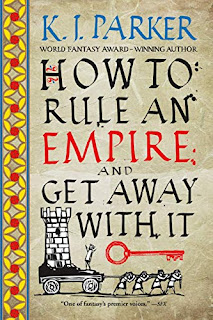
Reference: Parker, K.J., How to Rule an Empire and Get Away with It [Orbit, 2020]