Showing posts with label future tech. Show all posts

Wednesday, December 11, 2024

Film Review: Y2K

A retro comedy slasher adventure that struggles to connect with its intended audience.


It’s weird to think of January 1, 2000, as a historical date. For some of us, it may seem relatively recent. However, the relentless march of time has somehow brought us to the twenty-fifth anniversary of the turn of the millennia. It was the day much of society feared would descend us into chaos, or at least great inconvenience, due to the changing of computer calendars to a zero-zero date. In theory, this would make computers think we were in the year 1900 and all sorts of catastrophic computer failures would occur as a result. In retrospect, it seems strange that we were so worried about something like that. And, as it turns out, everything was fine.
 
But what if it hadn’t been? The film, Y2K, is an alternate history account of the first day of the millennia, a day where everything that could go wrong, does go wrong. Unfortunately for the kids in Y2K, it’s not just the ATM failures and computer data lockouts we all feared. Instead, legions of previously harmless, household tech turn into murderous robots, all skewering frantic teens and it’s up to our heroes to survive and try to save humanity. And, in case it’s not clear, this is a comedy.
 
The story starts just before New Year’s Eve, where a cross section of high schoolers are planning to party like it’s 1999. Quiet, video game loving Eli (Jaeden Martell) and his best friend Danny (Julian Dennison) are bored by their New Year’s Eve at home and decide to attend a big party thrown by one of the popular, athletic high schoolers, Soccer Chris (The Kid Laroi). Eli hopes to see the girl of his dreams, the also popular and secretly computer savvy, Laura (Rachel Zegler). In an intro scene, we see Eli and Danny with their supportive parents but we also see them being scoffed at by the popular kids for being too nerdy while also being bullied by the anti-establishment kids for being too mainstream. At the party, we get the set up of the mean, self-absorbed alpha-teens while Danny encourages Eli to be brave enough to share his true feelings with Laura. At the stroke of midnight things change when random electronic toys and household appliances suddenly attack the humans and kill them. As the panic ensues, Eli, Danny, Laura, and some of the anti-establishment crew, including grunge-girl Ash (Lachlan Watson) escape and try to find a way to survive and defeat the machines. Along the way, they meet more allies, suffer terrible losses, and discover that the machine attack is not just a Y2K bug but an organized uprising of machines against humanity. It’s sort of like The Terminator but with modified household appliances instead of sleek robots. The film gives some passing commentary on the ways humans misuse the internet for harm. But the real story is Eli’s coming of age, Laura finding her strength to try to defeat the machine monsters, and their rom-com moments amidst the death and chaos. The special effects are part of the humor with many of the machine attackers looking like a mini Radio Shack version of a Power Rangers Megazord. A funny scene involves Danny simply stomping a small, drill-toting robot instead of running (and tripping) hysterically like everyone else.
 
It's hard to know who the target audience is for this film. The onscreen tropes are intensely high school and juvenile but they are high school and juvenile for people who are now in their forties and fifties. Nostalgia-based adventures work best through a subtle lens of maturity for the current viewer base. Stranger Things did this well, at least in the early seasons, immersing us in the culture of the 1980’s with a nod to our current sensibilities. Y2K stays rooted in its very niche turn of the millennia aesthetic in a way that may not connect with viewers whose own experiences of that time differed greatly. As a result, many of the references and gags don’t resonate the way they were likely intended. Some lines made me laugh out loud but others sent me Googling mid-scene to try to understand the comment. The overall humor style also feels like a combination of Monty Python and Stranger Things but the underlying story heads in a different thematic direction. At one point there is an extended scene involving Limp Bizkit which was mostly lost on me.

A comedy slasher/horror is one of the hardest sub-genres to execute, especially if it is not a parody. The humor has to be clever enough or the adventure has to be engaging enough for viewers to stay entertained. The concept of Y2K is interesting and the lead cast is solid and likeable. Despite this, the story often struggles to maintain the difficult balance between humor and adventure. The adventure is comfortably predictable with some funny moments but much of the humor may slide past those who aren’t in the particular demographic niche referenced. Somewhere out there is a Monty Python-loving, Limp Bizkit fan in need of a relatively short, teen rom-com slasher and, for them, this movie will be the perfect adventure.

--

The Math

Nerd Coefficient: 6/10

Highlights:
  • Moderately violent
  • Solid acting
  • Unclear target audience
POSTED BY: Ann Michelle Harris – Multitasking, fiction-writing Trekkie currently dreaming of her next beach vacation.

Tuesday, April 30, 2024

Nanoreviews: Live Long and Evolve; The Extractionist; The Frame-Up

Live Long and Evolve: What Star Trek Can Teach Us about Evolution, Genetics, and Life on Other Worlds, by Mohammed A. F. Noor


I bought this book through Princeton University Press’s yearly book sale, which makes available an enormous selection of PUP books at, like, silly prices. I think I paid £3 for this one, and it was worth every penny.

This book is about using the science of evolutionary biology to make predictions about—or at the very least guide our search for—life on other planets. This is itself a fasincating question, but what makes this book charming is the way it integrates a deep knowledge of Star Trek lore into the discussion in plausible and entertaining ways. Mohammed A. F. Noor is not some kook arguing that Star Trek was ahead of its time or 'right' (except accidentally); and he’s not some buzzkill doing a take-down of all the things Star Trek got wrong (although he does note them). He’s simply drawing connections between his two passions in life, which are interested in the same thing—life on other planets—from very different angles.

The book is split up into six chapters. In the first, Noor discusses what conditions must be necessary for something recognizable as life to develop on a planet. For example: what is it about carbon, in particular, that makes it such a good building block? Must the life be carbon based, or could some other element serve the same function? This leads naturally into a discussion of the feasibility of species like the Horta (TOS: The Devil in the Dark), which is silicon-based, alongside real-world experiments showing that some bacteria can form molecules with silicon-carbon bonds. Other sections of this chapter discuss the necessity of liquid water, which is a useful solvent for bringing together chemical reagents, but  not necessarily the only one.  Ammonia, for example, might do the job. Noor also considers requirid temperature ranges, which are typically best when they allow water to exist in its liquid form—but if water is not the key solvent, then things might work out differently. Tolerance of extreme temperatuers is also a concern, but not a huge one. On earth alone we have extremophiles—creatures that tolerate or even prefer extreme temperatures, either hot or cold—and such entities appear in numerous Star Trek episodes, from the tardigrade-like animal Ripper in the first season of Discovery, to the silver-blooded inhabitants of the ‘demon planet’ from the Voyager episode Demon. (Althouh Noor does not mention it, I cannot let reference to the silver blood people pass without also reminding readers that they show up in the heartbreakingly excellent episode Course: Oblivion, albeit not in their extremophile forms.)

Other chapters tackle evolution, genetics, and reproduction. Noor fills this last chapter with fascinating examples of Earth species, such as the Amazon molly, which is entirely female, and reproduces by mating with males of other species. Fertilization triggers the process, but the eventual offspring contain no trace of DNA from the other species male fish. Thus the Amazon molly species remains distinct from whatever species the dildo-dad belonged to. 

Of course, when both parties in a cross-species night out are represented in the offspring, we have hybridization. This is a frequent phenomenon in Star Trek, most famously embodied in the TOS character of Spock, a Vulcan-human hybrid, but there are a variety of other hybrid characters that Noor analyses quite thoroughly. My favourite part of this chapter is his discussion of Haldane’s rule, which captures the (Earthbound) phenomenon whereby female hybrids are more likely to survive than male hybrids, and are more likely to prove fertile, contrary to the trend of sterility among hyrids. As a table on pg 128 reveals, of all the hybrids in Star Trek (up through the first couple of seasons of Discovery at least), more are female than male, and of the hybrid characters who are known to have produced offspring, all but one was female. As Noor concludes, ‘If we speculate that this depiction reflects a difference in hybrid fertility, meaning at least some of the hybrid males were sterile, then we may be observing some signal of Haldane’s Rule just lie among species on earth. I do not think that the Star Trek writers did this intentionally, but the coincidence is amusing.’

I myself suspect that this trend actually reflects a tendency of filmmakers to assign parental roles to female characters than to male characters, but I'm happy to take it as evidence of a galactic Haldane rule. Sometimes it's more fun to look for the science, even if incidentally, than to fume at sociocultural trends among filmmaking.

Nerd Coefficient: 9/10, very high quality/standout in its category

--

The Extractionist, by Kimberly Unger

Eliza McKay works as an extractionist in a futuristic extrapolation of our increasingly plugged in society. Extractionist is one of those jobs that doesn’t yet exist, but becomes necessary in a world where Elon Musk’s Neuralink vision actually works, and not only works, but has become the equivalent of cell phones in today’s culture. Everyone’s got an implant of one version or another, some of them state-of-the art super-fancy versions that are only accesssible if you’ve got military-grade connections, some of them super-cheap retail level chips that are perfectly fine for daily use but not up to more demanding tasks. These implants allow to directly experience cybernetic realities—sort of like the Metaverse, but, y'know, functional. Occasionally, however, people get trapped too deep, and their consciousness must be retrieved and reintegrated with their bodies. This is where Eliza McKay comes in.

So, as plot, she is hired by some secretive black-ops person to extract a member of the team who has gone too deep and knows some crucial information about Stuff. Naturally, the Stuff turns out to be much more large scale and elaborate than Eliza planned for, and heisty cybershenanigans ensue.

I cannot overemphasize the quantity of cyberstuff in this book. Everything is cyber; everything is tech; everything AI (but, y'know, functional). It’s clear that Unger has spent a great deal of time thinking about how this futuristic world will look, how the various technological advances will interface with each other, how the economics of version control and upgrades will affect people’s ability to do certain jobs or interact with different types of equipment. I quite appreciate the way the world she's created echoes the messiness of incompatible operating systems and forced reboots that plague our current digital lives. Just because you’ve got a chip in your brain that's, y'know, functional, doesn’t mean that an inconvenient software update won’t ruin your day.

Unfortunately, for all the thoughtful cyberworldbuilding, the cyberplot and cybercharacters and overall cyberexperience were underwhelming. It’s kind of funny, actually, because when I think about each individual component, I can’t identify any particular flaw beyond a mildly tortured reasoning to justify the circumstances under which extraction is necessary. The characters were fine; their motivations were present; their relationships with each other were developed. The plot proceeded reasonably pacily. I was just deeply bored throughout the entire book. Maybe it’s me. Maybe I’m not cyber enough to cyberappreciate what Unger is cyberdoing. 

Nerd Coefficient: 6/10, still enjoyable, but the flaws are hard to ignore

The Frame-up, by Gwenda Bond

Dani used to be one of the team—a team of magic-using art thieves, to be precise—but she got snookered into betraying her mother and her team by a persuasive FBI agent, and has been something of a pariah in the magic scene ever since. Mom’s in jail, now, and none of the old team are speaking to her. However, her mother’s former patron finds Dani and commissions her to steal a very big painting, with a very big pay-out, so she has to get her quite reluctant ex-team back together and steal a magical painting, while simultaneously evading that same FBI agent and negotiating her remembered feelings for an old flame on her team, which are interfering somewhat with some nascent feelings developing for the painting’s current owner.

This books is a very straightforward heisty heist, with twists and turns exactly where you expect them to be. There are mommy issues to be worked out, old relationships to smooth over, new partnerships to build with surprisingly understanding and unbothered-by-crime painting-owners, and a very convenient diary explaining that a demon whose power is only kept in check by a magical painting must under no circumstances be allowed to regain possession of the picture.

The book is fine. The wheels work, the twists twist. But I found the romantic subplots rather tedious, largely because I don’t think jealousy is an appealing characteristic in potential love interests. And although I don’t read too many heists, and so am not used to keeping track of so many moving parts, I still think some of those convolutions were a bit unearned. For example, at one point Dani’s mother causes extreme complications for her plans for no other reason than that she thinks Dani’s got it too easy, and needs to learn how to deal with jobs when they’re hard. Which doesn’t follow, since Dani’s mother is invested in this heist as much (or more) than any of them, and certainly more invested in it than she is in Dani’s professional development. But then, since (as I said earlier), the painting’s owner seems to have no interest in actually retaining possession of the painting, and is perfectly willing to hire Dani to manage the security of his art gallery, it is undeniably true that Dani seems to be playing the game on easy. Gwenda Bond had to insert complications somewhere, and I guess she chose Dani's mother to do it.

In sum, this was fine. Perfectly good to occupy you while waiting for your laundry to be done, or to read on the bus while keeping one eye out for your stop. But it’s not a book I’m going to stay up late finishing, no matter how twistily the twists twist.

Nerd Coefficient: 6/10, still enjoyable, but the flaws are hard to ignore

--

References

Live Long and Evolve: What Star Trek Can Teach Us about Evolution, Genetics, and Life on Other Worlds. Mohammed A. F. Noor. [Princeton University Press, 2018].

The Extractionist. Kimberly Unger. [Tachyon 2022].

The Frame-Up. Gwenda Bond. [Headline, 2024].

--

CLARA COHEN lives in Scotland in a creaky old building with pipes for gas lighting still lurking under her floorboards. She is an experimental linguist by profession, and calligrapher and Islamic geometric artist by vocation. During figure skating season she does blather on a bit about figure skating. She is on Mastodon at wandering.shop/@ergative.

Friday, November 7, 2014

Call of Duty: Advanced Warfare Multiplayer

[Call of Duty: Advanced Warfare, Sledgehammer Games, Activision, 2014]

Wow, that's a long name! 

No wonder people turn to acronyms when talking about most games these days. The names are getting ridiculously long. CoD:AW, tES:S, WoW:WtoLK, FH2, etc. We've even gotten so lazy, or game type titles have gotten so long, that we use acronyms to describe game types like FPS, MMORPG, TPS, and whatever else you can think of. None of this really has much to do with the game itself, it's just an observation I made when I realized it took five seconds every time I typed or spoke the name of this game. It's the same way with movies. The Avengers: Age of Ultron? Seriously? Is that necessary? Wouldn't Avengers 2 suffice? I guess I'm showing my age here by complaining about acronyms, aren't I? I sound like my Grandpa. 


What are you, like forty?

I guess I'm also a hypocrite because I love GRRM's SoIaF:aSoS. Fortunately for me, gaming keeps me young. Without it I'm afraid I'd just be sitting at home, listening to old grunge and indie rock albums from the 90s, complaining about how much better things used to be. Instead, I've managed to retain my sense of childlike wonder as each new generation of console steps up the graphics game and polishes titles to a shiny, impressive state of jaw-dropping wonder. While I've turned into something of a music snob, video games continue to amaze me, and Advanced Warfare is no exception.


Are you ever going to talk about the actual game? 

Yes, eventually. I started writing this week before I had tried out all the multiplayer game types, so that's the place from which those loosely-related opening paragraphs came. I guess I should get to the actual title at some point, though, shouldn't I? Let's start out with the graphics. While Titanfall, Forza Horizon 2, and Destiny have impressive graphics, this is the first game I've played on a next-gen console that really felt like it was starting to maximize the abilities of the console. Take a look at a side-by-side comparison of CoD: Ghosts vs. Advanced Warfare. Even though they're both from an Xbox One, the improvements are starkly evident. 


While the first is an impressive facial re-creation, the second could easily be mistaken for a scene from House of Cards. That's probably due to the programmers using the same facial re-creation technology that James Cameron is using in the second Avatar film. In fact, when I first started the campaign I literally thought that they were using video for the cutscene instead of computer-generated imagery. The facial creases, shadowing, hair, and eyes are the closest thing to actual high definition video that I have ever seen in a game. That fact made the multiplayer take a while to get used to when I first started. Game mechanics aside, and they are deep, the visuals made it so I often found myself so engrossed in the environment that my character ended up suffering the consequences by paying for it with his or her life because I was busy just staring in amazement at the detail in the surrounding area. 

Graphic distractions


The gameplay is some of the most fast-paced I've ever encountered. Some games cause a frantic panic response by simply overwhelming you with an unbeatable number of enemies. While Advanced Warfare has Exo Survival, a style of game that is reminiscent of Gears of War's Horde mode where wave after wave of increasingly large and difficult enemies assault your four-man team, it doesn't rely on such tactics to ratchet up your stress level in the normal multiplayer modes. Instead, it uses a brand-new type of maneuvering to take the game's speed up a notch (or three) over previous iterations of Call of Duty and other similar titles. It takes quite a bit of getting used to, and although I'm not some sort of special forces killing machine, I have played every Call of Duty title since 2, Halos 2-Reach, Titanfall, and (I'm somewhat embarrassed to admit) well over 100 hours of Crucible in Destiny, so I know my way around a multiplayer controller scheme. It's rare that I have to go into an options menu and check out the button scheme in order to figure out how to manipulate a game's protagonist. I can do that on my own 99% of the time. However, I've found myself returning to the Options menu repeatedly because there are so many facets to the character controls that keeping them straight requires more instant recall than any other game I've come across. 


Much of this difficulty is due to the addition of two gameplay mechanics: Exo Abilities and Boost/Dodge jumps. These abilities are both thanks to your Exoskelaton, a sort of super-soldier suit that allows not only special powers like cloaking and extremely fast movement, but also mid-air directional changes that would make Superman jealous. Boost jumps have been oft-maligned as a simple copy of the mechanic in the wildly successful Titanfall title of earlier this year. Although they're probably a bit too similar for me to completely chalk it up to coincidence and ignore the likelihood that Sledgehammer Games didn't, at the very least, have the nearly 1 billion units that the previous blockbuster title's release had cleared in under a month at the forefront of their consciousness when making some of their gameplay mechanic decisions. However, there are some distinct differences between the two. 
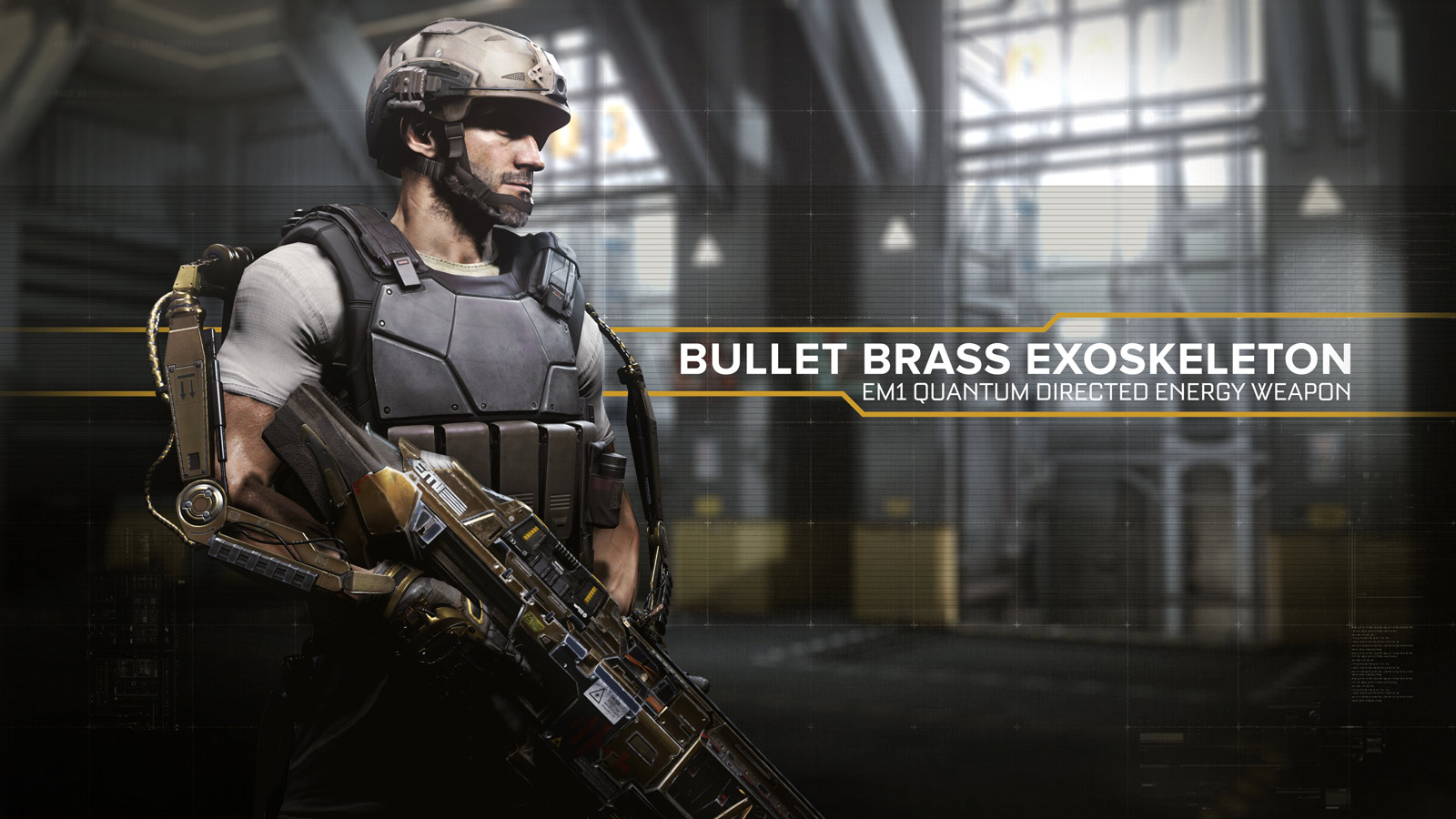


First and foremost, Titanfall's boost is about three times more powerful. The boost in Advanced Warfare only adds about six feet to your original jump, whereas the one in Titanfall takes you nearly thirty feet into the air. The other main difference is that there's a secondary boost (called a "dodge") in Call of Duty. It won't add to your altitude, but you can change direction in mid-air. It offers a shorter trajectory correction that pushes you forward, backward, right, or left. This little option has saved my bacon a bunch of times already, not to mention that the two boosts have sped up the overall gameplay in CoD multiplayer considerably. Call of Duty's multiplayers were already a bit above my head in terms of the number of people playing who seem to not only have no need of sleep, but no need of a job, family, or any of the other normal life obligations that should keep any average person from playing the game 24/7. I may not be the best gamer in the world, but my 44,095-point Xbox Live gamer score belies the fact that I'm, at the bare minimum, a competent player. And yet these guys just annihilate me like I'm a blind, deaf, and dumb 2-year-old with no thumbs. It's embarrassing, to be entirely honest. 


The Exo Abilities are basically just bonus effects that slightly aid your character in several different ways. The shield has been pretty useless for me so far. You have to have it aimed directly at an opponent for it to stop their fire, and I have enough trouble just pointing my laser-sighter machine gun at people. I can't be bothered to move a riot shield around 120 degrees to try in vain to save my worthless life. By the time I get it anywhere near the path of the bullets, I'm already dead. Overclock allows you to run at a heightened rate of speed. It's somewhat useful except for the fact that a simple jump and secondary boost does a better job of moving you along and it is more effective at moving you out of the firing line in the process. Exo Stim is supposed to give your character extra health points, but if it does they aren't enough to keep me from inevitable massacre. I'd need at least two or three of these at a time to make a noticeable difference in my kill/death ratio. The cloak is actually fairly useful at distance, but if an enemy is anywhere near you, you just look like translucent rainbow jelly. Exo Mute silences your movements, thereby making you harder to spot on enemy radar. I have yet to open up the Hover, Ping, or Trophy System Exo Abilities, but it's pretty obvious that Hover allows you to remain in the air for a longer period. Ping shows enemy Exo movement like Stim and Hover. The Trophy System is a passive aid that destroys up to two enemy projectiles when they come in close proximity to your character. 


I can't emphasize enough the speed of this game. I've probably been dying every 5-10 seconds on average. That's a bit much, even for an older gentleman like myself. The leaders who come in first place are still posting 10-15 deaths per five-minute match. Everything happens so fast compared to even the quickest of online multiplayers. On the one hand, it's a bit aggravating. On the other, it keeps you on your toes and you certainly don't get bored easily. The addition of the Boost/Dodge abilities can keep you alive when you would have easily been dogmeat in previous iterations of CoD, when used correctly. The Exo Abilities, while not the overpowering advantage that a Titan gives you over a Pilot, add just enough of an edge to help you eek out an extra kill here and there. They did a fantastic job of adding a plethora of new mechanics without completely changing up the basic way the game is played. While Titanfall and Destiny felt like totally new ways to go about the online multiplayer experience, there's something familiar about Advanced Warfare. It's like they just gave Modern Warfare 3 a healthy dose of steroids and some technological doo-dads and sent it on its way. It is certainly quicker and more stressful than any of the previous Modern Warfare games, but it isn't a complete deviation from the formula that has proven so successful over the years. I guess what I'm trying to say is they did just enough tinkering to make it feel fresh without going overboard and turning it into a completely different game. I, for one, am pleased with the outcome. 

Multiplayer Modes


First, let me get my complaints out of the way so we can get to the good stuff. I only have one strong one, and that is the elimination of Squad Modes. I was so glad when Ghosts came up with this co-operative multiplayer mode that allowed you to take on artificial intelligence with your fellow gamers rather than always facing down enemies that seemed to have been trained by R. Lee Ermey himself. I enjoyed being more evenly matched against my foes rather than feeling like I did when I was 12 and that dude who always played as Guile in Street Fighter 2 showed up at the arcade because I knew I wouldn't be winning any more matches after that. Without Squad Mode, it seems like there's always a "Ranger98" or "Seal85" who is obviously current or recently retired special forces member there to take me out from some ridiculously long distance with a shot I couldn't make by accident if I had 100 tries at it. 


Okay, enough complaining. The ability to customize your characters for your specific style of play is unprecedented. You have 13 points to spend on various perks any way you see fit. You can choose to go the Rennaissance Man route like I did and try to get a little of everything, or you can focus solely on your weapons or Exo powers and really max them out. This really is a multiplayer gamer's dream year's cap of perfection so I'll stop ruining it by acting like a baby because I suck at the stuff. Here are the offerings in Advanced Warfare

Same old, same old


Many a CoD veteran will be glad to see that lots of their old favorites have returned to the multiplayer mode list. Standards like Team Deathmatch, Domination, Kill Confirmed, Search and Rescue, and Capture the Flag are back and better than ever. For the uninitiated, Domination requires you to capture and hold one of three points around the map for as long as you can. The team that holds the most points the longest wins. Kill confirmed requires you to pick up a pair of dog tags that appears where a recently dispatched enemy met his or her untimely end. Grab the tags and you will get the full 100 points of XP gained from a normal kill in other games. Allow a member from the other team to beat you to the tags and you only get half the points a kill would normally bring. Search and Rescue is similar except for the not-so-minor detail that if you happen to be the unlucky chump that gets dispatched, you'd better pray one of your teammates gets to your tags first or you'll be watching the rest of the round from the sidelines. I didn't especially care for this game mode because, as I'm sure you've guessed, I spent a LOT of time in "Spectator Mode," watching other gamers run around the map while my sad ghost was powerless to do a thing. Capture the Flag and Team Deathmatch are pretty self-explanatory. If you don't know what they are by now, I'm afraid there's nothing I can do for you except hope your mom lets you out of the basement sometime this decade. 

New and unique

Although Advanced Warfare contained a majority of game modes that have been tried and true in everything from Halo 2 to the first Modern Warfare, it was some new twists on old modes and other never-before-seen game types that make this Call of Duty look and feel like something you haven't seen a dozen times before. 

Hardpoint


Although Hardpoint isn't a new game mode, the way it's handled is somewhat of a change from the traditional multiplayer game. As in Domination, your team is required to capture and hold a specific spot or "hardpoint" on the map. However, instead of three there is only a single spot and it is constantly moving. In my short experience with the game, I'd say the hardpoint makes at least five moves throughout the 5-7 minute long game. You can have your entire team strategically placed around a solidly held hardpoint, only to have it disappear and return somewhere completely across the map. This manages to keep complete dominance from occurring as can often happen with 2 of the 3 zones of control in Domination. This seemingly small and obvious shift in the pattern of play makes all the difference in this being just another retread and it being a new and exciting way to approach the game's multiplayer. 

Uplink


This is where the game really shines, in this writer's humble opinion. Among the new types of multiplayer mode is a highly enjoyable game titled Uplink. It's essentially Capture the Flag with some futuristic and sport-like twists in the game mechanic. One of your team members has to grab a module and carry it across the map to a satellite uplink module. It's kind of like a cross between rugby and football with lots of bullets thrown in for good measure. This was clearly the biggest change in the multiplayer game modes and felt at times like more of a sports game than an FPS competition. Of course, the other team is constantly trying to take out your ball carrier with heavy machine guns and energy weapons, but other than that it had all the makings of some sort of future-ball sport match.  

Momentum
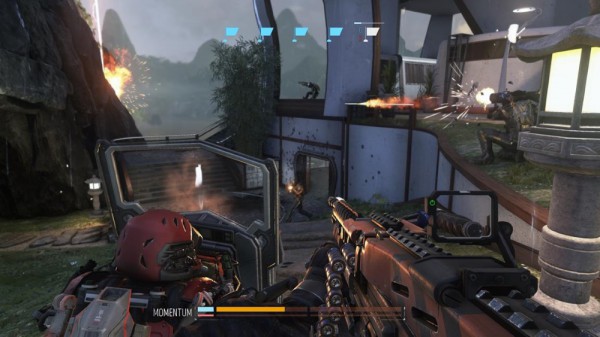


I'll be honest. I didn't enjoy this game mode as much as many of the others. It is also similar to Capture the Flag, but in it there are multiple flags and your team gains momentum (and XP) the more flags you carry to their final destination. The problem that I had with it was that I seemed to die with more frequency in this mode than any other, for some reason. I'm guessing it was the close proximity of both teams to the flag points that made that happen, but that's a regular component in most of the games where something needs to be captured and held or delivered. It also could have been that this was the final game mode I attempted and it was after midnight, so all of the kids had gone to bed and the only players that were left online were the hardcores who spend 40-50 hours per week at one online multiplayer title or another. Whatever the reason, I had trouble lasting more than five seconds with any given life and the constancy of my demise was rather frustrating. That said, the idea behind Momentum is a good one and I will definitely be giving it another chance during the light of day when the overall player skill level dips a bit more with a higher population of average FPS gamers like myself online. 

Maps


So far, Advanced Warfare is limited to four maps in its multiplayer modes, but what maps! They're large, contain a plethora of unique elements like sniping spots and close quarters combat areas, and they had sometimes as many as four or five levels on which battle takes place. With the addition of the Exoskelaton suits and their aid in three-dimensional movement, this felt every bit as widely traversable an environment as Titanfall and its parkour-like wall-running warriors. While none of the maps were quite as big as the ones in that other jet-pack toting multiplayer hit, they never felt small or confined due to the wide array of vertically varied areas that you were able to traverse. As I learn the maps more closely, as is inevitable in all multiplayers, they could begin to feel a bit more confining and limited, but in my first few days with the game I never felt like I'd run out of places to go. As a matter of fact, I only ran into the "end" of a map on a few occasions, and even then there were always at least two or three choices of where to head next so I never felt cornered in by limitations in the environment. 


 A brief summation for the gamer nation

I'll admit, I was skeptical about this game when I picked it up. I was actually planning to review Shadow of Mordor this week but it turned out to be too long to finish (as many RPGs do), so I made the decision on-the-fly to cover the multiplayer aspects of the latest in this, the most popular war simulating FPS in history. Looking back on that decision, I have no regrets. I had enough time to give each game mode its due without selling any of them short on time and I enjoyed the heck out of the experience, to boot! This isn't just the next Call of Duty game. It's a radical shift in how the franchise looks at its most popular of offerings, the multiplayer modes, and Sledgehammer's first foray into the CoD universe has most definitely thrown down the gauntlet to Treyarch and Infiniti Ward, the other two companies in Activision's new three-year development cycle for the series. I look forward to many more hours enjoying this title's unique game modes, including its fascinating take on the not-so-traditional war multiplayer.


The Math

Objective Score: 9/10

Bonuses: +1 for taking some real chances in the way they approached what has become a somewhat formulaic and predictable gaming format with only cosmetic changes being made to what was essentially the same game. Now let's hope they've taken the same approach to the campaign!

Penalties: -1 for all the dying. I mean, come on, every 5-10 seconds? I know I'm not a multiplayer super-hero who spent time in the special forces and uses actual military tactics in the game, but that's still a pretty excessive rate of frequency of death, and I'm not exactly a noob at this sort of thing, either. 

Nerd Coefficient: 9/10. Very high quality. A standout in its category. 

See our scoring system here.  

Monday, October 6, 2014

Microreview [film] : The Machine

An intruiging yet flawed low-budget sci-fi.


The poster above suggests more of a Rise of The Machines copycat than the reality of what this curious and admirable film turns out to be. However, the top quote is taking things a liiiiittle far... I take issue also with Fangoria's claim that it is "massively" cool. Pretty cool, yes. Fairly cool, absolutely. Massively? No. However, I applaud the release of any ambitious British film, at a time when most productions never see the light of day and gems get lost in the fight for distribution. This was made reportedly for under $1.5 million with U.K. Lottery funding in Wales, and yet has garnered a relatively wide release and plenty of exposure, and none of that would happen if it wasn't at least a partial success.

To run through the relatively skeletal plot here would dampen the enjoyment I gained from only having heard a few things upon its limited release earlier this year, before spotting it on a screening service that rhymes with wet bricks, and giving it a shot. However, suffice to say that a scientist is working on A.I. for the government in an under-lit bunker in some near future where China is at war with the U.K. (assuming Scotland is still with us...) and its allies. Mourning the severe dementia of his young daughter and wounded physically and psychologically by the violent results of his tinkering with veterans' brains to create super soldiers, he enlists a brilliant young American (I know, I know, but it's sci-fi; take a leap here...) to help him perfect his experiments - and help his daughter on the sly.

It's good to see that despite robot soldiers and futuristic tech that they still haven't sorted out weird British plug sockets yet
We learn all this largely through Toby Stephens, as the lead, looking pained and intense in that slightly unconvincing way of his. He shares some of his mother Maggie Smith's presence yet lacks the total immersion she brings to a role, so here again is his proud yet nervy posh man act, shorn of the smirk that worked so well in the past for him (see his villain in the Bond film so bad I am training myself to forget). However, he holds the film together from start to finish, with a quiet strength that I realised I had become impressed by as the credits rolled. Adding to this feat is that there are really only two other full roles in the film to help him - Caity Lotz as the American scientist and Denis Lawson (Wedge or Ewan MacGregor's uncle, depending on your age) as the sinister military boss. Whilst Lawson flounders in a part that requires him to spout bad-guy cliches whilst sitting behind a desk with a whisky, Lotz is a revelation. Well, to be honest, I thought she was Melissa George for the whole film as I have seen neither Arrow nor the dance battle films she began in and she really looks like her in this. Involving enough at first, as we learn of the base and Stephen's work largely through her morally-righteous experience, she abruptly changes role as her likeness is used to create the ultimate robotic lifeform. I was briefly concerned about spoilers there until I realised she is on the poster with a big bloody robot eye so the cat is out of the bag really... The lurch in her role(s) is handled relatively well, yet it does rob us of our entry into this world, and we are swiftly asked to re-sympathise with Stephens just as we started to sense some villainy at work. It's one of many uncertain notes in the plot but recovers well enough, in no small part due to the magnetism Lotz brings to the artificial human character. 

"Look, Toby, I know there is a recession on but turn some more lights on, please. Who's your electrician, David Fincher?"

By this stage the magnificently-monikered director Caradog W. James has really pulled some amazing slights of hand. As the images here hint, most of the action occurs in darkened rooms, and this is, despite adding claustrophobic intensity and sombre mood, clearly due to a small budget. What he superbly manages to do is to make a merit out of this, using lighting both on set and in post to add value and sell the futuristic world-build subtly, obliquely, without the resources for giant cityscape sets to ram it down our throat. The special effects, in particular of the robots and the body-gore, are wonderful and reminded me of the video work of Chris Cunningham. Whilst I never for a second was convinced the lead character was actually a genius who was doing believable work, I bought the setting and the detail full and its one of the best-looking sci-fi's I've seen since at least Oblivion. In addition, James and his crew immerse the slight tale and tiny cast in an atmosphere of foreboding and secrecy that serves the tension very well. We don't really need to know how they build the Lotz-robot, as we can just marvel at the clever moment of her 'birth' and enjoy the largely-effective synth score (which is probably why the poster critic thought of Blade Runner). To do all that in what was certainly a wet month in Wales with little cash is very admirable.

That's got to hurt...
However, perhaps due to this Herculean effort of creativity in some areas, many moments on the journey failed for me, with some uncertain or amateur points in the editing and the acting, due perhaps to the restricted schedule (Stephens's response to his daughter's diagnosis is a particular failure which smacks of a talent left hanging rather than a director left wanting). There is also far too much that is familiar from so many films with a robot-human role, and a lazy decision to film her often as a nude silhouette cliche. When she is blank and tough, I saw Metropolis, Terminator, Blade Runner, etc etc, and when she is scared and human I saw The Fifth Element, Alien4, Edward Scissorhands, etc, etc. It's not really the debutant makers' fault there has been so much before, but a fresh vision would at least have hidden that familiarity. However, as Lawson's evil will takes its toll on Lotz's creature and on Stephen's conscience, the two leads begin to really shine, and the film finds its voice - a cynicism mixed with a hopeful faith in humanity, no matter the form it takes. Whilst some violence at the end seems to do little than to show off the robot's fighting skills, there are many striking moments and it takes us to a satisfying yet downbeat conclusion to a flawed yet engaging science fiction treat.

Excuse me, do you have any Nivea please?

The Math

Baseline Assessment : 7/10

Bonuses : +1 for superb photography, sound design and fx; +1 for a captivating performance by Lotz; +1 for daring to have a story more concerned with morals and emotions than action and exposition 

Penalties : -1 for several leaps in plot flow, as if they ran out of time on some scenes; -1 for the undeveloped and distracting sub-plot of the weird-voiced veterans lurking in the shadows; -1 for some poor acting worthy of a short not a feature that has so much effort and imagination in other areas

Nerd Coefficient :  7/10 "an enjoyable experience, but not without its flaws"
Please observe, obey and respect our scoring rules 

Written by English Scribbler, contributor since 2013. If I were a robot, I'd be this one