Showing posts with label drugs and psychotropia. Show all posts

Monday, April 25, 2016

Nanoreviews [books]: Station Eleven, Zer0es and Afterparty


Mandel, Emily St. John. Station Eleven [Knopf, 2014]

I really wanted to write a long-form review of this book, but every attempt fell short of how I actually feel about it. Station Eleven weaves together several character studies, taking place before, during and after a postapotalyptic event. Each story is completely absorbing, and they fit together brilliantly--glued together by Mandel's elegant prose. This was my absolute favorite novel of 2014, and the best postapocalyptic novel I've ever read. Score: 10/10.


Wendig, Chuck. Zer0es [Harper Voyager, 2015]

After watching Mr. Robot: Season One, I wanted to read a novel about hackers. So I picked up this techno-thriller about a group of precocious hackers assembled by the NSA and who have to find a way to overcome their differences so they can work together, Save the Cat style. Then there's a twist and the book abruptly veers off course into quasi-science fictional horror/thriller territory. Wendig can be a very fun writer, and Zer0es can be marvelously fun at times. Ultimately, though, the book drowns in its twists, turns and desire to be very "right now." In the end, Zer0es probably would probably work better as a comic or television series. Score: 6/10.
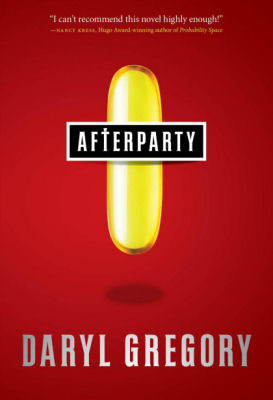

Gregory, Daryl. Afterparty [Tor, 2015]

Afterparty is a techno-thriller/urban fantasy mashup. It tells the story of a group of individuals who were part of a pharmaceutical startup whose last drug left them all with a personal "god" (i.e. a construct of the mind in the form of a supernatural being that advises and has conversations with the person in question). Now someone else has started making the drug, causing suicides and all other kinds of mayhem. To stop them, Lyda Rose breaks out of her Canadian mental hospital and rounds up her former co-workers--before the prerequisite psycho killer kills them all, that is. Sound like your kind of thing? It could have been mine, had the text been somewhat less contemptuous of religion (and religious people), and the "mind-bending" elements actually mind-bending. Philip K. Dick this is not. Score: 4/10.


***

POSTED BY: The G--purveyor of nerdliness, genre fanatic and Nerds of a
Feather founder/administrator, since 2012. 

Friday, January 24, 2014

Microreview [crime fiction]: The Heroin Chronicles


The Heroin Chronicles
Edited by Jerry Stahl
Akashic Books

The Meat

I suppose it’s the needle. I have been pondering the allure of heroin in fiction. From The Man with the Golden Arm to the most recent version of that story, heroin’s prevalence in film and fiction far outpaces its prevalence in actual society. Other drugs don’t get the same treatment. Meth is too scary; coke, for whatever reason, too comical. The only other drug that competes as a dramatic device is alcohol, but for very different reasons. Most of us know alcoholics. Most of us have been drunk. Some of us have struggled with our drinking—at the very least having had to “cut down” at some point. But heroin, elicits sympathy, rarely true empathy. This is a reality we will never experience firsthand. We can shake our heads and say “there if not for the grace of…” and not mean it. Like good Puritans.

Onto the review: The Heroin Chronicles is an excellent collection of strong, well-written, and often surprising stories. There are the kinds realist junkies stories one would expect, more often than not set in New York or Los Angeles. There’s a lot of hustling, a lot of sex work, a lot of scheming. And, when all that works, heroin. L.Z. Hansen’s wonderfully paced “Going Down” recounts a very terrifying, though not at all improbable struggle of a young junkie to find someplace to get high. “Fragments of Joe,” by Tony O’Neill, is notable for it’s macabre touches, reminiscent of The Damnation Game…but about heroin. “The Monster,” by John Albert, is an almost hardboiled, certainly violent revenge tale, of sorts. 

The Heroin Chronicles also features less stereotypical junkies. After three years of being clean, Nathan Larson’s protagonist Dos Mac—introduced in the Dewey Decimal Series, also by Akashic—finds himself looking for a score in a dystopian near-future New York in “Dos Mac + The Jones.” This is unsurprisingly a difficult task. Michael Albo’s “I Need to See a Man about a Duck,” perhaps my favorite of the book, is the comic tale of a seemingly straight-laced LA pornographer dealing with the hassles of stocking up for the weekend. Fair warning: there's a duck involved.

A couple of stories avoid junkies altogether, though not the heroin, of course. “Black Caesar’s Gold” by Gary Philips almost feels out of place: the only connection with heroin is a 1969 Mustang Fastback once owned by OG drug lord Frank Matthews. But our hero nerd’s struggle to get and then keep his hands on that piece crime memorabilia turns out to be a comical story of tables being turned.

All in all, The Heroin Chronicles is a very solid collection of stories, alternatively dark and funny, gritty but often lighthearted and sometimes poignant. In fact, the only disappointing entries were from Lydia Lunch and Eric Bogosian—the latter’s story being too insubstantial to say much about. 


The Math
Objective score: 7/10

Bonuses: +1 for junkie variety 

Penalties: -1 for Bogosian (because I generally like him)

Nerd Coefficients: 7/10

Tuesday, November 12, 2013

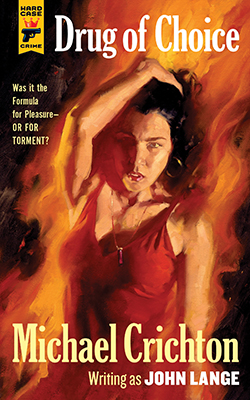
Microreview [book]: Drug of Choice by John Lange/Michael Crichton

Lange, John [Michael Crichton]. Drug of Choice [Hard Case Crime, 2013]


The Meat

Not too long ago a weighty package arrived from Hard Case Crime, one of my favorite publishers of noir and pulp. Inside were eight novels by popular science fiction writer Michael Crichton under the pen name John Lange. I'd never heard of these books before, or known that Crichton had once published pseudonymously. But apparently he did just that...while a student at Harvard Medical School. Let me just state, for the record, that this is insane. 

Later, even after Crichton became famous for books like The Andromeda Strain and Jurassic Park, the Lange novels languished out-of-print and became sought-after collectors items. Why--I'm not sure. Perhaps Crichton was embarrassed by them? Or perhaps there was something enjoyable about maintaining the mystery? Either way, Charles Addai and the good folks at Hard Case Crime managed not only to convince Crichton to put them back in print, but to re-edit the books as well.*

I decided to start with Drug of Choice, a speculative mystery about a secretive research-and-development company and its experiments with psychotropic drugs. The book is the purest pulp, the kind of thing I've often dreamed of finding serendipitously in the paperback aisle of used bookstores. Yet those adventures are often weighted down by frustrating anachronisms, like "golly gee willikers" dialogue or the sexism/racism/homophobia that was once normative but is now (thankfully) objectionable. Drug of Choice is not saddled with these burdens.

The story is tight, a thriller with just the right balance of mystery and action, and has an appealing Twilight Zone sensibility to it. The writing is also quite clear and focused. Sure, it may lack even the slightest hint of poetry or symbolism, but Crichton's prose is ultra-efficient and smooth. I read the book over the course of four days, though I easily could have consumed it in one sitting. And I mean that as a compliment.

My only real criticism is that, while a good example of pulp fiction, Drug of Choice by definition isn't really aiming to be anything more than that. It's good fun efficiently delivered, but at the end of the day, that's all it is. And the ending is a bit convoluted, though it's by no means terrible.

Still, the themes of unethical research, corporate malfeasance and manipulation of individuals should resonate in today's world as much as they four-and-a-half decades ago, making this one I unreservedly recommend to those who like their fiction pulpy.

*How much be managed before passing away in 2008 is not clear.

The Math

Baseline Assessment: 7/10.

Bonuses: +1 for being purest pulp fiction; +1 for not buzzkilling with racism/sexism/homophobia, like so many contemporaries.

Penalties:-1 for not really transcending purest pulp fiction either; -1 for the goofy ending.

Nerd Coefficient: 7/10. "A mostly enjoyable experience."