Showing posts with label Talos. Show all posts

Friday, October 16, 2015

Microreview [book]: Towers Fall, by Karina Sumner-Smith

A stirring conclusion to an excellent trilogy
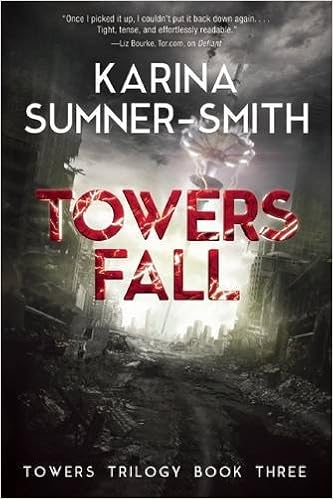

Sumner-Smith, Karina. Towers Fall. Talos, 2015.

You can buy it here in one month, starting Nov 17, 2015.

Xhea and Shai have already been through quite a lot by the point Towers Fall begins. They’ve experienced wild swings in fortune, like Xhea’s physical deterioration, especially her knee, which was more or less literally crippled during Defiant (book two), and yet they managed to overcome serious adversity and carve out a kind of improbable victory, a stability, and a stronger-than-ever friendship. Given how well, on balance, the second book ended, how was author Sumner-Smith going to up the ante for the concluding volume?

She hit upon a solid, if not totally satisfying, device to handle this: we get Xhea’s power re-bound, with she and the entire Lower City under the shadow of the Central Spire, which seems more and more sinister and even, ultimately, starkly evil. Oh no, I began to think, she’s turning the story into a morality tale with faultless heroes and irredeemable villains! But, without giving anything away, I can happily say that she neatly subverts this easy, melodramatic path and delivers a far more satisfying, because less typical, conclusion to the story.

I think this successful conclusion is partly due to the unique relational structure of the trilogy, which hangs emotionally on the obviously non-sexual (only one of them even has a body!), if not necessarily platonic, friendship and love between the amazing Xhea and the apparition Shai. Since there is no sexual conflict or love triangle driving the narrative, no one needs to be eliminated in order to ‘resolve’ the story in a melodramatically satisfactory way. Instead, they can chart a less absolutist, less violent path towards resolution. On the other hand, if we look at the story through Joseph Campbell’s eyes, taking an unconventional path towards triumph means the ‘boon’ is less cataclysmically impressive (i.e., not much stuff, on balance, gets blown up), yet the cost of this sideways victory, it is implied, is quite steep. I’m deliberately being circumspect here with my words, because it’s a book and a trilogy you should all read, and I don’t want to spoil it for you!

Sumner-Smith ramps up the relationship between the two principals, bringing them to realize that their main—their only!—reason for living (or in Shai’s case, not dying all the way) is the love and loyalty they feel for each other. They both decide they do indeed have something fighting and, if necessary, dying (for Shai, dying all the way) for: each other. It’s a wonderful bond they have, and handled well by the author, who hints at, or at least allows the possibility for a romantic dimension to their love without, of course, suggesting any actual romantic “yuri” pairing is possible (given Shai’s non-corporeal state). But then again, could there be any purer love then the kind they feel for each other? None of the messier eros side of love is even possible between them.

Perhaps I haven’t done a very good job of explaining how and why the story succeeds as well as it does, and if so, then just take it on faith: it’s good stuff!


The Math:


Objective assessment: 8/10

Bonuses: +1 for the continuing awesomeness of Xhea and an improved level of awesomeness from Shai (who finally starts to confront the vast inequalities between Tower dwellers and the hoi polloi of the Lower City)

Penalties: -1 for what I’ll cryptically call the unconventionally costly resolution (because who doesn’t want the two glorious protagonists to ride/float off into the sunset, secure in the promise of long years of happily ever after awaiting them? As readers, we desire at least the potential for stories with lots more of our beloved characters, so offering them a less expansive future stings)

Nerd coefficient: 8/10 “Totally worth your time and attention”


See details of our unusual scoring system (in which an 8 = very, very good indeed) here.


Zhaoyun, lover of love in all its forms, has been writing reviews and taking names at Nerds of a Feather since 2013.

Tuesday, June 2, 2015

Microreview [books]: Extra-Special Double-Bill! Radiant and Defiant, by Karina Sumner-Smith

An awesome sismance (the sisterly equivalent of a bromance) in post-apocalyptic magic-land!


Sumner-Smith, Karina. Radiant. Talos, 2014.
Sumner-Smith, Karina. Defiant. Talos, 2015.


Think back to the near-perfection of Terminator 2. It has it all, right? Excitement, poignancy, a bit of engagement with Deep Stuff, you name it. But have you ever thought about what it doesn't have? Romance. The main characters? An asexual cyborg, an awesome female protagonist whose worth has nothing at all to do with her attractiveness to anyone else, and a (super-annoying) prepubescent boy. The cyborg can be fatherly, and the three of them certainly come to resemble a weird nuclear family, but without the messiness of sexual attraction or desire.
With a face like this, you just know heterosexual romance is in the air

"But Zhaoyun, you're always going on and on about romance as the Best Thing Ever—what gives?" It's true, I'm about as romantic a person as there is. In sentimentality, I stand second to none: I cry at virtually anything. I'm almost as bad as that Brendan Fraser character in Bedazzled (you know the one I mean--Sunset Man!). The eternal dream of heterosexual union is near and dear to my mushy heart. Nonetheless, even for a terminal romantic like me, sometimes it's nice for books and movies to explore other dreams, and other kinds of love.

This brings us, at last, to Karina Sumner-Smith's glorious Towers trilogy, of which I've read the first two (in my defense, the third book has yet to be released!). At its core is the mighty bond of love (possibly Sapphic but seemingly asexual and, even if romantic in nature, obviously impractical!) between two young women and their very different types of magic. The first two novels are riveting (after the brilliant start with Radiant, Sumner-Smith may have accomplished that rarest of feats, actually surpassing her first novel with the sequel), despite knowing that obviously neither character is going to find true love—Sumner-Smith gently but firmly makes it clear that there is more to young women than who they're going to fall in love with, in the process throwing down the gauntlet on like 99% of cultural products nowadays (my favorite example is The Hundred, which is like a reality TV tell-all complete with webs of jealousy and almost immediate, and constant, speculation about who will shack up with whom in heterosexual bliss, but love triangles and so forth abound in post-apocalyptic/sci-fantasy fiction, e.g. Twilight, The Hunger Games, etc.).

As Vince Vaughn says in every movie, we "are [or can/should be] better than this." Ask yourself: do we really only care about characters when we can be confident they'll end up together? Is that all there is to their stories? Sumner-Smith has produced a resounding rebuttal in Radiant and Defiant (and, one hopes, a climactic conclusion in the eagerly awaited third volume!). Xhea and Shai form an unlikely friendship over these two books, and it certainly kept this reader entertained despite a serious addiction to romance and no prospect of a fix anytime in the future. Personally, I think it would have been even cooler if Sumner-Smith had taken it one step further and played with reader expectations (which, of course, will be overwhelmingly for some sort of heterosexual pairing by each novel's end) by introducing a likely male suitor only for him to suffer some grisly fate, or turn out to be gay, or something like that. For better or worse, Sumner-Smith has a far lighter touch than that, and weaves together a mesmerizing tale without the biggest crutch of all, romantic love.

To understand just how momentous an accomplishment this is, especially in this particular sub-genre of post-apocalyptic sci-fantasy, imagine that you didn't have me singing the series' praises, explaining how great and occasionally downright poetic the writing is, the delightfully rapid pacing and the extremely well-rounded characters. Instead, all you have is the following tag-line: "it's about two girls, one of whom is a ghost, and there are basically no boys in the story at all." Sound like a book you want to pick up? And the truth is, these are books we all should pick up, because it's such a wonderful series, but I have no idea how Sumner-Smith managed to convince the publishing industry to take a chance on her. I'm just glad she managed it, because this is the only sismance I've ever encountered and it's awesome!


The Math

Objective Assessment: 8/10

Bonuses: +1 for hanging a great, fast-paced story around two young women, with no male love interests in sight, and +1 for making those two young women awesome

Penalties: -1 for not sticking it to addicted-to-romance readers by playing with their expectations

Nerd coefficient: 9/10 "A standout in its category"


[Note that a 9/10 here at Nerds of a Feather is incredibly rare, and indicates the work in question is better than all but a tiny handful of all books—ever! See here for details.]


Zhaoyun, Terminator-2/sismance lover by day, regular lover by night, has been tearfully, joyfully reviewing books and other stuff here on Nerds of a Feather since 2013.