Showing posts with label Sequoia Nagamatsu. Show all posts

Wednesday, August 24, 2016

Microreview [book]: Where We Go When All We Were Is Gone, by Sequoia Nagamatsu

Its greatest fault: being too short to develop its tantalizing ideas/relationships further!
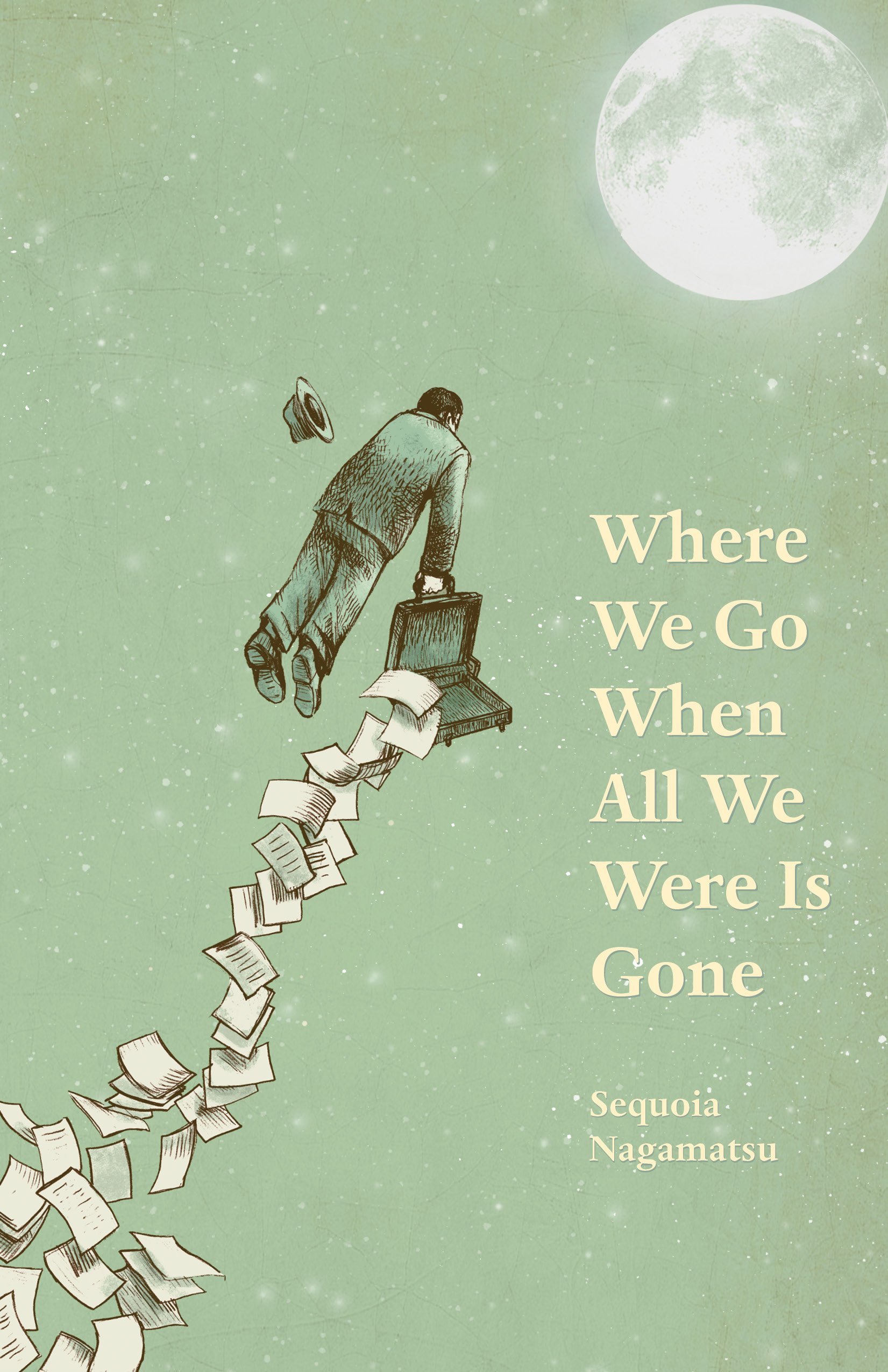
Nagamatsu, Sequoia. Where We Go When All We Were Is Gone. Black Lawrence Press, 2016.
Buy it here.


As my dozens of fans worldwide are no doubt aware, I’m generally not a fan of short story anthologies. That’s because there are only two types of short stories: (1) short stories so good the reader laments their shortness, wishing for a longer treatment, and (2) bad short stories. Ultimately, why read either one? Needless to say, I went into this assignment (and, you know, all other assignments) with a snarky, judgmental attitude.

The one glimmer of promise for this volume is that it’s a self-anthology, i.e. all short stories by the same author whose order, presumably, was also carefully considered by same, so it’s not as though it’s a typical third-person ‘throw it all in—the readers will never know the difference’ anthology hack-job.

The opening story in the volume took some time for me to get used to, but once I did, it fell neatly into category (1) above. (Not to ruin the suspense of this page-turner of a review, but I’m happy to report that actually all the stories were category (1)’s!) My reason for liking this story, about a family torn apart (in one person’s case literally!) by ‘kaiju’ (mega-monsters like Godzilla, etc.), was not so much the Japanese pop culture subject matter, though I’ll be the first to admit I like that stuff, but because of the central mystery: how, in just a few pages, did Nagamatsu manage to make me care about the characters involved? It’s written in a whimsical, nonlinear manner, from multiple perspectives, and although one of the central characters in this family drama had, it turns out, died years earlier, somehow I felt myself choked up imagining the trauma of this loss on the surviving family members. If you’d told me beforehand that I’d be crying at the end of a few-thousand-word story, I’d have chortled (a word that doesn’t get used nearly enough) right in your face, but sure enough, that’s what happened.

And it kept happening, for almost the entire collection! I began to perceive certain patterns to the stories, or perhaps to Nagamatsu’s own preoccupations: nearly all the stories (except, e.g., the one about the neck-extending yōkai and the one about the Kappa) feature a three-person family from which one person has been (usually violently) ripped away, and the stories, their supernatural content notwithstanding, are really all about bereaved family members making sense of their trauma. So even if you’re not really into the notion of, say, ghost visitations by a dead son inspiring his father to make a special fireworks display, I think you’ll find the way the father and the mother separately deal with their loss quite touching.

But that doesn’t absolve Nagamatsu of responsibility for writing category (1) short stories: almost any of these stories, in my novel-tinged opinion, would be better as novellas or novels, because that would afford Nagamatsu greater space to develop these triangular relationships more fully. So we’re back where we started, in the frustrating limbo of short story-land…let’s hope Nagamatsu will escape next time into the fully-fledged playground of the novel, because I can say with certainty that his ideas are great, and deserve longer treatment!


The Math


Objective assessment: 7/10

Bonuses: 
+1 for introducing a (hopefully!) wide audience to many of the coolest Japanese folk tales and supernatural legends, i.e. Kappa, rokurokubi, and more;
+1 for somehow making me care, in only a few short pages, about characters literally just brought to life on the page a few moments before!
+1 for the dendrophilic name!

Penalties: -1 for letting all these good ideas wither on the stupid vine of short storydom
-1 for the impossible-to-abbreviate title (a.k.a., WWGWAWWIG)

Nerd coefficient: 8/10 “It’s a bit of all right” in Australian, “kinda awesome” in American, and probably something silly like “capital” or “gobsmackingly good” in ‘English’ 


[For those unfamiliar with our draconian scoring method, see here.]

This little fireside chat (with the caveat that I’m not currently anywhere near a fire, and am not, in fact, chatting with anyone either) was brought to you by Zhaoyun, purveyor of exquisite long-form fantasy & science fiction and yes, even (ugh) short stories since forever, and reviewer at NOAF since 2013.


Extra-special bonus: +1 to Zhaoyun for using ‘chortled’

Friday, June 24, 2016

Summer Reading List 2016: Zhaoyun


Zhaoyun’s Totally Reasonable Summer Reading List, 2016 Edition

Summer is here, and that means fond memories of long-ago encounters with great (okay, probably not that great, but they seemed so at the time) books pilfered (or, you know, just loaned, mostly) from the library in the twilight before racing (more of a tortoise than a hare, to be honest) back home on my bike: the perfect end to perfect summer days! And aside from the library part, which is now out of biking range (i.e., I’m too lazy to go to libraries or bookstores or, in fact, anywhere, nowadays) I still feel there are few pleasures greater than a well-crafted, intriguing fantasy or science fiction novel to be sipped or gulped down in “those summer nights”, as John Travolta would warble. Will I get through all of these? No idea (some idea, actually: probably not), but I relish the challenge! (And that’s another thing I love: relish! Mustard/ketchup...ugh! What is it good for? Absolutely nothing!)

        
1. Pines, by Blake Crouch    

Yeah, the Matt Dillon one, but with words and pages and stuff, not Netflixery. Actually, I’ve already finished this book, and found it interesting if a bit uneven (or to put it in a more flattering light, it had a surprising structure); overall, I liked it enough to be annoyed by the subtle yet enormous changes from book to screen. I also liked it enough to add…


2. Wayward, by Blake Crouch
           
The just bearable hopelessness of the first book was intriguing enough to pique my curiosity: how will things develop in the horrid little town? How will the Burkes adjust to their idyllic prison? Is there any real future for the entire enterprise? I want to see how Crouch tunnels his way out of the dark-as-can-be pit of despair he left Wayward Pines in at the end of book one. Come to think of it, maybe he should change his name to “Bleak”…


3. The Obelisk Gate, by N.K. Jemisin

Because how could I not read it? I loved the first book in this new series (and, indeed, everything by Jemisin), and have high hopes for the second. I won’t be reviewing it at NOAF, because I’m not alone in my admiration for Jemisin, but that won’t stop me from reading it—in fact, nothing could possibly stop me!


4. Summerlong, by Peter Beagle


I’m trying to become shallower, more impulsive, and capable of baseless snap-judgments, so I base most book decisions these days on—you guessed it—the covers! Summerlong’s is delightful, and has raised my expectations quite high. But aren’t I just setting myself up for disappointment, you say? Maybe…but it’s the world’s fault for making such a pretty cover J


5. Where We Go When All We Were Is Gone, by Sequoia Nagamatsu

Intriguing title, and plus it’s based upon Japanese folk tales and legends, of which I am something of a connoisseur (or at least I aspire to be). On the potential minus-side is the fact that this is a collection of short stories (and unlike idiots like Edgar Allen Poe, I utterly reject the idea that a story should be short enough to enjoy in a single sitting—quite the opposite, in fact), but some of them are apparently about kaiju, and everybody loves kaiju! This is the perfect segue into…


6. The Kaiju series, by Jeremy Robinson


They say you shouldn’t read books by people you know (actually, I have no idea if ‘they’ say that, but I just felt instinctually like it was a bad idea), so for a long time I resisted the urge to read anything by this guy, who I knew as an older acquaintance/family friend long ago, in the halcyon days of my childhood. Then I tried reading something by him, and didn’t really like it, but it was the first book he’d written, and it didn’t seem really fair to judge him by his earliest effort (though that didn’t/doesn’t stop me from roundly condemning Patricia Cornwell and the cringe-worthy Postmortem—maybe the Kay Skarpetta series got better after that, but I certainly hope it didn’t manage to get any worse!). So I thought I’d give Jeremy another try, and somewhat randomly selected this Kaiju series. I’m a bit of the way into the series now, and am not at all disappointed—he’s really upped his game, as even if the story is somewhat familiar/well-trodden ground, the quality of the writing is top-notch, especially the “as ___ as ______” descriptive one-liners! Best of all (though not for the unfortunate characters caught by the monster thereabouts), much of the action takes place near, and a few scenes almost within sight of, my childhood home!

This list brought to you by Zhaoyun, ruthless devourer of fantasy and sci-fi novels and films since primordial times, and reviewer for Nerds of a Feather since 2013.