Showing posts with label Richard Swan. Show all posts

Friday, August 14, 2026

Book Nanoreviews: Heaven's Graveyard, The Infinite State, and The Demon Star

Heaven's Graveyard by Grace Curtis

Cover of Heaven's Graveyard

Heaven's Graveyard does a couple of unusual things for secondary world fantasy. First, it is set in a modern, industrialised world. It closely resembles the late 1920s/early 1930s in our world in both technology and geopolitics, with creaky automobiles, well-developed industrialisation, and simmering tensions between major powers suggesting a war might break out at any point. Second, it is set in the same world as Grace Curtis's previous book, Idolfire, but is not a sequel: it is in fact set 2,000 years later. Familiarity with Idolfire might add some marginal accents you'd miss if you haven't read it—the key initial motivating factor for our main character is trying to find evidence that the main character of Idolfire is real—but it really is marginal. And the accent could just as easily work the other way; a bit of context is added to Idolfire if you've read Heaven's Graveyard beforehand. Both of these things work very well for me; the worldbuilding is tight and compelling. The glint of largely absent magic in the background and some fine reflections on the nature of religion and belief add to the picture.

So the book initially looks like it will be an archaeological mystery: what happened in the past and can our main character, Cod, prove it? It quite quickly morphs into a murder mystery and then, about halfway through, takes a quite hard left turn into quite tense geopolitical drama: the whole thing feels a bit like lesbian nerd Indiana Jones and the Last Crusade. Typically for Curtis, however, the focus is not on the broader political ructions or big action sequences. Instead, the personal stakes and motivations of the core cast take centre stage.

In her previous work, I found that the personal, almost-cozy tone pulled in a different direction to the nuanced characterisation and often quite spiky, borderline cynical thematic and plot elements. Happily, four books in, Curtis has the tonal register working in harmony with all the other elements of this excellent book. This is in large part down to Cod's own spiky persona: unapologetically neurodiverse, relatable, and a bit of a mess at the same time as being extremely accomplished. A secondary plot focused on her family works fantastically to add depth and history to Cod's character. All of this is delivered—as I've come to expect from Curtis—in fabulous, evocative prose. Ultimately a hugely impressive novel from an author really hitting her stride.

Nerd Coefficient: 8/10.


The Infinite State by Richard Swan

Cover of the Infinite State

The Infinite State is an unfortunately topical book. Unfortunate, because it's about life under a fascist space empire and the compromises and sacrifices necessary to even imperfectly rebel against it, and those seem like vital themes right now. The book opens with the death of the head of a government-linked megacorporation, and the possibilities and vulnerabilities that that death opens up for his wife, Katherine. In particular, the key plot driver is her plan to buy a planet for colonisation from the galactic UN-equivalent and set up a less repressive state. Hers is one of three points of view, the others being Julian, a naïve foreign driver working in the fascist state without asking too many questions, and Cyprian, a cynical, burned-out cop both complicit in and deeply contemptuous of the state's repression. Right from the start, the atmosphere is impeccably crafted. Pretty much every single character is just waiting for the Sword of Damocles to fall; every action courts suspicion, and even the most paranoid worries have some risk of coming true. It's also a deeply patriarchal and misogynistic setting, with open homophobia and heavy coercion for women to have as many children as possible.

Unsurprisingly, given the pretty grim setup, the characters are all generally contemptible in a quite compelling way. Katherine and Julian start the book as privileged idiots who are shocked when the fash come for them too, while Cyprian and a number of other supporting characters are smart, broken functionaries within the system who commit evil in its name all the while seething—with varying degrees of impotence—to do something about it. So far, so promising, but there really is something quite lacking in its execution as a complete story.

The plot is thin and frayed almost to breaking point in places, unable to support the events and character development that hang off it. Swan jumps from (nicely done) set piece to set piece without much explanation. Some key plot events happen in an incredibly (in both senses of the word) easy manner, given the fascist state's otherwise tight control. Similarly, the worldbuilding elements outside the state—some of which are plot-critical—really don't quite make sense. The Infinite State is the first in a series, and I'm sure some of these elements will be developed later, but as a standalone proposition the book suffers from these deficiencies. A bit more thought and 50 or 100 additional pages adding character depth and connective tissue between major events really would have helped. As it is, the book leaves us in a place where I'm interested enough in the characters and in what comes next that I'm keen to read the next book, but with just a bit more attention (much of it editorial, rather than authorial, I think) we could have had something more impressive than the perfectly adequate baseline the published book presents us with.

Nerd Coefficient: 6/10.


The Demon Star by Jesse Aragon

Cover of The Demon Star

The Demon Star is an entertainingly gonzo dark science fantasy romp. We open on a shattered, hostile world with a few outposts of civilization doing only very slightly better than bare survival. These outposts have competing religious beliefs about gods and demons who must be appeased and/or fought as the case may be. Every so often there is a "harvest" where the gods descend and take people away who are never seen again, particularly those psychically talented. We expand from this setup to a slightly cosmic-horror-tinged plot of revenge, revolution, and pretty large helpings of violence. Although it isn't on the cover copy and isn't, from what I've been able to tell, what the author has said are her influences, I get strong impressions of R. Scott Bakker as written by C. S. Friedman: a dark science fantasy that isn't quite grimdark in the specific early 2000s mode.

I'm a fan of science fantasy done well, and the atmosphere and tone Aragon serves up are both great. Our two main point of view characters—a woman who was supposed to be harvested living on the fringes of the biggest city on the planet and an alcoholic, tortured priest of the city's religion—are compromised in a lot of ways, but interesting enough to maintain one's attention. There are several twists throughout that aren't quite unexpected (there are appropriate hints of what's coming) but do a good job escalating the stakes and the scope of the world.

The prose is largely straightforward, but with an appealing gothic tint to it that really works for the subject matter. The problem, though, is that it really, really doesn't feel like a complete work. Crucial character dynamics we're expected to pretty quickly care about are doled out largely in "as you know" asides or brief flashbacks. This means that key character developments feel occasionally unearned or incoherent. Similarly, several crucial bits of the political setup that undergirds both the societies in the setting and the conflict that erupts partway through are sketched so briefly as to be inadequate. Even moreso than was the case for The Infinite State, the skeleton of plot we're given just isn't sufficient to bear the weight of the characterisation and worldbuilding hung off it. There's so much that feels missing that one gets the impression of a duology cut down to a single volume in the editorial process. Again, this may well be more an editorial than an authorial issue. Either way, The Demon Star has enough glimmers of real interest and talent that I'm interested in what Aragon writes next, but for me at least does not come close to fully realising that potential.

Nerd Coefficient: 6/10.


References:

Curtis, Grace. Heaven's Graveyard [DAW Books, 2026].

Swan, Richard. The Infinite State [Tor, 2026].

Aragon, Jesse. The Demon Star [DAW Books, 2026].

POSTED BY: Eddie Clark. Professional nerd by day, amateur nerd by night. @dreddieclark.bsky.social

Tuesday, February 22, 2022

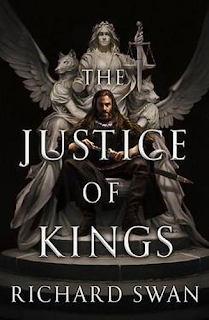
The Justice of Kings by Richard Swan is fine, if you can tolerate the utter lack of diversity

Mistakes were made

 A lot of people are going to really dig this book. A lot of people are going to find in this the exact sort of thing they read fantasy for, with all the character archetypes and plot twists and cool moments and fantasy worldbuilding they want to see in their stories. For me, however, there are several fundamentals of a good fantasy novel that are missing from this one, and I need to talk about them before I start talking about anything else:

  1. I don't like fantasy books with "man" as the default gender, and The Justice of Kings is very. VERY. full of men. Men who are soldiers, men who are nobles, men as senior political figures, men as religious leaders, men who are fathers or sons (no living mothers here), men as villains and assassins. There are a few women, fewer still who wield any sort of power and aren't there to be mad, servants, or dead. One is an antagonist who plays one specific role and then is never seen again. Yes, the narrator and sort-of protagonist is a woman, but that doesn't excuse the rest of the representation. The most mentioned category of women in this book is "whore" - but, of course, there's no sex workers with names or dialogue (silly me for even bringing that up as an option!).
  2. Related to 1: I do not like fantasy books which kill off their most interesting or powerful woman to further man pain: a technique known as "fridging". Guess what happens here. Yeah, sorry. Bonus negative points for "dead family" being the entire backstory of a second man as well.
  3. I don't like fantasy books where everyone is cisgender and heterosexual with no mentioned exceptions. In The Justice of Kings, the concept of homosexuality is brought up once, to assure us that the main character is not a homosexual.
  4. I don't like fantasy books where everyone is white. In The Justice of Kings, the existence of people of colour is brought up once, to explain to us that one of the main characters from a specific part of Fantasy Not!Europe is just a bit tanned, not actually a person of colour. As the setting here is very much "conservative backwater frontier of fantasy Not!Europe", I'm more inclined to let this one go from a worldbuilding perspective, because not many people choose to migrate to conservative backwaters. But it's still a choice and I'm still not into it.
  5. I don't like fantasy books without disability representation, and, yay! The Justice of Kings has some on-page disability rep, and includes mobility aids! Sure, they're minor characters, but that means it's not a total wipeout, right? Hmm.

So, uh, what can you do when you've got through a book like this, written on purpose in the year of our Zag 2022? If you're still here, either you're waiting for a comment section so you can explain to me how wrong my criteria are (sorry, we don't have one, but you can go collect a free block on Twitter if you like), or you're wondering why I'm bothering to talk about this book at all. So, let's talk about why I tolerated the above and came out still feeling somewhat entertained, I guess?

The Justice of Kings is, technically, the story of Helena Sedanka, an orphan from a conquered territory who is now a legal clerk to one of the Emperor's Justices, a sort of itinerant lawyer/judge/executioner. Helena's narration is told as a memoir, as she looks back on the events from the perspective of an old woman and occasionally gives ominous proclamations about how bad things are going to get, and significantly more charming proclamations about how dense her nineteen-year-old self is. Helena's account is dry, and it takes time for her to open up about herself or talk about the emotional state of other characters, and its through this style of narration that we get to know the real star of the show (and the front cover): Sir Konrad Vonvalt.

(Adri, you read a book with a protagonist called "Sir Konrad Vonvalt" and you were SURPRISED you got almost zero diversity? Yeah, look, I already said mistakes were made. I'll know better next time.)

Sir Konrad, as Emperor's Justice, is tasked with wandering around mainly in the frontiers of the Empire - territories it often just finished conquering a couple of decades ago, in the "Reichskrieg" war - and dispensing justice according to the Empire's Common Law system. With the weight of the emperor's authority, Vonvalt is empowered to hand down sentences from one penny fines up to and including death, with the only real oversight being his own conscience and his accountability to the Order of Justices. As part of his training, he has access to two magical arts, one which allows him to compel the truth from anyone he asks a question of, and one which allows him to speak to the dead, though both come with a high price tag. He's also a talented swordfighter. And handsome! At the point we first meet him, Vonvalt is portrayed as a fair and upstanding person, willing to overlook the letter of the law if he can dispense justice with a minimum of bloodshed. By the end of the book's events, he's done a lot more sword-waggling than fine-levying, and Helena's ominous older self makes it clear that that's the trajectory of things to come.

With its magistrate protagonist, The Justice of Kings wants to be taken seriously as a story of political upheaval through the lens of order and justice. My expectations when it comes to stories dealing with the rule of law are super high, particularly when it comes to administration of colonised places, but I think this story hits a lot of the right notes even if there's a lot more to be explored. There's a lot of showing how the law is inconsistently applied, particularly when it bumps up against the military strength of the church and local nobility, but we see less discussion of the enforcement of "Common Law" as a whole, and how that works in places recently acquired by an expansionist, assimilationist empire. 

In particular, we never see Vonvalt or Helena really grapple with the implications of legal events of Rill, the first location in the book, where Vonvalt uncovers widespread "draedism" (i.e. religious heresy), and goes to great lengths to avoid having to record it as a serious crime, instead levying minor fines for villagers to "renounce" their heresy and avoiding any major charges towards the Lord and Lady who are clearly also involved in the old religion. It's transparently the right thing to do: the reader knows it, all the characters except the shitty Empire religious leader know it, and the village itself is reluctantly grateful for being given just enough room to back down without total capitulation. But it's a case of Vonvalt bending the law as far as it will go to ensure justice, and it gives rise to a lot of questions about just how fair and universal this Empire's common law is, and also how far Vonvalt really deserves the characterisation of "upstanding lawman guided by impartial justice and not by his own whims" at the start of the book, and calls into question how much he really changes over the course of events. Of course, we only have Helena's analysis that he has changed, and while her narration is dry and detached in a way that makes it feel trustworthy overall, there's also a strong sense that her judgement around Vonvalt isn't exactly... unbiased. If there are aspects of Vonvalt's behaviour that are being de-emphasised or glossed over in Helena's chronicle, that sets the series up for some interesting potential twists later, but for now that's just one potential direction in a series that's still, as of the end of this book, setting the scene.

Am I going to be back to see this play out? See points 1 - 5 above: that is to say, probably not. Life's too short to read annoying books, and while I see a ton of potential in The Justice of Kings, I just don't think anyone in 2022 writes about this many straight white dudes by accident, you know? I'm sad to have to let go of a series with such an intriguing focus on law, but I'm sure there will be plenty more to pique my interest, and I won't have to play "mad, dead or unimportant" bingo with the handful of women in them.


POSTED BY: Adri, Nerds of a Feather co-editor, is a semi-aquatic migratory mammal most often found in the UK. She has many opinions about SFF books, and is also partial to gaming, baking, interacting with dogs, and Asian-style karaoke. Find her on Twitter at @adrijjy