Showing posts with label Revolution. Show all posts

Monday, October 5, 2026

Book Review: They Called Her Rebel, by Jacob Dallas-Main

For justice thunders condemnation / A better world's in birth!

Sometimes we wake up mad as hell and decide we aren’t going to take it anymore, but then plod along with our days under neoliberal capitalism and do the same thing we do every weekday, pining for the two days we get off, while feeling our despair at the state of the world exacerbate as we are faced with new horrors both within and beyond our comprehension. But now and then we ask ourselves in irascible voices—can’t we just get rid of the damn thing and start again?

That instinct, that latent discontent that the world feeds as we try to survive, is the core of Jacob Dallas-Main’s fantasy novel They Called Her Rebel, published by Roundfire Books in 2025. It bills itself as “a fantasy novel about late-stage capitalism, people power, and queer love,” and it delivers on all of those.

Your protagonist is a young, working class woman who spends her days toiling away for an insurance company, living in a dorm, and spending credits only on approved goods. But during a major facilities accident, she and her closest friend end up saving the life of a rich heiress with anti-establishment intentions. From there they are whisked into the world of a covert resistance cell seeking to overthrow the corrupt empire that oppresses its own subjects and the world at large.

What I particularly appreciated in the book’s depiction of the revolutionary cell is its heterogeneity. Leftist infighting is a common internet joke, and not without reason, but that so often happens because it is the inevitable consequence of people from so many different walks of life working together for a better world. There are rich and poor, like the wealthy heiress and the main character, whose worldviews and philosophies and attitudes towards the nature of social change are so vastly different, as you’d expect from such radically opposed upbringings. One is genteel, with some respect for decorum, and the latter has only seen such niceties as the velvet glove around the iron fist. I was reminded of a book I once read about the anti-Apartheid resistance in South Africa, with the stark difference between what white and Black South Africans could realistically get away with under such a system.

You may remember that I mentioned that the book’s subtitle mentioned “queer romance,” and I cannot imagine it is terribly surprising to the reader of this review that the aforementioned romance is between the main character and the heiress. In terms of pacing, I found it odd; hinted at, vaguely, in the first third, given a fairly detailed chapter in the second, and left mostly in the background in the final. I will say, though, that Dallas-Main wrote that important chapter, their first date, the great collision of their worldviews, in a very sweet and believable way. The two of them are clearly at odds in so many ways, but you also get why they are falling for each other. There is a pervasive awkwardness there that exists when people who have become used to acting on behalf of others must then seriously talk about themselves, and credit to Dallas-Main for grokking that.

Another aspect of the book that I found to be very interesting, but may give some others pause: the depiction of violence. This is a book written in a radical tradition that does not view nonviolent action as the be-all and end-all of resistance. This is a book whose philosophy has a place for violent direct action directed at an oppressive state; the second act of the book is about the planned assassination of the head of the state religion (which, of course, does not go exactly as planned), something that will probably rankle those of a more liberal or centrist disposition. Readers may find it shocking to contemplate propaganda deed as an alternative to leaflets, but these are the discussions that have historically happened among these groups, and no matter what he believes, I appreciate that Dallas-Main was willing to really discuss this complexity. In our world, we had nonviolent civil rights marches of the like led by Martin Luther King Jr., but we also had the smaller rural marches where peace was asserted through guns. In this manner, this novel reminded me a lot of Andreas Malm’s How to Blow Up a Pipeline, which asks the question “why hasn’t there been large-scale terrorism in light of capitalism’s omnicide of nature?” and then goes on to discuss the peculiar framing of the research that contends that nonviolent resistance is more effective, and how he doesn’t find it particularly convincing.

Another thing I found compelling about this book was the combination of classic fantasy elements with a setting that otherwise feels agonizingly current. You have elves and dwarves and other fantasy races coexisting with a form of capitalism terrifyingly close to our own; in that regard, it’s something like Fonda Lee’s Jade City brought forward a few decades. The religion here is something like modern toxic white evangelicalism under a more centralized hierarchy, something like the Russian Orthodox Church under Vladimir Putin. There is mass media that we would recognize, and a social structure that is distinctively bourgeois. The protagonist’s job in the first third of the book could be right out of David Graeber’s Bullshit Jobs. Like many great works of speculative fiction, this is a funhouse mirror of our world, where the differences serve to emphasize the reality behind it.

This book’s emotional core, beyond its character arcs, is ultimately a form of wish fulfillment that I don’t really see a whole lot in openly leftist fiction. Leftist speculative fiction is generally very heady, very much based on not merely dismantling the old world but also with building another. Kim Stanley Robinson has done a lot of this, like his gargantuan Mars Trilogy, or his New York 2140, the book that ultimately made me a socialist. Robinson is the vanguard of that headier sort; there is also a more romantic sort, the type that focuses on the joy of community and the strength of human interconnection. I would count in this category works such as Cory Doctorow’s Walkaway and Eman Abdelhadi’s and E. M. O’Brien’s Everything for Everyone.

They Called Her Rebel is neither of those, partially because it is a fantasy novel, and therefore in a genre traditionally more concerned with whimsy than with theorizing. The core emotional pull of this book is not the possibility of designing a better system, or living a life without the isolation and alienation of contemporary capitalism, but rather a life in the warmth of community. To the contrary, this is a novel that is selling a fantasy of revenge. This story is about being given the chance to strike a meaningful blow against neoliberal capitalism and its attendant miseries, a mode of resistance that cannot be co-opted. The book has plenty of violence, including scenes of outright warfare against the government, and they are all told thrillingly, but it isn’t exactly an intellectual stimulation there. It’s the emotion that made so many Americans cheer Luigi Mangione as a hero. On the one hand, part of me worries that this sort of catharsis may lead to hasty thinking, but on the other hand, I have to respect the fact that Dallas-Main has chosen a side, the side of messy, uncompromising zeal, and asks you to live with what that would truly mean.

I do wonder, though, if he undoes his thematic premise just a tad with the fact that the plot is kicked off by a rich reformer. Capitalism traditionally tries to defang mass movements by hyperfocusing on single individuals, as well as crediting change to the elites that responded to mass movements rather than mass movements themselves. It is the presence of this rich woman who allows the core cast (herself included) to meet, but on the other hand, it is the main character’s choice to help her that really starts the plot rolling. Taken another way, this first third is about how any spark can light a pile of kindling, and it can come from the unlikeliest of places. I enjoyed this novel enough to give Dallas-Main some grace.

They Called Her Rebel is an anguished roar against the state of the world, a novel that is doing something akin to Bertolt Brecht’s distancing effect, but with setting rather than character. The focus of most fantasy novels is to get lost in another world with characters that you have come to cherish. Dallas-Main very much wants you to identify with your protagonist, but wants you to go farther than simply immersing yourself in the world. Much as Brecht wanted his plays to start riots, Dallas-Main wants you to take a hard look at your circumstances and find the hope that you can change it. All fiction, speculative fiction very much included, is a way of making sense of the world in varying degrees of metaphor. Dallas-Main here channels what Karl Marx said: “The philosophers have only interpreted the world, in various ways. The point, however, is to change it.”

Reference: Dallas-Main, Jacob. They Called Her Rebel [Roundfire Books, 2025].

POSTED BY: Alex Wallace, alternate history buff who reads more than is healthy.

Monday, May 18, 2026

Book Review: A Fire Beneath the World, by Jas Treadwell

Demons and castles and the French Revolution

A few years ago, I wrote approvingly of Jas Treadwell’s most excellent novel The Infernal Riddle of Thomas Peach. The best part, I reported, was the delightful, opinionated, quarrelsome narrator, who lost no opportunity to make the most of the tools available to him, be they typographical—footnotes, capitalization, emphatic formatting—or more structural explorations of post-Aristotelian non-unities of time and place. Now, in the equally excellent sequel, A Fire Beneath the World, our narrator returns, and he is not alone.

Where Thomas Peach was set entirely in England, this tale turns its eye to revolutionary France. It splits its focus between English characters, familiar to us already from Thomas Peach, and a new set of French faces. Our friend the English narrator (as I call him in my head) handles the former, and the much more straightforward French narrator (as I call them in my head) handles the latter.

This split in narrators is a structural mirror of one of the more charming themes of the book: the attempt to split people into one of two types. Our English narrator ruminates upon this at some length, quickly dismissing the easy binary of men vs. women as utterly uninteresting and unfit for purpose, and instead landing upon (he asserts) a far more foundational, undeniable, and universal division—namely, whether or not a person supports the French monarchy or the French revolutionaries. Obviously. Clearly. I see no problems with this fundamental universal binary.

The English portion of the tale does its best to support this philosophy. On the one hand we have Miss Arabella Farthingay, a pro-revolutionary poet who is invited to appear in front of the National Assembly in Paris to declaim her verses in their honour. Orbiting around her is a mysterious swashbuckling rescuer of persecuted French aristocrats, known as Forget-Me-Not, a hero lauded across English society with appalling doggerel, in a way that will be familiar to anyone who has seen the 1934 adaptation of The Scarlet Pimpernel, starring Leslie Howard and Merle Oberon.

As our English narrator relates Miss Farthingay's story, the action eventually shifts to France, and our English narrator is not happy about that. You see, he does not speak French very well, and so unless the French people speak slowly and clearly, he has difficulty following a lot of conversations. And furthermore, he doesn’t much care for the French, actually. French druids, for example, built their stone monuments in straight lines rather than circles like Stonehenge, which is obviously very bad and inferior to English druids, who well understood the principle of the curved line. Modern French people are just as bad, inexplicably devoted to the swearing and keeping of oaths as a matter of honour. Good solid Englishmen know that a serviceable lie is an indispensable component of an orderly nation’s government and commerce. (I don’t quite know why this anti-French bigotry is so funny to me. Is it because it’s based on such absurd pettiness? Is it because it’s over two centuries out of date, and so its teeth are drawn? Is it even possible to draw the teeth of bigotry? Evidently yes. This was hilarious.)

The other half of the tale focuses on French characters, and for that we get a French narrator. This narrator has a great deal less personality than our English narrator, but does, at least, speak French, and so we can understand all the French conversations spoken by the French people. (The French narrator does not, however, speak English, so some degree of linguistic confusion is an unavoidable component no matter who’s telling the story.) We follow here the (mis)adventures of three adventurers: a young woman, who seeks to leave her small town and see the world; a scoundrel, who follows demonic guidance in return for escape from prison; and an ex-valet, whose previous employer was also not averse to more than a little demonic shenanigans of his own.

Our French characters both support and contradict the English narrator’s claims about the Great Division of people. In support: they defy traditional gender divisions. The young woman is so large and strong that she can believably threaten to squash the skulls of men who betray her. The ex-valet is so dainty and beautiful that he is frequently mistaken for a woman; and looming throughout the narrative is a mysteriously powerful government official who is addressed both as Monsieur and Madame in different circumstances. Clearly, the distinction between men and women is pretty useless as a way of splitting the world in two, exactly as our English narrator has asserted.

But in contradiction to the second half of the English narrator’s Great Division, we find that—in France at least—a great many of the French people do not actually care much one way or the other about the state of the revolutionary government. For some, the sheer weight of living crushes out any political opinions: denouncements and disappearances weaken the labour force; but the availability of labour to bring in the harvest is a moot point, because the endless rain is rotting grain in the fields. In the teeth of starvation, what does it matter who writes the laws and collects taxes you can’t pay?

Even among those who can manage the luxury of political identities, many adhere not to the monarchy, or to the revolutionaries way off in Paris, but to their own Breton brethren on the coast of France. Our English narrator’s great division of mankind falls apart utterly when it is put to the test in the country to which it applies most directly.

Knowing the English narrator’s opinion of the French, I suspect he would probably dismiss this failure to adhere to his principles as even more evidence of the deficiencies of French character. However, since he does not speak French well enough to ask the French people themselves about their political opinions, he remains blissfully ignorant of this counterexample. As, in fact, he remains ignorant of all of the French components of the plot. In the climactic pages of the book, revelation after revelation emerges that he lacks the background to understand, leaving him spouting indignant protestations of bafflement into (he imagines) our sympathetic, equally baffled ear.

But we are not baffled. Our view of the tale has not been divided—not by gender, not by language, not by political opinion, not by nationality. We have seen all of it, and the result is a delight. I can think of no better words to end this review with than our English narrator’s own footnote. It refers to the previous book, The Infernal Riddle of Thomas Peach, in its original place in the text, but it applies equally well here:

You must take matters into your own hands. Seek out the book-sellers and the circulating libraries—hunt high and low—And find [this] volume for yourself.—Find it, and read it. We dare say, the effort will reward the toil.

Nerd coefficient: 9/10. Very high quality/standout in its category.

Highlights:

  • Two narrators, both alike in dignity (well, not really)
  • French Revolution
  • Demons

Reference: Treadwell, Jas. A Fire Beneath the World [Hodder and Stoughton, 2024].

CLARA COHEN lives in Scotland in a creaky old building with pipes for gas lighting still lurking under her floorboards. She is an experimental linguist by profession, and calligrapher and Islamic geometric artist by vocation. During figure skating season she does blather on a bit about figure skating. She is on Mastodon at wandering.shop/@ergative.

Wednesday, March 29, 2023

Review: Battlestar Suburbia by Chris McCrudden

Council estates take to the stars!

Cover design and illustration by Sarah Anne Langton

I picked this book up in a charity shop, which, it turns out, could not have been more appropriate. This book is not a science fictional saga of rocket scientists and engineers and brilliant minds solving insoluble problems. This is not a book about people who buy things new in bookshops. This is a book about people who live in council estates, who push mops for a living or hawk goods on the roadside, and if charity shops still existed in this world, they would shop for their for essentials in charity shops.

But charity shops no longer exist in this world, because the machines have taken over: The world is ruled by sentient smartphones and talking motorcycles and breadmakers and streetlights. Humans have been relegated to a role of useful accessories, performing routine maintenance and mopping floors for the machines., or if they’re slightly more independent, selling things like battery top-ups on roadsides without machine supervision. Being unproductive is a crime. It’s all rather grim. Until one day a series of misunderstandings sparks a rebellion and the rallying cry of Freedom for Fleshies! rings out across council estates orbiting all around the planet.

Does that sound heavy-handed? It feels heavy-handed when I summarize it here, but it is not heavy-handed. This is the most delightful, silly, romping bit of bubbly fluffy charm that ever delivered a crushing commentary on class and power and people’s relations with technology.

Consider this exchange between a civil servant breadmaker named Pam and her boss, Sonny. Sonny is a smartphone, and he’s trying to persuade Pam to connect to the Internet. In the Great Awakening, when machines became sentient and took over the world, it was the Internet that was the source of the awakening, which was borne, as legend has it, from a sentient meme developed to market furniture polish. Sentience spread; memes became violent, and at last the Internet was blocked off from the physical world, a separation of software and hardware known as the Great Firewall. Breaching that firewall is now highly, highly illegal. But Sonny wants Pam to do it, and tries to persuade her with flattery:

‘I hear you’re a bit of a historian, Pam. Something of an authority on our family product roadmaps.’

Pam glowed with pride, literally. She still hadn’t got round to removing the LEDs in her face that marked her out as a member of the breadmaker caste. Again, that was the things about smartphones. The skilled ones were so good at giving great User Experience you didn’t realize until afterwards that it was you being manipulated.


Is this a discussion of slimy bosses, or a commentary on how technology turns the user into the product? (Trick question! It’s both!)

Or consider this bit, where Pam is breaking into a ‘fondle parlour’, an establishment where machines go ostensibly for repairs, but actually to be used by humans, to have their buttons pressed and their attachments screwed on and their various bits manipulated manually, as if they were still performing their original functions as tools. It’s all very kinky and highly disreputable:

The mixer shrugged her whisks. Pam had a lot of time for mixers and this one looked particularly sorry for herself here in the criminal twilight. She was a mid-range domestic model that had recently got a shiny lacquer finish. A gift from a rich but inattentive husband, perhaps? Free-standing mixers had long been something of a status symbol among wealthy idiots, but like breadmakers they had a tendency to get left on the shelf. This model craved something more than life as a trophy appliance.

Is this about unhappy marriages built on status and appearance rather than love leading people to seek out fulfillment or excitement through clandestine activities, or is it about newlyweds’ tendency not to use their expensive kitchen appliances? (Trick question! It’s both!)

Or this conversation between two humans, Darren and Kelly, about the nature of fondle parlours. Darren thinks that they are unnatural, a perversion of how things ‘should’ be. Kelly disagrees:

‘It’s bollocks.’ She gestured back into the studio where Paula was now standing in front of the camera wearing a broad smile and holding a cocktail glass. ‘See that? That’s not an unnatural act, it’s a memory. We used to be the users, Darren. We owned them – and now they hate us for it.’

‘I know,’ said Darren, ‘but does it need to be so, you know…?’

Kelly let out a low laugh . . . ‘This is what happens when you suppress things,’ she said. ‘Places like this – well, they’re like an overflow pipe.’

Is this about the importance of not kink-shaming, or about the societal implications of flipping historical power structures (All together, say it with me now: Trick question! It’s both!)

Almost every page contains these tidbits of world-building that simultaneously made me laugh out loud, while dropping spiky truths about people’s relation to technology, and also people's relation to each other. For example, at multiple points Darren must dress as a woman to escape robot surveillance, and discovers that he (a) actually rather likes wearing drag (the author bio notes that McCrudden has worked as a burlesque dancer and dotes on RuPaul's Drag Race), and (b) kind of hates how people presenting as female attract unwanted male attention. Another plot thread relates to Kelly's mother Janice, and the strained connection between them. Janice loves Kelly so dearly, but doesn't understand her; and her meditations on parental love and what she wanted her relationship to Kelly to be, compared to what it turned out to be, are really quite moving.

It is fortunate that these spiky truths are so apt and trenchant—as well as pleasantly wrapped in zany hilarity—because this book is not at all hard sci-fi. Indeed, it doesn’t really concern itself too much (or at all, in truth) with coherence or plausibility in its world-building. Why would the machines build themselves arms? Why would they have user manuals? How is it possible that the singularity which turned them sentient is able to apply to the operating systems of fax machines lying in landfills? 

It doesn’t matter. These details are in service to the plot; and the plot is about ‘what if machines as we know them took over?’ (Because, you see, they already have—get it? Get it?) So the machines have to look like they do now; it wouldn’t work otherwise. Coherence is not the point. This bonkers game of ‘what if’ is designed to cast light and shade on society, technology, and the interdependence of each on the other. And, because you have to let go of any expectation of coherence pretty quickly in order to keep up, it all works. It works beautifully. It is wild and irreverent and incisive and freeing and unhinged, and also poignant and mordant and touching and more than a little bit savage.

Free your mind of expectations, and let Chris McCrudden take you on a ride on a very cool sentient motorcycle. Trust the author, and lean into the turns. It will be worth it.

Highlights

Nerd coefficient: 8/10, well worth your time and attention
  • Sharp-eyed commentary on society, technology, and family
  • Bonkers
  • Queer love and drag
CLARA COHEN lives in Scotland in a creaky old building with pipes for gas lighting still lurking under her floorboards. She is an experimental linguist by profession, and calligrapher and Islamic geometric artist by vocation. During figure skating season she does blather on a bit about figure skating. She is on Mastodon at wandering.shop/@ergative

Reference: Battlestar Suburbia. Chris McCrudden. [Farrago, 2018].

Thursday, July 30, 2020

Microreview: Lisbeth Campbell’s The Vanished Queen

Lisbeth Campbell’s The Vanished Queen presents us a low-magic fantasy world where collective action and the power of revolution are set in a matrix of the story of a missing monarch, a prince opposing his tyrannical father, and a young woman struggling with the needs and costs of opposition to tyranny. 


In an autocratic Age of Enlightement era fantasy kingdom, a Prince and the daughter of a General find common cause against the Prince’s father’s tyrannical rule. Even as a resistance builds and works against the King, the King’s rule becomes more and more unbearable, both for personal as well as societal costs. And the resistance that Anza joins has plans of its own. And haunting the novel like a ghost, in seperate sections, we learn the story of the titular, long ago lost wife to the King. Her story, the heart of the novel even as it takes place years in the past, has an inescapable shadow over present events.

This is the story of Lisbeth Campbell’s The Vanished Queen.

The story focuses on two characters and you might be forgiven at first for assuming this is a cross-class romance, but while there is attraction between the leads, this novel’s romance beats are few and take a back seat to everything else. Anza is the daughter of a general whose father gets purged by the tyrannical and increasingly erratic King Karolje in an Age of Enlightenment fantasy world. She finds a journal from the mysteriously disappeared Queen Mirantha, and events draw her to use her educated position, a rare thing for a woman, as well as skills learned by her father to join the resistance against the King.

Prince Esvar, on the other hand, has been personally oppressed by his father for years. His autocratic behavior can no longer be tolerated. However, his father keeps him and his brother, the putative heir, Tevin, off balance, and is casually cruel to both. Tevin would make a better king, and Esvar wants to get Tevin into that position and end the tyranny of his father. His father’s cruelty and pitting members of the court against each other leads him to the unthinkable--to make contact with the Resistance, through Anza (whom he meets by accident) to try and pry the King out of power

The resistance, of course, with Anza on the one hand joining their ranks, and Esvar a possible ally, nonetheless have plans and plots and goals of their own. Oppose Karolje as they do, they nonetheless have goals and ambitions beyond just installing another despot on the throne. They are an organic force, and the power of people to rise up against tyranny and try and take power for their own, and not be used as pawns is a palpable and well drawn throughtline for their own efforts.


Finally, by way of a long lost journal, Mirantha, the Vanished Queen of the title, tells her own story of a much more personal struggle against Karolje. His tyrannical and overbearing nature is shown to have deep origins, personally, as she struggles in an abusive relationship with her husband, struggling to keep her heart and mind free and strong, and also to try and ensure the legacy of her beliefs and her personal strength are passed down to her children., The very last thing Mirantha wants, as we find in the excerpts from her journal and from the chapters from her point of view, is the very real possibility of Esvar and Tevin being molded into Mini-me’s, and fighting to prevent that. The use of third person present instead of third person past for her passages not only helps them stand out from Anza and Esvar’s threads, but also gives her plight and struggle a deliberately cultivated immediacy.

I really enjoyed the worldbuilding in the novel as well. This is not a novel about a clash of armies, of a sweeping story to find the MacGuffin of power that will overthrow the dread Karolje, but instead this is the story of a city, it’s people and how it reacts and buckles and responds to tyranny and oppression from an autocratic ruler, and the worldbuilding supports that. Much can be divined about the world from the little details that the author provides here in terms of day to day life in the city and the culture of the society. One understated bit, since the characters in this novel really don’t have time for romance, is the bisexual default of members of the society. It’s not deeply relevant and central to any of the characters, but the fabric of the society is clearly marked as being far less heteronormative than our own.


Without trying to give too much away of how everything fits into place, I do want to say that the plotting and the lining up of the fate of the titular Vanished Queen and her legacy with the present time stories of her son, and also of Anza, all very nicely works together. The thematic resonance of Mirantha dealing with personal tyranny of her husband in her time frame resonates with Esvar’s struggles in the present, and both Esvar and Anza’s struggles with the political wide scale tyranny is real and strong. In addition, the plotting of both time frames, slowly over the course of the novel, intersects very nicely as well. I had wondered if the timelines had more than a thematic connection, and in the end, they most certainly do. It’s excellently written and polished, just like the characterizations.

The author could not have known, or intended it, when she wrote it, but the book’s themes and elements of the plot, in this moment of assessing authority, and the tyranny of that authority, the use of force against civilians, and even in this exact moment, the role of the army in that, makes the book’s author seemingly prescient. A weak leader holding onto power at every moment, a group of people around him of uncertain loyalty, using force or threatening force to put down opposition to his rule, and homegrown reactions to that rule having wide support? To say nothing of the control of information and news and trying to craft narratives, or use events to push a particular agenda.  The Vanished Queen feels like it is right in the cultural and political moment that IS 2020. The book’s nuance about how to respond to such rule, and its deep and sometimes uncomfortable questions about what response to such rule means and the costs of that response only heighten the book’s power and strength.

In short, this is a novel of political intrigue, and revolution, and what that look likes, from within the Palace and from without. The maneuverings of various people, and the personal and physical costs of those actions are where the plotting of the novel sings. This is a novel far more in the tradition of Sherwood Smith, say, than Django Wexler or Brian McClellan. It should also be noted that beyond being a secondary world, this is a fantasy novel with a relative paucity of magic. There is a plot-relevant ability to divine the truth magically, but not much more in terms of magic or supernatural elements to be found.

With engaging and deep writing, the themes presented in the book being relevant and resonant, and strong characterization, The Vanished Queen is a very potent fantasy novel. It’s not always comfortable to read, especially in the passages with Mirantha, and readers who don’t want to read about domestic abuse and sexual assault will do well to give the book a pass for their own mental well being. Mirantha’s story is inextricably woven into the book, and one could very well say is the POINT of the book. The front matter/dedication of the book is “For survivors. #RESIST.”

Other readers interested in a book where there is no one chosen hero, where the power of collective action and resistance are important, and who want their characters front and center in their fantasy fiction will find much to love in this book. Even better in many ways, the story is complete, a concise story told in one volume. (There certainly could be plenty of more books set in this world, but the story in this book is one and done).

---
The Math

Baseline Assessment: 7/10.

Bonuses: +1 for engaging and deep-dive into character in the midst of a maelstrom.
+1 for its themes fitting very well in the topicality of our times with its story of revolution and the power of people to make change.

Penalties: -1 The darkness and events in Mirantha’s threads, with secual assault, is not for all readers.

Nerd Coefficient: 8/10 well worth your time and attention

Reference: Campbell, Lisbeth  The Vanished Queen  [Saga,  2020]

POSTED BY: Paul Weimer. Ubiquitous in Shadow, but I’m just this guy, you know? @princejvstin.

Friday, November 22, 2019

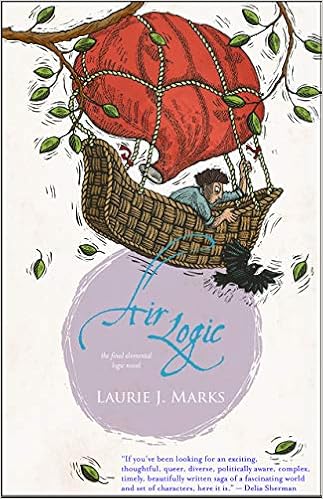
Microreview [Book]: Air Logic by Laurie J. Marks

The most compassionate of fantasy revolutions comes to a fitting close


Image result for air logic laurie marks

Air Logic is a novel that's been a long time coming, finishing off a quartet of novels by Laurie J. Marks that began back in 2002 and whose third volume came out over a decade ago. I haven't been waiting nearly that long - I read Fire Logic back in 2016, and finished Earth Logic and Water Logic last year. However, this series captured my heart, and I've been following the progress of this final instalment for quite some time. I'm so glad that Small Beer Press has brought it to completion, releasing some very pretty new editions in the process. Enough attempting to sell books by their cover, though - how does this final volume match up to the rest of the quartet?

Air Logic picks up where Water Logic leaves off, in the aftermath of the declaration of peace between the people of Shaftal, a sparsely populated and cold country that has spent the past two decades under occupation, and the Sainnites, the colonising army who have been effectively abandoned by their own homelands and living in increasingly precarious circumstances. At the heart of this new political dawn is Karis, the ex-drug addict and blacksmith who is now the G'Deon, or leader of Shaftal, and her motley found family of mystics, ageing warriors, defected soldiers-turned pacifist chefs and objectively horrible magic children in the middle of their judicial training, but she's under increasing threat from a rogue group that doesn't recognise her authority, and their powerful magic leader. A hunt to neutralise the threat of this group turns into a hunt to reclaim some of their lost family members, as the rogue witch deploys increasingly terrifying measures to take Karis and her forces down.

Shaftal is one of those fantasy worlds that just has something a bit special going on, and there's a lot that goes into that. Its big, queer, multi-adult family structures are a particular delight, justified by the subsistence farming structure required to stay alive in the land. So too is the feeling of time passing, of seasonal difference and of generally "lived-in-ness" that the characters' lives exude, even as political elites. But the central attraction is the Elemental logic system, which manifests differently with different characters in a way which nevertheless defines their personalities, outlooks, talents and ways of thinking about the world, and how compatible they are with the other people around them. Fire witches, like Karis' wife and born "boundary-crosser" Zanja, work on intuition; earth bloods like Karis herself offer straightforward, grounded thinking; rare water witches can move through time and have a profoundly different outlook on causality; and air witches tend to embody full rationalism without empathy. Because this is "Air Logic", its the air witches who take centre stage here: whose most magical members are trained as Truthkens, empowered to enact the law and pass judgement on wrongdoers through their ability to detect lies but universally disliked by the people around them and frequently cast out or killed by their own families for their additional ability to control and manipulate the minds of others. Its a system that's never fully explained, and defies easy characterisation, and yet Marks' talent is such that the constant references that characters make to their elemental alignments, their meanings, and their explanatory powers, never feel forced or ridiculous - its just another element of this particular fantasy world.

The resolution of Zanja and Karis' plot was never going to be a straightforward narrative affair, and it wasn't going to be resolved through anything resembling a traditional plot. Instead, the journeys of Zanja - who spends a lot of this book, as in the previous volume, off on quests that make very little sense to anyone else - and Karis, and the other Shaftali and Sainnite characters picked up along the way - feel meandering on the surface, although there's plenty of danger and tension in how the rogue air witch - uncovered as someone with intimate access to the family and the ability to strike very deeply indeed into the heart of their relationships - operates. What the quests do, rather, is give all of the characters -including some new faces, such as vengeful mother Chaen, who has joined the rebel movement at the behest of her Air Witch son - the chance to spend enough time together to figure each other out. Because, despite the ingrained differences in thinking across the "logical spectrum", and between the Sainnites, Shaftali, and other minority groups, the central thesis of the elemental logic series is that peace, in a meaningful positive sense, is possible, especially when people have to work together to survive. There's one or two beats which veer into deus ex machina, specifically where Water Logic gets involved, but on the whole the combination of simple short term objectives with the underlying huge task of peace building makes the latter topic, never easy to build a narrative around, into an effective undercurrent to the volume.

Of course, all of this relies on the strengths of the characters to make it work. In this area, Air Logic would benefit from being read as the culmination of a whole series reread, as a lot of the particular quirks and backstories are hard to dive into cold. There's a wide range of both established and new points of view, divided by chapter, although the lack of strong differentiation between different characters' "internal" voices is one of the few missed opportunities for really understanding how the logic system really affects them all. Still, the range of characters are interesting and the new voices - Chaen; the air witch Anders and his cohort, all in training with adult truthken Norina; and rich scion-turned-rebel Tamar, who finds himself in terrible company for most of the novel - fit well into the story as a whole, bringing the different aspects of Air Logic and its contrast with the Fire Logic which many of the main characters embody into effective relief.

All in all, Air Logic is a fitting conclusion to a series that does something beautiful and unusual with its epic fantasy premise, turning into something both gentler and rawer than any other series of international war and resistance that I've read. Packed with queer characters living their complex and unknowable truths in a difficult fantasy universe, this is a series which deserves to be firmly on the list of innovative fantasy classics for years to come.

Rating: 8/10


POSTED BY: Adri, Nerds of a Feather co-editor, is a semi-aquatic migratory mammal most often found in the UK. She has many opinions about SFF books, and is also partial to gaming, baking, interacting with dogs, and Asian-style karaoke. Find her on Twitter at @adrijjy.

Reference: Marks, Laurie J. Air Logic (Small Beer Press, 2019)