Showing posts with label New Orleans. Show all posts

Wednesday, July 20, 2022

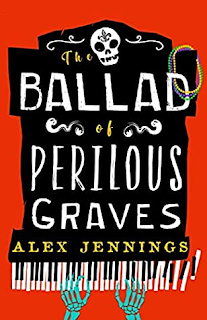
Microreview [book]: The Ballad of Perilous Graves by Alex Jennings

A magical, musical adventure with a strong dose of chaos


Welcome to New Orleans: well, sort of. The Ballad of Perilous Graves drops us not in the city of our own world, but in Nola, a city full of magic and music (and a lot of musical magic), which at once feels like it must be New Orleans, while also being... something weird and new. This distorted city is home to the titular Perilous Graves - usually referred to as Perry, perhaps because he doesn't seem to quite fit the vibe of a "Perilous" just yet - and his sister Brendy, as well as their friend (and Perry's crush) Peaches and a cast of parental figures, ghosts, musicians, and a combination of the three. But something is going wrong with the rhythm of Nola, something which seems to threaten the city's very existence in ways that don't make sense to our young protagonist. In good old adventure fashion, though, it's up to  Perilous, Brendy, and Peaches to right these mysterious wrongs, bringing back the songs of power which keep the city running. Meanwhile, in a city that really is called New Orleans, a man called Casey returns to his hometown years after leaving (in the wake of Hurricane Katrina) to track down what happened to one of his old friends, and confront the weird, possibly magical, events that led to his departure.

All of this unfolds into a very rich, strange fantasy world, one infused right through with the spirit of New Orleans - which, while not a city I'm familiar with, is one whose reputation and aesthetic is very much recognisable all the way through this book. Nola is also packed full of casual magical elements, most of which exist purely to make the place feel more: trams float in the sky, haints drive taxis, and Peaches, the Graves' best friend, is super strong and lives with a ghost in a strange old house. Jennings doesn't spoonfeed any of this worldbuilding, nor does he concern himself until much later in the narrative with making sense of Perry and Casey's dual cities. Instead, the reader is left to feel out the boundaries of this fantasy and its rules as we go along, in a move that's frequently confusing and demands a lot of attention, but makes for some really magical storytelling as it goes along.

What really makes The Ballad of Perilous Graves different is how that sense of magic shifts and evolves as the book goes on, from something which feels like an adult take on classic kids' adventure fantasy into something more complex and mature, even as it keeps the fun of its early magic in mind. In particular, magic is very linked to the characters who perform it: for example, early on, Peaches tries to explain how to fall without being injured to Perry, by suggesting that he "drop out" of the high fall at the last minute and fall from lower instead. It's a concept that baffles Perry - and which has that delightful "semantically that makes sense but... no" vibe to it that's right at home in children's fantasy (like The Phantom Tollbooth, which gets a couple of shout-outs here) - but it makes sense in Nola because it makes sense for Peaches, this overpowered and undersupervised youth, to be able to do that kind of thing. Similarly, Perry and Brendy both receive personal magical items within the first third of the story, which feels quite early for these types of quests to wrap up, but it means that they have these encounters at a point in the story where their world is just beginning to get more complicated. It's how they use their items in the world they live in, discovering more about that world and their place in it, that becomes the real story here, and it's really interesting how Jennings manages to make that transition from "juvenile" into adult work for his young protagonists. 

It helps also that the characters are great fun, and while it's Perry on the front page, his younger sister Brendy gets plenty of time to shine too. Casey's story is intriguingly separate from the other three for most of the book, and is important for the way it grapples with the realities of New Orleans, and particularly the devastation of Hurricane Katrina - Casey is also a trans man, and that affects his past relationships and his decision to leave the city in the way he did as much as the hurricane and his experiences with magic did. I could happily have read more about Casey, and his eventual tie into the main plot wasn't as satisfying as it could have been for me - but he's still a great character and his older, non-magical presence juxtaposes really nicely with the kids particularly in the first part of the book.

Things do begin to make more sense in Nola eventually, though it's not until we spend more time with older characters in the book's second half that we start to understand how this version of the city fits in with Casey's New Orleans. But even then, The Ballad of Perilous Graves keeps things loose and chaotic as it moves towards its big showdown. Some of this chaos is, frankly, hard to follow: I found myself getting confused often, and sometimes that confusion felt like more than standard for "this is a book that's trying to do a lot, is set in a culture that I'm not personally familiar with, and its not spoonfeeding me anything". I struggle to put my finger on what it is about the style or story that causes this - perhaps if I'd read through in a single sitting instead of spreading it out across a week? Whatever it is, it's always frustrating to come out of a book feeling like you didn't get the full experience out of it, and not even understanding why it caused that reaction, and I honestly can't say whether it's my fault or the book's fault - or both? Who knows.

Despite that frustration, though, The Ballad of Perilous Graves is a book well worth reading, and one which I'm glad I persevered with even when it was confusing the heck out of me. I'm really intrigued as to what Alex Jennings does next.


Adri (she/her), Nerds of a Feather co-editor, is a semi-aquatic migratory mammal most often found in the UK. She has many opinions about SFF books, and is also partial to gaming, baking, interacting with dogs, and Asian-style karaoke. Find her on Twitter at @adrijjy 

Friday, July 27, 2018

Microreview [book]: The Black God's Drums by P Djeli Clark

The Black God’s Drums is an interesting window into a character and her Steampunk-with-touches of magic alternate New Orleans


Creeper is a teenager living on the streets of an alternate 1880’s New Orleans, often spending time near Les Grand Murs, the huge wall used as a airship dock in this world’s version of the Big Easy. Creeper has big dreams of being crew on one of those big airships, but to get a chance at that, Creeper is going to have to help the captain of one of those airships stop a plot to unleash a devastating weather weapon designed by a Haitian scientist and coveted by the Union, Confederacy and everyone else.

Welcome to the world of P Djeli Clark’s The Black God’s Drums.

Creeper makes for an appealing and strong protagonist. The book doesn’t really feel like YA story to me although it has some traditional elements of that. The youth of the character, the coming of age story, the relatively breezy pace, and the general tone do earmark it in that direction. There is plenty here for readers of all ages to sympathize and identify with her, as she learns to really understand her connection to the orisha, Oya, and her own other talents besides. Captain Ann-Marie, of the Midnight Robber, is every inch the steampunk airship captain that can and does serve as an exemplar and a role model for Creeper, and a character with her own agency in her own right. I wouldn’t mind a novella from *her* point of view.

The real richness of the novella is it is delight in invention, with an eye for creating a world that is rich for the potential for story and adventure. From the palpable existence of very active orishas, to an alternate history with a Confederacy, Haiti as a Caribbean power, and, naturally, airships, the world that Clark has created is a fascinating one that we only get a small short-novella taste of, but I want to read more of. The vision of New Orleans as a freeport where the Union, the Confederacy, Haiti and other powers all meet and trade, complete with extensive airship facilities is a compelling and fascinating one. There are hints that the world beyond what we see is similarly not the one we know, either, but really, Clark could tell many stories just in the North America and Caribbean around New Orleans. There is just simply a lot of canvas here for the author to unleash her protagonist and other characters upon.

My major beef with the novella is that for the story it is trying to tell, which does have a sequel hook in the offing, is that it feels a little bit breezy and short for all that. The line by writing is very good, crisp and neat, and I was intrigued by that world we see. But for all of that, i think there could have been a little more meat on the bones of the story. While leaving a reader wanting and wishing for more is always a good hook for future stories and novels, it is more frustrating when it comes to the actual story being told. I wanted more “there there” on the story I was getting. It’s not a complicated or particularly twisted story, it is a clean and straight story that feels more like a long novelette than a pitifully short novella. I also am of the opinion that while short stories and novelettes can do “one thing”, by the time you get to novellas, having an additional subplot or two helps enrich the characters and the world. This novella is lacking in that regard

That said, I found the world depicted here to be an intriguing one, and if that sequel hook in this novella does pan out, the promise of this first novella can be completely fulfilled in a subsequent, and hopefully more substantial work.

The Math
Baseline Assessment 7/10


Bonuses : +1 for a stunning and immersive alternate world with a ton of potential.


Penalties : -1 for being far too breezy and short for the story being told


Nerd Coefficient: 7/10. An enjoyable experience, but not without its flaws

***


Reference:  Clark, P. Djeli:  The Black God’s Drums [Tor, 2018]

POSTED BY: Paul Weimer. Ubiquitous in Shadow, but I’m just this guy, you know? @princejvstin.

Wednesday, September 30, 2015

Interview with "Bloodthirsty" Comics Writer Mark Landry


Today, Titan Comics releases issue #1 of Bloodthirsty: One Nation Under Water, the debut title from writer Mark Landry, illustrated by much-lauded artist Ashley Whitter (Squarriors, Interview with a Vampire). Mark is a Louisiana native who, for the last ten years since Hurricane Katrina, has been trying to find the right story to tell about that disaster while simultaneously building a career as a film and television writer (notably, of the Disney Channel movie Teen Beach Movie, which is a 180-degree tonal shift from Bloodthirsty),

When he had the idea for Bloodthirsty fully formed, he took to Kickstarter to help make the vision a reality. Despite getting successfully funded, there have been many roadblocks and lessons-learned that threatened the project ever seeing the light of day. Mark has been more open about these challenges than many Kickstarter creators, and discusses those elements, along with the genesis behind the new comic, the gulf between Disney TV fare and gritty comics for engaged, adult audiences, and why vampires aren't scary with Nerds of a Feather.

Nerds of a Feather: You're a Louisiana native, and you talk a little in the introduction to the first issue about the inspiration behind the book and what made you want to tell this story after Katrina. That really spoke to me because I was in the same boat -- I was a Gulf Coast native in L.A. when the news broke. I remember that sense of helplessness, and I feel like I understand your drive to contribute through storytelling. Can you talk about what the process of finding the "right" Katrina story was like? How did you land on this tale?

Mark Landry: It’s interesting, because I was already a “professional” writer when I wrote Bloodthirsty, but I hadn’t written any personal work that I would ever have wanted anyone to read. The only works I had really shown people at the time were topical comedy pieces and work-for-hire projects. Those always had my sensibility in them, but were never truly driven by any personal experience of my own (Teen Beach Movie for example; I’ve never even tried surfing).

I think, as writers, we all write a handful of early personal stories inspired by our terrible love lives, we all write about our parents in one way or another, etc. But I never liked my own autobiographical work. I only ever liked my writing when it was thematically in tune with my perspective, but not at all “about” me. So dealing with and navigating through the emotional inspiration for “Bloodthirsty” was really my education about who I am as a writer, and who I want to become, in terms of how I could even approach writing through a subject that has had a profound effect on me as a human being.

I had struggled with a lot of complex feelings about Katrina – anger, guilt, frustration – and year after year, they wouldn’t go away; they just kept getting worse. I didn’t have a therapist, but as a writer – as an artist – I could intuitively feel a nagging in my head that understood the best way to deal with this was going to be to make something, write something, say something. I had to start that process with a sort-of self-analysis: What’s angering me about Katrina? What’s frustrating me? Why do I feel guilty? And the answers to those three questions became the foundations for this story: I was angry because the human cost of the storm was largely preventable; I was frustrated because it had become clear to me that human nature and society have a long way to go to reach the point at which such a cost could ever actually be prevented; and I felt guilty because I – as a citizen in a democracy – was doing very little to contribute to our species and to our society’s very necessary improvements.

So I started with the anger, which is to say I started building the story with the villains. Once I had constructed their motives, I could figure out the hero and what he would do to try and short-circuit their plans.

NF: In other interviews, you've been clear that the blood-drinking bad guys here aren't vampires, although somebody not paying much attention might think so. There's something of a sci-fi element here in what's otherwise a horror story. Why was it important to you to make it more...well, feasible?

ML: Well for one thing, I have never found vampires particularly interesting. I know they’re supposed to be sexy or what have you, but I really couldn’t care less about some supernatural being that can live forever and doesn’t have a reflection. I fall asleep. Probably thanks to the various aesthetic trappings having become cliché, the vampire trope has grown stale to me; it has lost whatever allegorical significance it may have had.

I’m interested in human beings! The greatest threat to civilization is basic human greed! That’s exciting to me because it’s real. You see it on the street and in the news every day! It’s what caused the housing bubble, the great depression, the slave trade, the holocaust, and every social malady ever known to man. I would go so far as to say that racism stems from a basic greed of resources. One group wants to hoard resources (money, crops, power, etc.), and the easiest way to turn its members toward this purpose is to turn them against the “other” – which is any group that can be easily defined as “not us.” And the simplest way of doing that is the visual: they look different, so we must destroy them and take their resources.

For Bloodthirsty, I knew the project was going to be the longest and most time/energy consuming I’d ever undertaken, so it had better mean something to me. I needed the villains to be exactly what I despise about society: the Socratic ideal of the greedy, 0.001 percent, government-corrupting multi-billionaire class. They needed to be human beings who have cultivated a way to live better and longer at the expense of other people’s lives. I needed them to be “bloodsuckers” in every sense of the word, which is synonymous with greed.

If you look at organisms that feed on fresh blood – hemovores like leeches, mosquitoes, vampire bats, etc. – they all have a biological need for blood as a meal, and if they don’t get it, they’ll die. The hemovores in this story are the same way: their bodies are in a constant state of cellular repair, so they can enjoy long, youthful lives. But if they miss a blood meal, their cells become starved of oxygen and they die. Game on.

You just aren’t going to see any sparkly, pointy-toothed, flying, mind-controlling non-humans in this story. Our villains are 100 percent plausible. Heck, they could be in New Orleans right now. That’s way scarier to me than some non-existent boogeyman.

NF: Your hero, Virgil, was a Coast Guard rescue diver during Katrina. What did your research process entail to get that part correct -- the real-life part of this thing, which comes through in the issue's prologue?

ML: Most of the previous answer was devoted to the idea that people are the worst. And at the same time, only people can be the best. What I absolutely love about our existence is that, yes, people can do some horrible things; but other people have the power to do something about it! We’re not talking about alien invasions and sea monsters. Humans are villains, and humans are heroes. Period.

If you think about how absolutely selfish and evil money in politics is, and how absolutely evil racism is, and terrorism, imperialism, etc. – on the far opposite end of the evil-vs-good spectrum are human beings who literally put their lives in danger in order help others. I think of individual human beings as falling somewhere on that empathy scale. No empathy means you’re an evil, self-serving bastard; mega empathy means you would literally die to save someone else. And the men and women of the US Coast Guard are on the mega-empathy extreme.

Whenever anyone even scratches the surface of looking into the rescue and recovery efforts of Katrina, they’re going to find out pretty quickly that the Coast Guard operated at a stunning level of precision, speed and selflessness that would make your head spin. And it’s all online – every detail of it. The Coast Guard has an amazing archive of interviews, timelines, statistics, facts, figures, etc. about the event. So that’s where I started to discover facts like: there were 52 helicopters in the air, no air traffic control, zero collisions, and they rescued 33,000 people! Those facts alone are stunning. Then you dig a little deeper and read interviews about individual rescues. Beyond that, I contacted the Coast Guard, who were generous enough to arrange interviews with two rescue swimmers and a former captain – all of which will appear in upcoming issues in the series, after a statement from General Honoré and an environmental spokesperson.

I wanted the hero of the story to be one of these selfless, real-world heroes. At the same time, he needed to be someone from Louisiana, whose heart was breaking as he rescued people from the rooftops of his own flooded neighborhood. This is the kind of person who will find it within himself to take on the blood-sucking villains – so that’s exactly who Virgil LaFleur is. He’s the empathetic beating heart of New Orleans, sharpened and focused by his experience in the Coast Guard, and he’s the only one courageous enough to draw a line in the sand.

NF: New Orleans is definitely a main character in this comic. But there's a hell of a mix of characters overall in Bloodthirsty-- drag queens, prostitutes, do-nothing cops, corrupt officials, and so on. Did you have a sense of wanting to get New Orleans "regulars" X, Y, and Z into the comic, or did the story dictate the cast?

ML: The story dictated the cast, really. Or rather, the themes did. There had to be greedy plutocratic villains, so then there had to be corrupt cops and politicians (you can’t have one without having all three). But because these corrupt plutocratic types never get their hands dirty, I needed lower-level enforcers on the front lines doing the dirty work.

New Orleans was a factor here, in that only in The Big Easy would it make sense for a cross-dressing pimp and his prostitutes to perform at a nightclub that’s actually a converted church. I mean, that could actually happen in New Orleans, and that’s part of why everyone loves the place! It’s got character; it’s colorful and unique. I think of Mother Taneesha as Grace Jones meets Prince meets Frank-N-Furter, and his Hell’s Belles as the singing prostitutes from Cabaret.

Next, I couldn’t really tell a story about hemovores feeding off the blood of the poor without actually having any poor characters. So that’s where Mr. Parks and Dante come in. A story like this has to have victims, and it also has to have someone for whom the hero is fighting. Again, the story’s themes are dictating which characters are needed to tell it.

NF: Filmmaking is also a collaborative medium, so I wonder what kind of experiential overlap there might be between that and comics. As a produced screenwriter but first-time comics writer, can you discuss what the creative process of working with an artist on this project was like?

ML: I get the sense that every artist is a little different, as is every writer. In working on screenplays, I typically have a close collaborator of some sort, whether it’s a co-writer, a director, producer, etc. We get together often to discuss the story over several iterations until the script is locked. After that – in Hollywood at least – the writer is often handed his or her walking papers while the production team goes and makes the final product.

In comics, the editor is more like the producer, and on Bloodthirsty I was both writer and editor (with John Hazners and Chris Fortier at various stages) for most of it, until Titan brought on their editor, which has also been great. But I’ve been the person working most closely with the artists. Like I said, every artist is different. Ashley pretty much does her own thing, as does Richard Pace, who is working on later issues in the series. I provide a script and thumbs, and they go off and work, only calling or texting if they have a question or to talk through something. I’ve learned that sequential art is such an underestimated, difficult, arduous undertaking that artists need all the time, peace and quiet they can get while they’re working.

Georges Jeanty (Buffy the Vampire Slayer, Firefly, etc. - ed.) – who has been a very generous mentor to me on the project – has been a lot more collaborative in his role, and I can tell that’s how he is as an artist. We get together and go over thumbnails, we talk on the phone about story points, and he’s even done a bunch of layouts to give the artists a better place to start than just the script I give them. I actually prefer the more collaborative writer-artist relationship in terms of getting the plan laid out. After that, of course, the artists just need their space to concentrate on getting the pages done. I try not to bother them much during that phase.

NF: This book is a Kickstarter success, but I know it took some doing to see the light of day even after being successfully funded. What would you most like to tell other independent artists who are eyeing Kickstarter as a launching pad for their own projects?

ML: I think the best bit of advice I can provide is this set of three guidelines:

1) Limit your variables. This means to limit the number of people you have to depend on to actually produce whatever the Kickstarter is funding. When I started my Kickstarter, the script had been written, but I after that, I had to rely on hired artists to bring the project to fruition. Be careful with that, because you’re making commitments based on another person’s ability or willingness to perform. If they’re late and your backers get mad, they don’t get mad at the person you’ve hired; they get mad at you. So if you limit or eliminate those variables and can do everything yourself (write, draw, etc.), do that instead…but only if you’ve got both the proper skills and a solid sense of professional integrity.

2) However much you think it will cost, double it. I know people always say that, but it’s so, so, so, so true. It’s not an exaggeration. Bloodthristy has ended up costing more than double its funding amount, which has come out of my pocket. I’m happy to do it because it’s a project about which I’m passionate, but everyone should be aware of the financial traps that unforeseen roadblocks can cause on a project.

3) However long you think the project will take, quadruple it. I started Bloodthirsty four years ago. When the graphic novel version (all five issues) is finally printed and sent to backers, it will have been two years late vs. the estimated delivery date. None of this is a result of laziness or poor management on my part. A litany of unforeseen roadblocks and setbacks has plagued the production process, but I’ve learned that these are sometimes a natural part of putting together collaborative creative projects. Expect delays, plan for them, schedule for them, and that way, you’ll be able to better manage your backers’ expectations in terms of when the project will be complete.

# # #

Bloodthirsty is available today from Comixology and Local Comics Shops everywhere.

Posted by Vance K — cult film and occasional comics reviewer, and co-editor of nerds of a feather, flock together since 2012.
Monday, April 28, 2014

Microreview [book]: House of the Rising Sun, by Kristen Painter

Painter, Kristen. House of the Rising Sun. Orbit: May 13, 2014.

Breaking News: Fauxmance Strikes Again!


The Meat


I have a hate affair with urban fantasy. The mixing of various otherworldly creatures and a seedy cityscape just seems like a losing combination to me, and there have been precious few books (or movies, come to think of it) that have challenged my low-grade distaste with the subgenre. Does that mean I'm some sort of purist who wishes to insist that vampires or whatever should only appear in stories set in medieval Eastern Europe, or something? No, not really—but shouldn't there be a compelling reason why a given story is placed in a particular setting? For example, contemporary New Orleans just screams vampires because of that Christian Slater movie (you know the one I mean, and yes, I know he's not the actor from that film that people usually focus on, per se). But if, when writing a new urban fantasy story, the decision is made to set it in New Orleans and we the readers begin to sense a "yeah, it's set there because lots of other otherworldly tales were set there!" vibe, that's not exactly a mark in said new story's favor. In that respect, I liked Meyer's decision to set Twilight (etc.) in the American northwest, a 'region less trodden by', so to speak.
  Sadly, Kristen Painter's new human, vampire, voodoo, witch, 'fae' (magical being) mash-up House of the Rising Sun is stuck back in that supernatural cesspool, New Orleans. There are of course some things to appreciate about the story (interesting echoes of Billy Wilder's Sunset Boulevard! An appealing variety of races/character types!), as there are about the city (test tube shots! Those doughnut things!), but do the good bits outweigh the not so good ones? Nope—or rather, insert whatever folksy quasi-Creole expression "the natives" of New Orleans use for "no" here.
 The logic of the various races' magic, etc. was intriguing, and so for the first third of the book or so just learning about the principles of the world Painter was creating was enough to sustain my interest, but where she lost me was in her decision to hang the story around two of the least believable (and, in Harlow's case, least likable) characters I've encountered in ages.
  Remember the Vomit Comet at amusement parks, where in the blink of an eye you've moved 180 degrees? That's what Augustine and Harlow seem to do in terms of character motivation, and at times it induced the same visceral reaction in me as I clutched my spinning head, trying not to paint the furniture. Harlow in particular is all over the place. She's supposedly a mousy yet also smoking hot computer nerd obsessed with RPGs (every male computer nerd's ultimate fantasy girl, no doubt! Take another look at the cover of the book, posted above), who hasn't spoken to her Norma Desmond-like mother in years because the latter denied the former the chance to form a relationship with her father. Wait, what? She severed ties with her loving, compassionate mother because mommy wouldn't give her any info on daddy? There's nothing believable about this at all, and before you get on my case over the absurdity of pointing out suspension of disbelief problems in an tale filled with vampires, witches and an almost limitless variety of magical 'fae', this is an issue of character development and motivation, or in other words, the emotional and dramatic core of the story (since all the magical stuff is just window dressing, in the end). If we find it impossible to believe the characters' relationships or actions, that's a serious problem no matter what kind of story is being told.
  The relationship at the center of the book, though, is the burgeoning romance between the fae Augustine (who is supposedly as tough as he is self-confident: he pompously remarks at one point, to reassure the sometimes brash, sometimes wimpy Harlow, 'I am by far and away the most frightening creature that lives in this city') and Harlow. Here, too, I'm not buying it. Augustine is perfect in every way, impossibly sensitive throughout Harlow's crazy mood swings ("I want you out of this house" followed by, a day or so later, pleas that he not stay with her), and so deeply does he care for her after spending a few days near her that he prioritizes her moods and feelings over the ostensibly critical investigation (of Harlow's mother's murder).
   Not only would no actual being, human or otherwise, be this infuriatingly accommodating, his pathological overprotectiveness of Harlow and her precious feelings frequently impedes his efforts to find a solution to the very problem upsetting her, meaning any self-respecting woman (human or otherwise) would tear him to shreds for his counterproductive condescension (and to make matters worse, he utterly fails to protect Harlow from physical danger, but does a bang-up job shielding her from any risk that she might get tired, etc.). And if Augustine's really such superhuman man candy, how is it that two totally normal humans could get the jump on him? If run-of-the-mill humans could manage to grab his arms before he could capture a certain vampire ("Augustine jerked away, but it was too late"), even his much vaunted abilities become mere deus ex machina tools to be deployed—or in this case found wanting—when the romance at the heart of the book demands he let Harlow down (or, alternatively, impress her/us with his prowess later).
  There is also a certain unevenness in the writing, a tendency either to get carried away in hyperbole or possibly a lack of editing for plot consistency (the third person narration gives us windows into various characters' psychological states, including one who mentally remarks how much more exorbitant a certain service had been than she expected, only to follow up a few pages later with "[it] had been as exorbitant as expected". But this is all small potatoes next to the fact that there's nothing likeable about Harlow and nothing believable about Augustine. This is a fauxmance, I'm afraid.


The Math


Objective assessment: 5/10

Bonuses: +1 for echoes of Sunset Boulevard, +1 for an interesting menagerie of creatures in this world

Penalties: -1 for the lack of believable characterization (and wildly shifting character motivation), -1 for everything about Harlow, and -1 for the fauxmance between her and Augustine

Nerd coefficient: 4/10 "not very good"

[Even though a 4/10 probably sounds brutally low, it's not nearly as bad as you might think: see here for more info on how we score these things.]


This has been a public service announcement brought to you by Zhaoyun, sf/f book and movie aficionado and main cast member of Nerds of a Feather since early 2013.