Showing posts with label Cat Rambo. Show all posts

Tuesday, December 16, 2025

Book Review: Rumor Has It by Cat Rambo

The Disco Space Opera (a.k.a. You Sexy Thing) universe continues with more relationship-based SF, this time at an amazing space station

The crew of the You Sexy Thing has been through a lot in the previous two books, often self-inflicted. Like when Talon decided to make a clone of Thorn, the twin brother he misses so dearly. Or the often untrustworthy plans of archaeologist (and thief) Jezli. Or the drama-inducing hijinks orchestrated by the You Sexy Thing herself.

But now money is tight (again), and the best chance for the ship and crew to get money for needed repairs and just remain flightworthy is to visit the very expensive Coralind Station. The group mind find some peace in the gardens there, a chance to make some money with a restaurant, and get themselves back on their feet. Tubal Last, their enemy, is still out there, and is up to something—after all, The Devil’s Gun didn’t work when fired last time against him. But this time, the plan is for a peaceful rest at the station.

Things, once again, will not quite go to plan.

This is the story of Rumor Has It, the third book in Cat Rambo’s space opera universe.

The magic and secret sauce of Rambo’s work is her work on characters, first and foremost. Given that this is a crew that has been fused together by a variety of circumstances and adventures, it’s not a unified whole, but rather much more like a trail mix of a variety of ingredients, some of whom do not always get along with each other; and there are also centrifugal forces threatening to rearrange or break up our set of characters. In the main, all the action and drama is driven by the constraints and circumstances forced upon the crew and by letting them bounce off of it and each other. While seeing Niko have to navigate the bureaucracy of the bank is fun, it in is moments like the conflict between Thorn and the clone of his brother, who calls himself Rebbe, where the real strength of the series lies. Given that the ship is parked at the station and various groups go out into it, we get a variety of these types of character moments and dramas and scenes between members of this found family as they try to make their way.

And this is where I want to bring up the whole idea of Found Family. This is where Rambo excels, this group of misfits that the “Ten Minute Admiral” has indeed cobbled together (with some losses as well as additions) over the course of three books. They squabble, fight, protect and love each other with all the drama and verve of the archetypal found family in space that we need and deserve.¹

And one further joy, speaking of love and relationships, is the gleeful and unapologetic queernormness of the characters, both aboard the You Sexy Thing and in the characters they meet. This is the space opera found family where you can much more easily find someone to identify with, given the panoply and diversity of relationships, genders, and identities we get on the ship (and the ship itself as a sentient character to boot). And with Rebbe, as mentioned above, we get the whole interrogation of finding and forging an identity, especially when others already have strong opinions on what that identity should be, whether Rebbe likes it or not (he does, in fact, not).

Hand in hand with these strong characters is the rich worldbuilding of Coralind Station, a lush place with a large number of gardens of various kinds where, again, much of the plot and character drama takes place. Why have a character blow up in a sterile white 2001: A Space Odyssey space when you can instead have it happen in a lovely, flowering garden? Or a garden devoted to water features? Or any number of a hundred types of garden. We get descriptions and scenes set in a few of these, and mentions of a bunch of more, and a strong implication that the rest of the ones unmentioned are as scenic and amazing as the places we do see. Rambo expertly has a playground of the imagination and describes what we see and what we might see in a way that the reader can imagine more beyond the boundaries of the actual novel.

So, food. Readers of Rambo’s previous two novels will not be surprised that her focus on food has returned. The plot revolves around yet another pop-up restaurant and trying to adapt to their most challenging and biggest stage yet. And even amid restaurant shenanigans, sharing food is a bonding event throughout the book that helps develop the characters and the world in an engaging and immersive way. The preparing and sharing of food is shown as an act of intimacy, of love, and it is something more science fiction could stand to do, even today, decades removed from food pills.

One last thing I want to mention, something I wish more writers and publishers would embrace for series like this, is keeping the reader up to date. It had been a while between my reading of Devil’s Gunand this volume, Rumor Has It, and while some things were crystal clear in my mind, other details were somewhat less so. Fortunately, the author provides a recap of the plot in the first two books, as well as “Where are they now?” descriptions of the characters. I found this enormously helpful in getting myself settled into the Disco Space Opera verse and rolling right into their latest adventure.

So the obvious question is: Could you in fact start here if you didn’t want to start with the series? I suppose in theory you could; besides that opening forematter, the author does a lot of good in folding in previous plot and character beats into the present narrative. But such a reader would miss some things—like just why Tubal Last is such a threat, or the character development that the ship as well as the other characters have undergone to get to this point when they visit the station. I think it’s doable but not ideal (I’d point you toward You Sexy Thing and let you take it from there).

The series by its nature is episodic and (so far) continuing. Given the denouement of this book and how things are shaken up (yes, yet again), I look forward to more novels in the Disco Space Opera verse.

Highlights:

  • Deeply immersive setting that spurs the reader’s imagination
  • Engaging, inclusive and diverse found family set of main characters
  • Heartwarming and engaging space opera

Reference: Rambo, Cat. Rumor Has It [Tor, 2024].

POSTED BY: Paul Weimer. Ubiquitous in Shadow, but I’m just this guy, you know? @princejvstin.

¹ So I keep seeing a certain ’90s television show (with a movie) that keeps getting brought up again and again as the model for Found Family on a spacecraft among the stars. And I am here to tell you, friends, that the You Sexy Thing is a far, far more relevant, queer-friendly, diverse, and interesting found family to use for your comp than that show. You can’t take the skies from Niko Larsen and her crew.

Wednesday, March 9, 2022

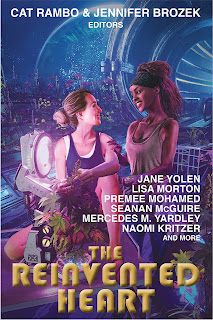
Microreview [Book]: The Reinvented Heart: Tales of Futuristic Relationships, edited by Cat Rambo and Jennifer Brozek

The Reinvented Heart: Tales of Futuristic Relationships is a collection of short stories by female and non-binary authors, focussed on imagining how relationships might look in the future, and how technology, social change and a wider span of time and difference between people might change those relationships (or not).


The theme for this collection is absolutely spot on, and while I liked, disliked and was indifferent by turns to some of the stories, I nevertheless finished the collection feeling glad that it was a theme being written about. Characters and relationships – in all their complex, messy glory – are by far my favourite thing in reading fiction, and so to have that spotlight focussed on them here, and specifically how they might change as the world, technology and the people in it change, was a gorgeous choice. It’s also a collection where the stories rove widely in their variety, and yet they do all stay extremely true to that uniting theme. And it’s not like we didn’t see stories with glimpses of interesting future tech or distant worlds or all the other good stuff of SF… it just all took a bit of a back seat to seeing how people have changed because of those changing contexts. And, of course, how they’ve stayed the same.

The editors/authors have also done a great job in providing a really interesting variety in what counts as a “relationship”. It’s not all romantic, and the ones that are push at the edges of what counts as romance. Near the beginning, for instance, Seanan McGuire explores the - necessarily and disturbingly intimate - love of a host and an intelligent symbiotic fungus, in what is by far the story that has stuck with me the hardest from the collection. It’s an intensely creepy read, with clearly a lot of her Mira Grant hat on, and one that left me doing a bit of a shudder of horror when I finished it and moved onto the next.

But we also see the relationship of a man and the young spaceship that can talk to him from within his brain; the slowly improving relationship of a woman with herself and her life as she moves asexually through a world obsessed with lust; the fond relationship of a woman and her inherited, genetically reincarnated cat. All are vividly emotional, all are different, but all absolutely centre and showcase a little snippet of feeling for someone or something, and how the changing world might have affected that. 

Conversely, some stories show that those relationships haven't or wouldn't change at all - we see fond partners still loving one another despite hardship and lovers struggling to relate while going through difficult times, and while the nature of the hardships may have changed, the very human feelings at the core of it haven't at all.

The collection also plays around with form, including not just short stories (and one a little longer), but also several poems. “They: A Grammar Lesson” by Jane Yolen is what opens the book, and is a short and lovely statement of purpose. There are several others, scattered through the sections, and they felt like a moment of rest and peace in between more immersive stories, a time to catch your breath and pause, rather than bombing through at the highest possible speed and maybe, by doing that, missing some details. There’s also one story in the format of an interstellar horoscope broadcast, and another in an adapting AI questionnaire for an automated matchmaking service. The stories are told not just in prose, and not just in human voices, but truly trying to look out into the scope of personal interaction that might exist in the future.

If it has any problem, the only one I can really find to talk about is hardly the worst to have. In most short story collections, there will be at least one story I love, several I like, some I dislike, and maybe one I hate. The Reinvented Heart has the last three, but there is no single, standout story that spoke to me, or grabbed me, or has lingered in fondness in my memory. There isn’t one story I’ll look back on in a year and remember, or the one I’m rushing to tell other people to read. There are plenty I enjoyed – if anything, I’d say my average rating of them was probably higher than most collections – but there’s nothing that really sang out and said “yes, me, I am the reason you read this book”. And this does probably mean that, as time passes, this won’t be the book that really sticks with me from 2022.

But I’m not sure that matters. My predominant feeling as I read the stories here was of fleeting glimpses of moments in longer relationships, little windows into bigger stories, that I saw flit past and then fade away. The experience was a very pleasant one, and the joy was to some extent in the transitory nature of the experience. I don’t need to remember them in intricate detail, but I know I’ll remember having read them fondly.

The Math

Baseline Assessment: 7/10

Bonuses: +1 for genuine breadth and depth of relationships on show

Penalties: -1 for putting by far the creepiest story right at the start and so nearly stopping me reading it entirely because I’m a wuss

Nerd Coefficient: 7/10 an enjoyable experience, but not without its flaws

Reference: The Reinvented Heart: Tales of Futuristic Relationships, Cat Rambo and Jennifer Brozek (ed.), [CAEZIK SF & Fantasy, 2022]

POSTED BY: Roseanna Pendlebury, the humble servant of a very loud cat. @chloroform_tea


Thursday, July 1, 2021

6 Books with Cat Rambo


Cat Rambo lives, writes, and teaches somewhere in the Pacific Northwest. Their 250+ fiction publications have appeared in places in Asimov’s, Clarkesworld Magazine, and The Magazine of Fantasy and Science Fiction. In 2020, they won the Nebula Award for their novelette, Carpe Glitter. Their 2021 books include fantasy novel Exiles of Tabat (Wordfire Press, May, 2021), and space opera You Sexy Thing (Tor Macmillan, September, 2021), while in February 2022, anthology The Reinvented Heart, co-edited with Jennifer Brozek, will appear from Arc Manor Books.

Today, she tells us about her Six Books

 1. What book are you currently reading? 


I just started Devices and Desires by K.J. Parker, book one of a fantasy (ish) trilogy. I'm enjoying it because it talks about one of my favorite things, the economics of a world, and how trade and other market forces drive civilizations.  No magic whatsoever! But lots of lovely details and interesting characters, and a slow-burning epistolary romance. I love fantasy that thinks about the economics of things because it feels so much better thought out than some of the cartoonier books.


2. What upcoming book are you really excited about?


Cadwell Turnbull's No Gods, No Monsters. I thought his first novel, The Lesson, was outstanding and when he appeared on the podcast I sometimes co-host, If This Goes On (Don't Panic), he talked about this second one, which also moves into one of my favorite genres, superhero fiction. I can't wait to read it.


3.Is there a book you're currently itching to re-read?

I just re-watched Howl's Moving Castle, the Miyazaki anime version, and it's made me want to go back to the book, which is so different and just as lovely in its own way. I found that I had most of the Miyazaki films available on a subscription service recently so I've been working my way through those, but that's the only one based on a book that I've read multiple times (like a number of Diane Wynne Jones' other works).


4.How about a book that you've changed your mind about -- either positively or negatively?

Laura Ingalls Wilder's Little House on the Prairie would be one that I certainly see in a different light nowadays than I did when I read it -- again, multiple times in those pre-Internet days -- as a child. For me one of the most striking moments has always been when Laura sees the columns of Indians going by, but the book glosses over the reality of that journey, which is the Trail of Tears in 1838. The Wilders are occupying Native American land, but the only mention of that, really, are the beads scavenged by the little girls from what I now realize was an Indian campsite that they'd been driven from. This change came about from reading a recent biography of the author, Prairie Fires: The America Dreams of Laura Ingalls Wilder by Carolyn Fraser.


5.What’s one book, which you read as a child or a young adult, that has had a lasting influence on your writing?

There's a book aimed at children, about writing, that my grandmother gave me when I was 10 or 11, called Turn Not Pale, Beloved Snail, by Jacqueline Jackson. I read that book so many times! And it really shaped my writing, particularly using sensory stuff. My signed copy is beaten to hell (though it retains its dust-jacket, something few others of my books can say), but I've carried it around all these years. I tracked down the right email address last year and wrote to Jackson last year to tell her how much the book meant to me. She wrote back an incredibly nice letter, saying I'd gotten her book at the perfect age.


6. And speaking of that, what's your latest book and why is it awesome?

I'm lucky enough to have two books in 2021! The one that's coming out this September from Tor Macmillan is You Sexy Thing, the start of a space opera series featuring retired mercenaries turned restauranteurs who are launched into adventure when an unexpected package arrives and they're forced to steal an intelligent spaceship -- who isn't convinced it wants to be stolen. The one that came out earlier this year was Exiles of Tabat, the third book in my fantasy quartet from Wordfire Press.


Thanks, Cat!

---

POSTED BY: Paul Weimer. Ubiquitous in Shadow, but I’m just this guy, you know? @princejvstin.


Wednesday, February 27, 2019

Adventures in Short Fiction: February 2019

I've been on holiday in Costa Rica for the last couple of weeks, armed with my trusty e-reader and a mountain of reading intentions (and obviously some paperbacks as well for "just in case"). In between animal encounters of land and sea, I got a lot of reading done and tons of that was short fiction, filling spare moments with brief journeys into fantasy worlds and far future concepts. Along the way, I feel like I've gained more of an appreciation of what good short fiction brings to the table that longer lengths can't, hitting whatever emotional or intellectual centres it needs to with a carefully chosen balance of character, plot and world. Plus, while not every story is equally memorable - though many which I have read and forgotten from are no doubt the ones which have provoked other people to muse on and reread - the investment for reading short stories that miss the mark is much lower than for a novel, which makes a reading list of anthologies and magazines a great counterweight if, for example, you've also decided to also commit to some challenging longer stuff on the side. (Marlon James, I'm looking at you. And no, it wasn't even that Marlon James novel.)

New Suns ed. Nisi Shawl (2019).


This anthology of original speculative fiction by writers of colour has been put together by the magnificent Nisi Shawl, which is an early indication we're all going to be in for a great time. The seventeen stories within are varied and interesting and there's a good proportion of authors I already love, including Silvia Moreno-Garcia and Rebecca Roanhorse, and new-to-me names. The breadth of stories, tones and styles on display here is entertaining and, I think, important, making it abundantly clear that the work of authors of colour can't be reduced to a single set of issues or sub-genre or to the ever-shifting label of "message fiction".

There was so much interesting stuff in here that it's tricky to pick favourites: "The Galactic Tourist Industrial Complex" by Tobias Buckell hit some great notes on the theme of intergalactic inequality and dependency, casting Earth as an "undiscovered" tourist spot for aliens, and the exploration of humans trying to live their lives and maintain their own culture against the constant stream of visitors is very well done. "The Virtue of Unfaithful Translations" by Minsoo Kang, told through the form of a historical text examining a war averted between a mad emperor and an ambitious sea captain, is beautifully written and contains a well-crafted sting in the tail of what could otherwise have been a romance for the ages. Rebecca Roanhorse's "Harvest" tells of a fling between Tansi, an aspiring chef, and a deer woman with murder on her mind, and is told with Roanhorse's talent for slow burning entrapment and horror even within the space of fifteen pages. And while it was a bit left-field, I have a real soft spot for "One Easy Trick" by Hiromi Goto, about a woman who finds a way to magic her own belly fat away and learns that it was a more important part of herself than she ever imagined. This is a great anthology to dip into, either story-by-story or in one super varied read, and I'm happy that it's put some great new authors on my radar.


Rating: 8/10

If This Goes On, Ed. Cat Rambo (2019).


This collection, kickstarted last year by the small Parvus Press, sets itself an interesting goal: encompassing the sense of disaster and impending doom that current political and environmental factors evoke (mainly focused on the USA) while also incorporating notes of hope. The result is slightly uneven, as some stories contain little more than a grimly extrapolated premise, but others do shine. Of these, it was the stories with a feeling of historical weight to them which really grabbed me. "Mr. Percy's Shortcut", by Andy Duncan, recounts the tale of an Appalachian miner - one of the few in his version of the future who hasn't switched to data mining - who spends his life digging through a mountain in order to reach the other side. It's a story of almost nonsensical triumph, but it feels "lived in" and the speculative elements are compelling but understated. On the much grimmer side, the stories "A Gardener's Guide to the Apocalypse" and "Free Wifi" present very different testimonials which we have reason to suspect would never be canonically read - the former, by Lynette Mejia, is a diary charting a year in the life of a gardener recording the growth around her despite the destruction which has taken all but her and her partner; the latter, by Marie L. Vibbert, a story of young rebellion in a corporatised world which is crushed in actuality but not in spirit. Both have strong character voices, underscored by the modes of telling, which really underscore the premises and stop them from being too grim despite the subject matter.

Some other gems in here include "Welcome to Gray", by Cyd Athens, a superhero origin story with notes of Henrietta Lacks and a great subversive take on representing dialect, and E. Lily Yu's story, "Green Glass: A Love Story", a no-expense-spared romance in very late capitalism which manages to keep the protagonist's wish - to have real ice cream served at her wedding - naively sympathetic, without flinching from showing the widespread destruction and misery which surrounds those without the means to keep themselves insulated. All in all, this is a neat little collection despite its ups and downs, and while it's very tied to the political moment, if you're interested in on-the-pulse speculative fiction this is one to consider.

Rating: 6/10

How Long 'Til Black Future Month by N.K. Jemisin (2018).


This is the first collection (i.e. a set of stories by a single author, whereas an anthology is a set by a group of authors brought together by a particular editor) I've covered in this roundup so far, and it's going to be a hard act to follow. I've read a couple of N.K. Jemisin's shorts before - notably, "The City Born Great", her Hugo-nominated urban fantasy of a couple of years ago, as well as some fiction around the Inheritance Trilogy (which is notably absent here). Lack of god-politics aside, if you're a fan of N.K. Jemisin then this is definitely a collection you will want to read. Spanning well over a decade of Jemisin's writing career, and running the genre gamut from space-faring science fiction ("Cloud Dragon Skies", "The Evaluators") to alternate history ("The Effluent Engine") to dystopian realism ("The Elevator Dancer") and urban fantasy ("The City Born Great", "Sinners, Saints, Dragons, and Haints, in the City Beneath the Still Waters"). The worlds of the Broken Earth and of Dreamblood both put in appearances, in "proof of concept" stories which predate their respective novels, and there's a pair of stories, "The Trojan Girl" and "Valedictorian", set in the same post-singularity reality from very different perspectives.

There's so much good stuff in here, but I particularly want to highlight one which most represents the volume as a whole: the opening story, the "The Ones who Stay and Fight". As the title suggests, this is a response to Ursula K. Le Guin's "The Ones Who Walk Away from Omelas", set in Um-Helat, a city of generally kind people living sustainably and harmoniously, and actively working to correct the injustices of the past and maintain their society as it is. In introducing this society, the narrator holds a dialogue with a fictionalised version of the reader, challenging their inability to suspend disbelief for a society bent towards compassionate progress without any dark "catch". Why is it so hard to believe that a kinder, better society is possible - and even if it isn't, what value is there in insisting, angrily, that hatred and suffering must always be present? It's a theme taken up in so many ways, big and small, by Jemisin's stories in this collection and beyond: where protagonists are often trying to exercise agency and dream of better things in the most imbalanced, hopeless of situations, and those who stand in their way are often not the characters who do incomprehensibly awful things - who are often complex, sympathetic and sometimes even redeemable - but who uphold and insist on the status quo which brought those "evil" acts about. "The Ones who Stay and Fight" explicitly challenges us to question where our suspension of disbelief kicks in, and why, and while that self-examination isn't strictly necessary to enjoy the rest of this collection, it's an exercise that we can only benefit from.

Rating: 9/10

Tor.com Jan/Feb 2019 (Download for free)


Tor.com's short fiction output hardly needs any introduction, but what might have escaped some peoples' attention is that there's now a free subscription service where they will send you a bimonthly ebook of stories published on the site for your e-reading pleasure. While this doesn't seem to be every single one, getting a free collection like this is still a no-brainer for me, and there's a range of fascinating stuff here by some great writers. "Deriving Life", by Elizabeth Bear, is a story of life and love in a world where people can guarantee a reduced but painless term of life by becoming a host to an alien parasite, explores its concept through the lens of a relationship between a dying host and the lover they are leaving behind. It's a deeply nuanced look at autonomy and the choices we make now and for our own futures, and while it doesn't offer any easy answers it maintains a huge amount of compassion towards its (queer) characters. Another favourite was "Circus Girl, the Hunter and Mirror Boy", about a woman who used to have the ghost of a drowned boy as her reflection, who reappears in her life right as he's being hunted down. The themes of identity are particularly interesting in JY Yang's atmospheric ghostly tale.

For fans of Mary Robinette Kowal's Lady Astronaut stories, there's another piece of punch card punk history here: "Articulated Restraint", a story of Elma York's colleague Ruby working a training mission that suddenly becomes much more serious and painful than expected. Ruby's voice and drive wasn't distinct enough from Elma's to really invest me in this as a standalone story, but taken with the rest of the series it's another interesting window into the ambition and fortitude expected of women trying to break through a militarised patriarchy in this high stakes world. There's also a piece from Analee Newitz's Autonomous world, "Old Media", which follows a couple of the characters from that piece in a sweet slice-of-life story about recovery, anime and naps. Worthy stories by Mimi Mondal and John Chu round out an overall very strong set of stories with lots of variety and food for thought.

Rating: 7/10

Anathema Magazine, Issue 6 (2019) (Read Online for Free)


Anathema's tagline is "Spec from the Margins", publishing queer speculative fiction from POC/aboriginal/indigenous creators, and this is the second issue of theirs I've read. Based on my experiences so far, I can confirm it's a magazine that's well worth your time, but one which requires a particular mindset to sit down and enjoy; in this issue in particular, every single story bursts off the page with loss and grief and while it's an exquisite, well-crafted sort of pain which never feels gratuitous, it's still a hard thing to get through. Among the best, most painful experiences in here are those dealing with families going to unimaginable lengths to hold together. In "There Are Ghosts Here" by Dominique Dickey, a young boy's life cut short under violent circumstances begets a similarly grim sacrifice from his sister and cousins, held together with magic that is simultaneously mundane and extremely creepy.

"The Plague House" by Maria Chhabra follows Catia, one of the few people immune from a deadly, unpleasant plague that is sweeping through her city, as she nurses the sick, watches those around her succumb and tries to save the life of one particular girl left in her care. It's a story which handles its body horror extremely well, driving home the awfulness of the plague without dwelling too deeply on the physical horror at the expense of the wider pain that people are going through as a result. The issue closes with "Pale Blue Dot", by Kai Hudson, an understated but equally powerful story about a family's survival in the face of economic uncertainty, even with the promise of the stars on their doorstep. Also of note is "This is the Nightmare", by Aysha U. Farah, which is a compelling futuristic Sherlock Holmes riff whose eventual direction left me guessing until quite near the end. The use of technology here - and particularly the "personality" that the Sherlock character ends up giving her unwanted robot pall - will make any reader who remembers their angsty teenhood wince in sympathy, but the relationships and setting make it so much more than an exercise in vicarious teen nostalgia. All in all, Anathema is a publication that's worth giving your heart to, even when you know its going to crush it with every page.

Rating: 7/10


POSTED BY: Adri is a semi-aquatic migratory mammal most often found in the UK. She has many opinions about SFF books, and is also partial to gaming, baking, interacting with dogs, and Asian-style karaoke.