Robot battles, class politics, and numbers going up
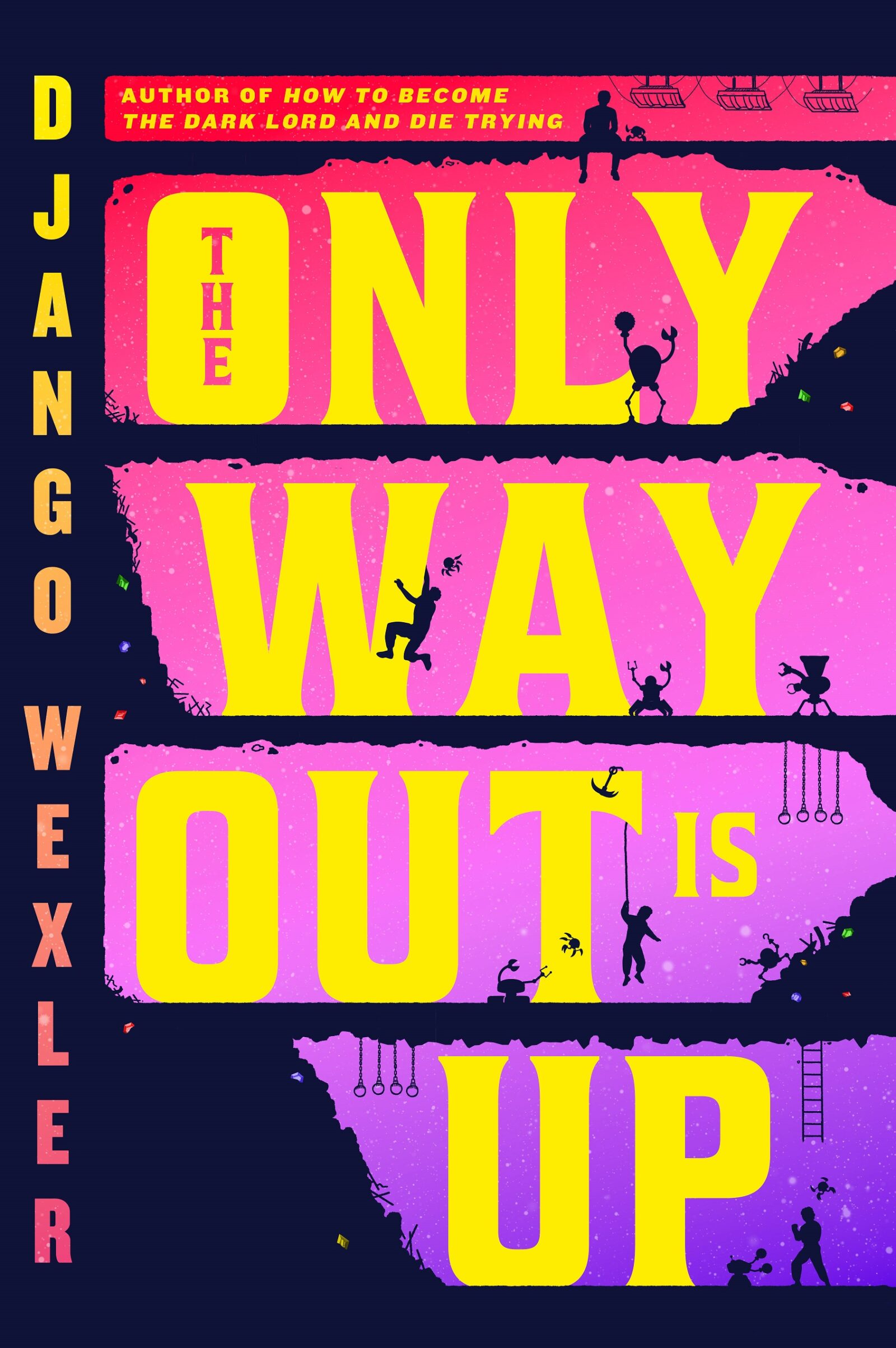
Django Wexler has had an incredibly consistent career across a wide range of subgenres, ranging from the flintlock military fantasy of The Shadow Campaigns to the excellent YA fantasy of The Wells of Sorcery to the genuinely funny Dark Lord Davi duology and more. Dark Lord Davi was openly an affectionate pastiche of isekai (i.e. a specific Japanese iteration of portal fantasy) anime. This stuff has a huge and increasing fanbase among the anglosphere, well known within anime fandom, though I’m not quite sure how familiar traditional written SFF fandom and much of its attached critical apparatus is with the same.
Wexler takes this mining of popular spaces that are potentially unfamiliar to traditional SFF fandom up a notch with The Only Way Out Is Up. The book is a progression (science) fantasy, where our protagonist, Taj, and his probably sentient robot, Star, fight their way literally up from the bottom of a garbage heap to power and influence. As I will discuss a bit more below, this is another excellent effort from Wexler, engaging and fast-paced without being shallow. But before I turn to the book itself, forgive a digression into definitions here. Having just said I think this is a subgenre many won’t be familiar with, and being greeted with slight bafflement by a number of social media acquaintances when I’ve said “progression fantasy”, I hope this is both useful and potentially interesting.
Progression fantasy is arguably more a collection of subgenres than a single clearly defined thing. Its influences include Xianxia (i.e. Chinese cultivation fiction), manga, anime, light novels, JRPG video games and TTRPGs like Dungeons & Dragons (as an example of how this all comes together, one of the key early influences is Record of Lodoss War, a Japanese series that started as a narrated serialisation of the author’s TTRPG campaign, was converted into a light novel series, and has spawned video game and anime spinoffs). These are in fact quite disparate urtexts, which contain different cultural and literary assumptions. They are united basically by only one single theme: Number Goes Up (i.e. the protagonist grows in power over time).
Some of these influences are literally games, and at the crunchy end of the field (LitRPG), books have full-on stat screens and dice rolls as part of the action: think Dungeon Crawler Carl or the "trapped in a video game" subgenre of Japanese media, of which Sword Art Online is probably the most famous, though not quite the earliest. But not everything broadly in the progression fantasy realm is quite so literal in its gamification: I'd argue much of Brandon Sanderson's work teeters on the edge of progression fantasy with its focus on exploiting detailed magic systems. And in between those poles is a rich stew of iterations, from Sarah Lin's enjoyable, idiosyncratic, "architecture of a literal house inside your soul dictates power growth" Weirkey Chronicles to Tobias Begley's quantum magic school Journals of Evander Taylor to Will Wight's mega-selling Cradle series (which is clearly heavily Xianxia influenced). There are also a range of themes: outright individual power fantasy is probably the most common, but protagonists using their growing power to support the building of communities with their friends is also a recurring theme, and series with actively revolutionary politics directed at capitalist oppressors are also quite frequent.
The progression fantasy field in English is dominated by self-published authors and web serials published on sites like Royal Road (Indeed, Wexler is currently posting *another* progression fantasy, The Thirteenth God, on Royal Road). The quality is wildly variable: the best is very good fun and occasionally significantly more than that, but a large amount is individualistic power fantasies in leaden prose. In addition, one side effect of this serial fiction publishing context is that often this is the author’s first time writing for an audience. Even for more experienced writers in this space quite often the opening arc takes an absolute age to find its feet in its world, with its narrative, and with its characters. When these are turned into formal volumes for sale, either via self-publishing or when picked up for traditional publication, the first book is very often notably weaker that what follows (this is true even of stuff I overall enjoy, like John Bierce's Mage Errant and the aforementioned Dungeon Crawler Carl).
This traditional publication pickup is a relatively new thing: SFF publishers failed to pay much attention to this collection of subgenres even though they had absolutely been doing the numbers online for years (For example, Unsouled, the first book in Wight's Cradle series, had 65,576 ratings on Goodreads at time of writing). Alongside republishing existing works, publishers now seem to be actively courting this zeitgeist and putting out original work in the progression fantasy space (the dynamic reminds me of a more male-coded attempt at repeating the flood of cozy fantasy we saw after the success of Legends and Lattes). The Only Way Out Is Up is an early and very good example of major publisher resources being put into such work. Wexler has no problems with a meandering or muddled start: the book begins with immediately engaging action and continues impressively from there.
As noted above, Taj is a young man (twenty years old) who lives at the bottom of a city built in tiers around a giant hole several hundred metres deep and several kilometres across. There are three main tiers, each containing a city of increasing economic and social status as you go up. Periodically, various construction and electronic junk from the mysterious Above (i.e. the outside world) will drop through the aperture at the top of the hole (dubbed, rather evocatively, "the Asshole"). This forms a giant pile of e-waste—the Heap—at the bottom of the hole, below even the lowest city tier. Taj and his adoptive family make a precarious life around this huge mass of the detritus of those wealthier and more powerful than them.
The progression element here, at least for the first book, focuses on Taj upgrading his robot (called “runics” in-world) to fight in increasingly high stakes battles, both for money and to advantageously position himself and his friends politically. This means that a lot of the action set pieces are these robot battles, which are hugely entertaining, like a souped up science fantasy version of the old BBC programme, Robot Wars. The runics are built from metal and powered and controlled by sigils, seemingly magic runes charged by a person’s life force to make inanimate objects either do something (verb sigils) or change the way it is done (noun and modifier sigils). This is largely understood in-world as a standard programming language with standard operators, though Star, Taj’s runic, seems to be largely self-aware in a way other runics are not, and there are hints that it is possible to create nonstandard sigils. This is not a large feature of this book, but the title of the series (The Sigilist) suggests it may well become so, and may well become Taj’s route to the ever-expanding power and agency that is at the core of progression fantasy’s plot drive.
Outside the world of sigils and robot battles, the plot focuses on Taj’s attempts to keep his family safe, housed, and fed (no small task in the precarious world of the Heap) and on the political manoeuvering of the deuteragonist we meet early in the novel (Ky, a young woman from the fancy upper tier city). The book is first and foremost hugely entertaining; a pacy romp through a slightly implausible, slightly gamified world. But there is also a bit more going on than pure confection. The character work is operating within generally expected archetypes, but the dialogue and integration with setting is skillful and naturalistic, quickly building rapport between the reader and Taj. Star is a very effective snarky robot sidekick, and Ky, our deuteragonist, has her own motivations and character and is far more than a distressed damsel for Taj to moon over. The gender and class politics of the setting are pretty clearly critiqued; the fact that the system sets up a no-win situation where those at those top pit everyone below them against each laid bare. This is very much a book one, so none of these issues are completely resolved here, but one plot arc is resolved and the board has very effectively been set for the rest to be explored as the series continues.
Writing this review, one of the things that I struggled with most is how to get across just what it is this book does well beyond "good fun" (which it absolutely is). I'm a sucker for what Wexler serves up, and I think, like his previous work, The Only Way Out Is Up is definitely a cut above merely competent and enjoyable commercial SFF. He's a very good writer. But Wexler is not, to pick another contemporary author I think writes works similarly a cut above, the flashy prose stylist Freya Marske can be. He doesn't play the games with form and narrative the similarly consistent and excellent Jenn Lyons does. Where I think Wexler excels is in between this sentence level and volume-level creativity: he's as good as anyone currently working at conjuring atmosphere and character and plot drive across a paragraph or a scene.
This mid-level structural mastery makes for a quick, breezy read that still vividly evokes setting and character. This is, I think, very hard to do, but while you're in the middle of it, whipping through a perfectly paced fight scene, it's easy not to notice how much skill is deployed. This is me noticing, and I hope readers of this review and Wexler's work will pay attention and appreciate it. Wexler is a hugely able purveyor of this sort of high-quality commercial SFF, and The Only Way Out is Up is another excellent example. It's also very clearly knowledgeable and respectful of the slightly out of the spotlight traditions it's drawing on, pulling us into the thrill of watching the weak and downtrodden get stronger and stick it to the rich and powerful, without ever veering into the bland, power fantasies of the less impressive examples of those traditions. Bring on book two.
--
The Math
Highlights:
- Faced-paced, engaging action
- Appealing, naturalistic character work
- Excellent gateway book for the sometimes impenetrable world of progression fantasy
Nerd coefficient: 7/10
Reference: Django Wexler, The Only Way Out Is Up [Orbit, 2026].
POSTED BY: Eddie Clark. Professional nerd by day, amateur nerd by night. @dreddieclark.bsky.social