Monday, May 15, 2023

6 Books with Martha Wells (May 2023)


Martha Wells is an American writer of speculative fiction. She has published a number of fantasy novels, young adult novels, media tie-ins, short stories, and nonfiction essays on fantasy and science fiction subjects. Her novels have been translated into twelve languages. Today she is best known for her popular Murderbot SF novellas and novels.

Today, here at Nerds of a Feather, she tells us about her Six Books.

1. What book are you currently reading?

I just finished reading The Blue, Beautiful World by Karen Lord, which is coming out later this year. It's part of the same series as The Best of All Possible Worlds
which is one of my favorite SF novels ever. I loved seeing those characters again and her work is always so warm and engaging, so reading this book was a real treat.


2. What upcoming book are you really excited about?

I'm actually excited about a ton of the books coming out so it's hard to pick just one. Also, I'm behind on reading the books that came out last year and I want to get started on those, too. But one of the new ones I've been looking forward to for a while is The Mimicking of Known Successes by Malka Older. I love SF/F mysteries and this looks like it will be an excellent one.


3. Is there a book you’re currently itching to re-read?

I like to re-read the books in Ben Aaronovitch's Rivers of London series. They're great comfort reads for me and the mysteries and ongoing story arcs are complex and reward re-reading.


4. A book that you love and wish that you yourself had written.

That's kind of difficult as the books I usually love are ones that I wouldn't have been able to write. But one recent book that I love is The Shuddering City by Sharon Shinn. She's been one of my favorite writers for a long time and her work has inspired my writing a lot. I loved seeing her return to epic fantasy in her new book.


5. What’s one book, which you read as a child or a young adult, that has had a lasting influence on your writing?

It was My Enemy, My Ally by Diane Duane. I loved the story, and the conflict and negotiation between two groups of characters who had been enemies but who now had the same goal. Also the way the two groups were learning about each other's cultures, overcoming their prejudices about each other. I loved the book so much I was basically studying the technique to teach myself how to write.


6. And speaking of that, what’s your latest book, and why is it awesome?

My latest book is Witch King, coming out May 30. It's an epic fantasy about a group of immortals with a deeply personal stake in their world. They are part of an alliance of peaceful civilizations who have fought off a conquering genocidal attacker, and then have to deal with what happens to that alliance years later, if it can be kept from turning into an empire, the thing they fought so hard against. There's found family, adventure, accidental child acquisition, betrayal, loyalty, all that good stuff.


Thank you, Martha!

POSTED BY: Paul Weimer. Ubiquitous in Shadow, but I’m just this guy, you know? @princejvstin.

Friday, May 12, 2023

6 Books with Jules Sherred


Based in Duncan, BC, Jules Sherred is an award-winning photographer in the fields of commercial food and lifestyle photography, author and recipe developer, journalist, and outspoken advocate for disability and trans rights. His website Disabled Kitchen and Garden and his cookbook Crip Up the Kitchen were born out of the need to include disabled people in the conversation around food. Visit him at julessherred.com

1. What book are you currently reading?

Will by Will Smith. Lately, I’ve been rotating between really good memoirs, reading in the genres of my current WIPs, and reading whatever sci-fi catches my eye. Smith’s memoir strikes a nice balance of difficult situations and humor.


2. What upcoming book are you really excited about?

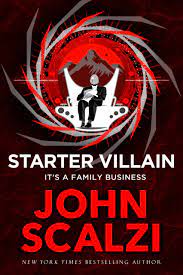
Starter Villain by John Scalzi. I have a feeling it is going to live in the same spot as another book that I’m about to mention. The sales copy is eight quick sentences. It just screams as another homage to old Bond movies but with the Scalzi humor we love.


3. Is there a book you’re currently itching to re-read?

Redshirts by John Scalzi. This is the other book I alluded to in the previous question. It is my favorite book of my adulthood. I laugh until I cry reading that book. It is the perfect love letter to my favorite TV franchise to ever exist, Star Trek.

4. A book that you love and wish that you yourself had written.

Once again, the answer is Redshirts by John Scalzi. Star Trek is the thing I love. It is the only media franchise that, if it were to disappear tomorrow, I’d be gutted. Redshirts not only pays the perfect homage to all the things we love about Star Trek, but it also pokes funs at all the things that are goofy about the franchise. It is everything I’ve said about Star Trek but written in a hilarious and intelligent manner.


5. What’s one book, which you read as a child or a young adult, that holds a special place in your heart?

Winnie-the-Pooh by A. A. Milne. I still pick up The Complete Tales when I’m feeling really down and need a safe, loving space in which to escape. So much of my childhood revolved around the book, including Heffalump hunting in the back woods of my childhood acreage and playing Pooh Sticks on the bridge over a creek on the property of a different childhood home. It has always been the place I go when things get rough.


6. And speaking of that, what’s your latest book, and why is it awesome?

Crip Up the Kitchen: Tools, Tips and Recipes for the Disabled Cook. It’s awesome because it not only makes cooking accessible again for millions of people but there is a lot of heart in the book. It validates people’s realities. It meets them where they are at. It teaches people where the food they love comes from. There are a lot of features in it for neurodivergent people who get overwhelmed in the kitchen. Flat-lay binding. There are some cool departures from how cookbooks have been written for the last 60-80 years. It is also beautifully designed. I am very proud of it.


Thanks, Jules!

POSTED BY: Paul Weimer. Ubiquitous in Shadow, but I’m just this guy, you know? @princejvstin.


Wednesday, May 10, 2023

Review: The Water Outlaws by S. L. Huang

A stunning reimagining of a Chinese Classic work of literature with modern worldbuilding, queer sensibilities and a feminist approach that retains the power and strength of the original text.


As a reviewer, I heavily debated with myself how to introduce this review and bring you into the world of S. L. Huang’s The Water Outlaws. With a work like this, there are a lot of handles to grasp, but which is the right handle to grasp onto to start the explanation, the discussion, the importance of this work. Finally, I have decided to go with a historical approach, because, in the end, as good as this novel is as a standalone work, it is a work that is not only in dialogue with a classic piece of literature, it goes much further.


So let’s start with a little bit of background. In Classic Chinese literature, there are a number of canonical novels, core books that are the backbone of a strand of Chinese history, culture and society. These are the books that, once upon a time, everyone who was literate could quote from, read, enjoyed, and shared. These were foundational texts in a way that, say, the Iliad and the Odyssey were for Classic Greece and Rome. There is, as there is with all canons, some debate over the lineup, but four novels are always on the list.


Romance of the Three Kingdoms:  Out of all of these, this is the one you, who may not know much about Chinese literature, may have most likely heard of. This is the story of a period between two major Chinese Dynasties, the Han and the Jin, a period of turbulence, anarchy, strife and conflict. Pieces of this story have arrived in the west in the form of movies, and even videogames. 


Journey to the West: This is the second most likely you have heard of, especially for fans of Wuxia films and the like, for it has been adapted and reimagined numerous times on screen. Even the very Western flavored movie “Forbidden Kingdom” really is a retelling of this story. The Monkey King goes on the titular journey to India, and gets into numerous adventures with his companions along the way.


Dream of the Red Chamber: Again, there have been movie versions of this work, and it, too, has had literary adaptations and provided inspiration. Aliette de Bodard’s “On a Red Station, Drifting” borrows from this powerful novel of love and family. 


And finally we come to the fourth of the set, The Water Margin. The Water Margin is set in the Song Dynasty, the last native Chinese Dynasty before the invasion of the Mongols. The Water Margin is a story that in its 50000 foot level will be familiar to Western readers. A group of diversely outlaws in an inaccessible area, fighting against corrupt officials who are oppressing the people? Yes, in the most broad of senses, The Water Margin is the Chinese parallel to the story of Robin Hood. It’s bigger scale, (108 outlaws in all, much larger than Robin’s band), larger stakes--fighting against full imperial armies, and, sadly, ends in a tragedy, the heroism of the outlaws ending not quite in a happily ever after.


And it is The Water Margin that is the story that S. L. Huang retells in The Water Outlaws.


S. L. Huang puts us in a slightly different China right from the get go by giving it a more feminist approach, starting with genderflipping the main character, Lin Chong. In Huang’s slightly alternate China, women have a significantly better role and place in society, but not so much that sexism and oppression of women are still not huge obstacles. But as a guard captain, Lin Chong is certainly in a position she would have not had in our own history. In this way, The Water Outlaws invites for me, comparisons to Shelley Parker-Chan’s She Who Became the Sun, which has a genderflipped protagonist, but she is a character who hides her gender. And her story is at the end of the Yuan dynasty, a century or more after the events of The Water Margin. But the queer, feminist lens of Chinese history and the perspective that it brings is strong in both works.


Lin’s path from Guard Captain to Outlaw is a shockingly fast one, but in an autocracy where enormous power is held by a few men, it is rather understandable. There is a deep injustice to Lin’s arrest and sentencing, and it helps put us on the footing right away that the Outlaws in general all started as unjust victims of a corrupt state apparatus, and are fighting against that injustice to themselves and the general citizenry.¹


Too, Lu Junyi is another genderflipped character from The Water Margin. Here, instead of being an archer beyond compare, Lu Junyi is a warrior and a scholar of a different sort, wielding knowledge and the spread of it as her weapons. This makes her very different than the almost monstrous antecedent from the original novel, but it also makes her very much a unique creation and invention of the author’s. Her story, while it starts with scenes with Lin, is off on her own, away from the Marsh, providing perspective particularly on the doings of the pair of antagonists. She provides a good contrast with the much more martial Lin.


In the case of those main pair of antagonists, Minister Gao Qiu, and Cai Jing,  Huang sticks closer to the mark, depicting both closer to the mark from the novel. Gao is ultimately who sets Lin on the path of being an outlaw and joining them in the marsh. Cai is a more martial sort, with plans and plots of his own. They are rivals in the imperial court of the Emperor, however, and one might even see the story from the perspective of these two rivals in the Song court, and how their rivalry plays out in a number of ways, including the disgrace and outlaw of Lin, Cai’s plots for power, and how the looming threat of Northern adversaries are a danger to the Court and the Empire. I do think that there could have been another “book” here, set entirely within the Imperial Court, with the machinations and intricacies laid out. But that is not the story Huang wants to tell, and I think the story she does tell is the more salable and appealing one for most audiences. The conflict between outlaws and empire is what Huang wants to do, and do it in style.


So far, you might think that this novel is as lightly fantastical as the aforementioned Parker-Chan novel. Is this even a fantasy book at all?  However, this is a Huang book, and this means we get a lot of action beats, and we also get an explicitly supernatural element as well. The introduction of “God’s teeth”, ancient artifacts that bond with a user and grant them supernatural powers, is the most explicitly fantastical part of the story. In the course of the plot, an ambitious plan to get more God’s Teeth and use them as weapons is a strong subplot that wraps up Lu Jinyi, and keeps up the fantastic elements of the novel. There is an interesting tension with the God’s Teeth, while they are powerful, they are seen by many as relics of the past, a bygone age gone by in more modern, enlightened times. And God’s teeth, while powerful, are not the be all and end all, as a sparring match with Lin proves ably. Still, having supernatural-esque martial arts and powers reminds me of Huang’s original novels, Zero Sum Game and its sequels.  


The writing of the action beats does, too. Those aforementioned novels, with Cas having greater than human physical abilities because of Math, showed me early that Huang had a talent for writing action beats. That talent is on full display here in a very different context and setting. However different near future LA and Song China are in terms of weapons, style and scene, when it comes to actual physical conflict, Huang once again delivers the goods with crisply executed action sequences that also provide characterization  in the bargain. Whether it is sparring by the bandits in the Marsh, or desperate fight against the Imperial forces seeking to overwhelm them, the action beats are top notch. 


I haven’t talked much about the panoply of secondary characters of the actual band of Outlaws that make up the outlaws of Liangshan Marsh. They do not quite hold up as perfectly well as Lin and Lu, but those are towering characters, almost characters of destiny. There is a gradation of characters in the novel. Below Lin and Lu are characters like Wu Yong, the Tactician, and Jiang Jing, a mathematician. Lu Da, as possessor of a God’s tooth of her own, is a ferocious fighter and combatant of the first level. All of these are genderflipped from the original novel. More lesser characters are included, including some men who retain their gender from the original work. This means in effect that the Bandits are overwhelmingly but not entirely genderflipped into women. But, as given with Lin’s former guard captain status, it means that they are capable--and yes, underestimated by the Empire in the same turn. 


I should also note that the novel can be extremely violent and bloody. There are also, again in dialogue with the original novel, references and allusions to things like cannibalism as well. This is one of those novels where anyone can die, and there are some sudden and shocking ends for some of the characters in the novel. Being a rebel against the Imperial government, or defying it in any way, is not an easy business. Huang pulls no punches here with her characters. But, again, that is keeping with The Water Margin itself.


The novel, however chonky and thick it is, does not recapitulate the entirety of The Water Margin in its story, giving the story a heroic ending (although definitely not without costs to the bandits of the Marsh as mentioned above) but supplying a satisfactory conclusion all the same. The question you might have at this point is--do you need to read the Water Margin in order to truly appreciate this novel?  


I think no. Certainly having read The Water Margin gave me a strong appreciation for what Huang does here. The allusions and parallels and borrowings, to say nothing of the dialogue with the original novel, is a rich strand that really enriched my reading experience, I will admit. But divorced from that, this is a historical fantasy that provides its readers with everything one needs to enjoy it. The worldbuilding is enhanced by the original novel, it doesn’t depend on it for readers to get what is going on. And really, the aforementioned very general “Robin Hood band in medieval China” is really all you need to know in order to get to know the characters and what is going on. The differences and additions that Huang brings (such as the Teeth) and major omissions from the novel, such as the Spirits, means that the novel does stand on its own.


The Water Outlaws is an entirely successful fusion of Chinese Classic literature with modern sensibilities, writing and point of view. In The Water Outlaws, S. L. Huang takes one of the pillars of Chinese literature and reinvents it as a queer, feminist retelling of an important and nation-defining story. With strong characterization, immersive worldbuilding, strong resonances with the original text, and vivid action scenes, The Water Outlaws encapsulates all the power and strength in Huang’s writing. This is a book that both works for readers unfamiliar with the original work, and those who find it one of their heart texts. 


---

The Math

Baseline Assessment: 8/10

Bonuses: +1 for strong writing, especially action beats and bringing the reader into medieval China.

+1 for an entirety successful reimagining of a Chinese Classic that is diverse, queer and unapologetically feminist.

Penalties: -1  Some of the secondary characters do not shine as much as the main antagonists and protagonists.

Nerd Coefficient: 9/10

Reference: Huang, S. L., The Water Outlaws, [Tor, 2023]


POSTED BY: Paul Weimer. Ubiquitous in Shadow, but I’m just this guy, you know? @princejvstin.


¹The ELO song “The Greenwood”, about Robin Hood, comes to mind about the bandits and how they came to be:

“The city boys, and the country boys, they come from miles around,

To defy their king and country, save the poor folks from the hand,

Of the thieving dukes and abbots, and the gentry of the land.”


Although it must be said again, the Chinese version of this is that the Bandits are absolutely  loyal to the Emperor...but not to the corrupt officials that are ruining his rule.


Review: Poor Man's Sky by Wil McCarthy

Murder, Monks, and the Moon! What's not to like?


There’s something about the great black void above us that attracts a wide variety of peculiar people. In our world, we have the likes of Elon Musk (who promises settlements on Mars when not driving Twitter to implosion) and other billionaires with god complexes and more money than sense. This is a theme that runs through Poor Man’s Sky Wil McCarthy’s most recent novel, a sequel to 2021’s Rich Man’s Sky.

Rich Man’s Sky was something of a near-future spy novel set on a space station run by a megalomaniacal billionaire with plans under suspicion of Earth governments. Poor Man’s Sky is a sequel, but not one particularly tied to the original; you’ll recognize some character names and the political situation, as well as the significant fleshing-out of a setting that appeared in bits in pieces in the first book, a setting that complicates the first book’s conflict of government versus business. I would, however, recommend that you read the first book anyway, partially because it is very good and partially because I sense that McCarthy is planning great things here.

Much of the book has a particularly intriguing setting: a Catholic monastery on the Moon. Earth’s nearest natural satellite is a perfect place for a monastery, and McCarthy exploits this congruence. Outer space is a place where the work is monotonous and exacting, far from other people - and so is a monastery! There’s a certain claustrophobia here that creates a very particular sense of mystery here. It’s also quite historically apt, as the Catholic Church has on several occasions adapted to modernity in surprising ways.

If Rich Man’s Sky is a spy novel in space, Poor Man’s Sky is a detective story in space. This leads to some mildly convoluted exposition, especially regarding the main character, who is a police detective in Colorado Springs. In many ways, he is a clear homage to detective fiction of yore, but McCarthy has imbued him with great dialogue and much pathos. He is a man of the world in an environment - the monastery - where being ‘worldly’ is a sin, and the culture clash, on both ends, is some of the best parts of the book (I liked the bit about whether monks can drink a certain beverage).

The plot is complicated, but never becomes convoluted. The inciting incident is a very peculiar coincidence regarding a landing and a death under suspicious circumstances. Through all this, what strikes me so much is how well McCarthy uses isolation. The Moon is a harsh mistress in McCarthy’s universe, and there is a claustrophobia that pervades much of the narrative, on the Moon and in other settings, that forces a certain focus and a certain edge. In investigating a death, the characters are courting death, and it makes for compelling reading.

What surprises me is that, despite McCarthy being a libertarian, is how blistering a critique of the corporatization of space this series is. One subsidiary setting in the novel is a space station run by a Russian oligarch in the throes of an outright worker revolt, and the workers are portrayed quite sympathetically. Here, the isolation is even starker as the trip back to Earth is one more thing the bosses can deny their employees. As elsewhere, the isolation focuses the plot sharply. The menace of the bosses is colder than it would be on Earth, to great effect.

Rich Man’s Sky was a confident first step. Here, McCarthy’s series hits its stride, combining a number of seemingly disparate elements to form a biting critique of current trends in the development of human activity in outer space. Read the first book first, of course, but hasten to read this one. It’s worth it.

--

The Math

Nerd Coefficient 8/10
  • Great use of isolation
  • workers uprisings in space
  • great narration
Reference: McCarthy, Wil, Poor Man's Sky, [Baen Books 2023]

POSTED BY: Alex Wallace, alternate history buff who reads more than is healthy 

Tuesday, May 9, 2023

Review: Just Like Home by Sarah Gailey

It’s not always wrong to love a monster, as long as you love the right one.

Cover illustration and design by Will Staehle

Sarah Gailey is a writer who has undergone a remarkable shift over their career, tilting from a purveyor of breezy, heisty, hippo-filled romps five years ago (NoaF nanoreview here) to someone who has realized that their real strength lies in—whatever the hell kind of monstrous grim horror story we have here in Just Like Home.

I want to pause here to emphasize that when I say whatever the hell kind of monstrous grim horror story we have here, I mean it in the best possible way. I don’t typically seek out horror as a genre, but I’ve deeply enjoyed Gailey’s previous work, and it hasn’t escaped me that the bits I’ve enjoyed best—The Echo Wife (2021) and ‘Bread and Milk and Salt’ (2018) most notably—have been the darkest and grimmest and most monstrous. And it was on the basis of this trust that Gailey has instilled in me that I read this book—a book I absolutely, under no circumstances, would have dreamed of picking up if I had not already trusted Gailey to take care of me.

And they did. I mean, sort of. Wowzers. This is a doozy of a rough ride. It starts out with a dedication--to everyone who has ever loved a monster—and it follows that path all the way down to a surprisingly touching and horrible and satisfying and really bizarre conclusion.

Vera Crowder returns home after a decade away, called back by her mother who is dying and wants Vera to be ready to settle the estate. Once she is back at the Crowder house, the book loses no time in fulfilling the promise of its dedicatory note by introducing three core monsters. The first is Vera’s father, Francis Crowder. He’s no longer around, having died years ago, but it becomes clear quite quickly that Francis was involved in something Very Bad, something that was responsible for the enforced estrangement that has distanced Vera from her family home for her entire adult life. Whatever it was, it made her family into a sort of celebrity among the true-crime loving community. Surfaces are protected with plexiglass to preserve the house in the state it was when the whatever-it-was actually happened. True crime writers and artists and probably rather twisted fans visit the house to spectate on the site of whatever-it-was. But, for all that Vera seems to recognize that badness of whatever-it-was, she is unwavering in her loyalty to Francis. She loved and adored and trusted him when she was a child, and in all the flashbacks to Vera’s childhood he appears as the epitome of a good father. And even now, as an adult, with the perspective of years and maturity and distance, Vera yearns after his memory, treasuring traces of his letters and journal pages in a way that seems quite incompatible with the monster he seems to have turned out to be.

Such a set-up leaves a reader of less skilled narratives expecting that the truth will turn out to be something obvious and predictable—he was actually a sexual predator! Vera must come to terms with the truth of what a monster her father was! Fortunately, Gailey eschews such tedious tropes, and the actual truth of Vera’s father, and Vera’s relationship with him, turns out to follow a much more unexpected path, one that is entirely in keeping with the starting dedication of the book.

The second monster is the house itself, Crowder House. Vera’s relationship with the house is characterized by a kind of childlike, magical trust that goes well beyond nostalgic affection for the times we felt safe and protected as children by virtue of our ignorance of all the things that make us unsafe. When she snaps her fingers four times, anything distressing—strange shadows, unwanted noises—fades. Francis built the house himself, and built it well, designed it to meet his specifications—including the requirements of whatever-it-was that looms over the Crowder family’s downfall. Even when some deeply, unpleasantly weird stuff starts happening—black ooze, moving furniture, traces of monsters under the bed—Vera’s sense of comfort and safety in this house never falters. She’s aware that the house is being weird, but she does not seem as freaked out by the weirdness as the situation warrants, and her desire to get to the bottom of it is connected with her love for her father and her desire to understand the house more than with fear or horror. This was a very good thing for me, as a scaredy-cat reader who doesn’t like to be frightened. If Vera had been afraid, I would have been terrified. Since Vera was not afraid, I was fascinated—and when the true nature of the house is revealed in the final chapter, I was delighted and horrified and comforted in equal measure.

The third monster is Vera’s mother, Daphne, whose monstrous nature is built along much more mundane lines, but no less chilling ones for all that. She has always been a cold and unloving woman, seeming to see Vera as a rival for her father’s love. After whatever-it-was went down, Daphne banished Vera from her childhood home and welcomed the true-crime vultures to Crowder House, capitalizing on the same gruesome whatever-it-was that made it impossible for her daughter to remain there. Even now, as she lies dying in a hospital bed in the dining room, unable to stomach anything except lemonade, she rejects Vera’s attempts at reconciliation, preferring instead the attentions and company of her most recent guest. This guest is an artist in residence, living in a shed in the yard that has been furnished and fixed up for the use of these sorts of guests, leeches who take inspiration from Crowder House to make art that cannot be anything but a truly tone deaf appropriation of sick tragedy. (I suppose a case might be made for viewing him as a sort of monster, a kind of second-hand voyeur whose goal is to titillate the sorts of people who get off on true crime, but his monstrousness, and the kind of love he might inspire, is weak and pale in comparison to the Francis, Crowder House, and Daphne.)

Throughout the book, Vera’s entirely mundane actions—visiting a hardware store, buying a bed frame, heating up frozen lasagne—take on sinister overtones. Everything she does is connected with her childhood, and whatever-it-was that Francis did to turn his family into a pariah, and Crowder House into a magnet for weirdos who fancy themselves artists. Through flashbacks and conversations, we do, eventually learn what that inciting action was, how it is that Vera can still love her father despite his involvement in it, and the secrets that Crowder House holds which she only now manages to uncover. And again, I must hasten to add that Gailey again eschews such lazy, easy narrative tropes as, ‘He had reasons’ or ‘it was all a misunderstanding.’ The revelations make sense, but, as with all of Gailey’s best work, it is a sick sort of sense, that is twisted and dark and weird, and, in the end, equal parts comforting and horrible.

-- 

Highlights

Nerd coefficient: 8/10, well worth your time and attention
  • Wildly messed up families
  • Very well-constructed childhood homes
  • All sorts of monsters
CLARA COHEN lives in Scotland in a creaky old building with pipes for gas lighting still lurking under her floorboards. She is an experimental linguist by profession, and calligrapher and Islamic geometric artist by vocation. She is on mastodon at wandering.shop/@ergative

Reference: Just Like Home. Sarah Gailey. [Tor Books, 2022].

Monday, May 8, 2023

Review: Can't Spell Treason Without Tea by Rebecca Thorne

 A low-stakes, cosy fantasy that unfortunately fails to pull together the magic it needs to really make the story sing.


A while ago, Elizabeth reviewed Travis Baldree's hit novel Legends and Lattes, talking about what works (and doesn't) in making it such a cosy fantasy story. I predominantly agree with her assessment, but would like to add that, at least for me, there was something in there, some little spark of magic that made me get why this got so big, why people loved it so much. Yeah, it was flawed, especially with regard to the clichés and lack of depth of character backstory, but something about it did just... click.

Of course, when you have something so wildly successful, there are going to be other stories hot on its heels - there are plenty floating around at the moment, some of which so clearly play by play copies that it's hard not to laugh - but one that seems to have caught some buzz of its own is Can't Spell Treason Without Tea, and indie published novel by Rebecca Thorne. It's not quite got the intense upswell of tiktok love that Baldree got, but it's definitely doing the rounds as another great example of cosy fantasy, without seeming like an exact duplicate.

Can't Spell Treason Without Tea follows Reyna - a royal guard to a frankly horrendous queen - and her girlfriend Kianthe - the leader of the mages of the neighbouring kingdom - in their long-hoped-for escape from both of their lives by running away from their responsibilities and setting up a cafe-cum-bookshop-cum-library together in a little town on the edge of nowhere. They need to escape the strands of their old lives, make friends, and figure out how to do this new thing that has been in neither of their skillsets up until now, and see if their thus-far-long-distance relationship can stand up to living, working and simply being together. So much the similar, you might think.

Unfortunately, Thorne does not have that little spark of magic to make it all hang together.

And it's interesting to see this, because so many of the key ingredients in the two stories are the same: sapphic love interests, the desire to open a little shop in somewhere far away, a focus on the baked goods/food in general, the kindness to be found in community, escaping the roles we play in the familiar stories, found family, all that good stuff. But what you get out of the story at the end is very different.

I think one of the key issues in Thorne's work is actually quite simple - we come into the story with the romantic relationship already in place, and nothing about that relationship changes in the course of the book. And I so wanted to like that about it. I wanted to be happy to see a stable relationship in place, and have the story not be about falling in love, but simply being in love and responding to the plot together, as a couple. There are few enough examples of this dynamic in good stories, and it's something I really treasure when it's done well, because well... once they've fallen in love, does that have to be the end of the story? It's not how it is for most people. It's not how it feels like it ought to be. And yet... here... it just doesn't work. I found myself wishing for that same old new relationship story instead because then there would feel like some sort of stake, or change, or tension or... something. Their relationship is nice, but no more than nice, and I wanted it to have a substance it was lacking - a substance that it being the beginning of a relationship would at least paper over with drama.

But it's more than that - not only does the relationship not really change, we also never get the relationship really showcased in how they react jointly to issues. We don't see Reyna and Kianthe strongly pulling together in the face of whatever drama is thrown their way. What we mainly see is them taking turns on whose go it is to be stressed out by something the other person has done. And while that can be incredibly realistic in terms of actual relationship dynamics... by the time we've had the third go around of it in the story, it feels somewhat dull. We know how it's going to play out, and then it does, and it just feels... pointless.

But I don't think this is an inherent flaw with this style of story. I think you can have a good, stable relationship at the heart of a good story, where the actual relationship doesn't change all that much through the course of the story. But it isn't this one.

Some of that is unfortunately also due to the story around it - Thorne has not set things up well to make this strong relationship the core of a strong narrative, simply because so much of what goes on around it is, to be blunt, a bit of a mess. And again, it would be easy to critique this as inherent to the low-stakes that come part and parcel with a lot of cosy fantasy, but I think that would be a mistake. There's actually quite a lot of stakes happening throughout the story here - dragon attacks are nothing if not dramatic - but the prose, the tone and the general emotion of Thorne's writing do a lot of work to downplay them in a frankly strange way. It's a rare story that makes a near death experience feel a bit bland, but this one does it. Kudos, I guess? What the problem mostly comes down to is the general vibe the whole story has of being meandering - there's not coherent plot drive at any point that makes it feel like a joined up, moving story on an actual track towards something. It's just some things that happen. And that lack of cohesion underpins everything that happens, robbing it of the drama or emotion it might have because it doesn't fit into any sort of greater pattern, it just... is.

Again, to compare it to Legends and Lattes, for all that the two are superficially similar in their low stakes, what Baldree does do is give a constant sense that we are building towards something. Viv has her end goal of her coffee shop and all the stuff that happens in the story either works towards her achieving it, is a problem sent that might prevent her achieving it, or is a benefit that comes from the process of trying to achieve it. It all ties together and feels purposeful, tight and has movement, even when the actual events that happen are incredibly small scale, like the bard wanting to come in and play to her patrons.

Can't Spell Treason Without Tea however has cast its net too broad; there are wider bits and bobs that pop up throughout the story that don't really tie back into that central plot core of the café/bookshop dream, and they just serve to rob it of the drive it would need to keep the lower stakes parts of the plot interesting. Thorne is just too interested in too many things. And many of them are interesting things! I really liked the subplot about the two competing political powers from the two countries wanting to be in charge of this nowhere town on the border, and their having to work together to solve a dragon problem. But it felt like a subplot that came from - or frankly was the whole of - another story altogether, and just pulled us away from what CSTWT could have been on its own. 

And we have enough parts like this that we end up with really quite a long-feeling book, for all its 388 pages. Somehow, it feels bloated and stagnant through much of the middle part, without ever even being long enough to have much of a middle part in the first place.

I do wonder if this is a risk inherent with cosy fantasy as a genre. Obviously it can be done well and right - I think both Legends and Lattes and The Very Secret Society of Irregular Witches have something to recommend them as fun, light, enjoyable reads - but I think when you strip out higher stakes drama, you really have to be conscious of the craft of what's left to make sure it holds together as a story, with a pace people want to read. The pace doesn't have to be fast - not all stories need to be high-speed adventure romps - but there needs to be something that keeps pushing you on to read, to want to find out what happens next, or how, or just to know that it's all happy in the end. There needs to be a feeling of purpose, even at the lowest level, somewhere, that holds it all together as a "story", not a catalogue of some events that happened to some people, and the lower the stakes you strive for, the higher the risk of this failure state becomes. Maybe you fix it by adding a little bit of stakes, as a treat. Maybe you fix it with making the characters incredibly compelling, or their development particularly interesting. Maybe you put in a smidgen of a mystery. Or maybe you just hone everything to a perfect, crisp point so even the lowest of low stakes still feel considered and deliberate. There are many ways to make it work. But in the same way as the failure state of hard sf can sometimes be "textbook", I think there are enough cautionary examples out there now that we can see the failure state of cosy fantasy is just... some things what happened. And that is, to an extent, what has happened with Can't Spell Treason Without Tea.

Fundamentally, it's such a shame, because there's so much in here that could, without a lot of change, have been a fun, light, low stakes bit of fun. It's so close to getting it right. But it hasn't, and given its similarity, what that means is it ends up feeling like just another of those rip-offs, attempting to snag some of the glory from Legends and Lattes' success, when in many ways, it could so easily have been its own, albeit similar, self.

And thus I would sadly say, if you have read Legends and Lattes, don't read this, because it's just... not as good. And if you haven't read Legends and Lattes... well, just read that instead if you want something in this mode, because it does it a whole lot more competently.

--

The Math

Highlights: some amusing subplots with quite funny characters, cosy vibes

Nerd coefficient: 4/10

Reference:  Rebecca Thorne, Can't Spell Treason Without Tea [Rebecca Thorne, 2022]

POSTED BY: Roseanna Pendlebury, the humble servant of a very loud cat. @chloroform_tea

Friday, May 5, 2023

The Writer's Guild of America is on Strike

This week, for the first time in 15 years, the Writers Guild of America (WGA) called a strike against the major Hollywood studios. Pencils down. Unlike 15 years ago, however, the "major Hollywood studios" now include names like Apple, Amazon, and Netflix.

A lot of the reporting I've seen this week has been...not great. Not biased or misleading, necessarily, but incomplete, lacking crucial context, and subject to the routine both-sides-ism of many mainstream news reports. So to the best of my ability, I'd like to walk readers who are interested through what this strike is about, how we got here, and why the Guild position that this is a strike about an existential threat to the profession of writing for film and television is in no way a hyperbole.

Full disclosure, while I do belong to a Union, I am not a WGA member. I recently participated in negotiations for my Union and helped achieve a pay raise for other film and video professionals represented by my bargaining unit, and I lived through the 2007-2008 WGA strike. In many ways, that strike cost me a burgeoning screenwriting career. I'll address that later, but the point is that writers are going into this work stoppage with eyes open, aware that there will be personal costs, and yet they go in — in service of the greater good of all writers, and future generations of writers. While I acknowledge the familiar trope of the "Hollywood elite" and the popular characterization of professional artists as entitled or ungrateful or what-have-you, I reject that. This work stoppage underscores why we have Unions at all — this is fundamental E pluribus unum shit.

Let's take a walk together.

This is not about “wages”

Much of the reporting I've seen around the WGA strike has said something along the lines of "Writers are asking for increased compensation." To my mind, this is a meaningless sentence. No Union I'm aware of has an agreement that ties employee compensation to the Consumer Price Index (CPI), so every Union, during every bargaining cycle, will ask for increased compensation to, at the very least, keep up with inflation. In my experience, even during economic downturns Unions will usually get an annual pay bump or contract bonus. This is basic, basic Union stuff. So while the WGA proposal does include a raise to writer minimums, this is not the issue.

There are two core issues behind this strike: 1) The studios have engaged in systematized practices of eliciting free/discounted work from writers while their own profits have ballooned, and 2) the advent and proliferation of streaming services has irrevocably changed the nature of filmed entertainment. This is crucial to understand. We are on a new planet, and while the studios may feel that, sure, the oxygen content is different but everybody who keels over can be replaced, the Union would like to acknowledge that yes, we are on a new planet, but no, writers are not interchangeable cogs to be worn out and tossed away. The difference is that stark, and almost that literal when it comes to the integration of AI.

For context, the last time the WGA contract expired was in 2020. Streaming had advanced out of its infancy, but because of the pandemic, all of the Hollywood guilds decided to punt on contract negotiations and mostly extend the previous contracts. This was entirely justified. Nobody wants to go public with demands for more money for prestigious jobs when millions of Americans are out of work and locked at home. But the reality was that the landscape had already, irrevocably changed from when the previous contract had been negotiated in 2017. So 2023 is a reckoning that has been brewing for essentially the entire lifetime of streaming television.

Free Work

In 2018, the WGA rolled out an initiative called "No Writing Left Behind." At issue was the practice of studios bringing in multiple writers or writing teams to pitch on "open writing assignments." This means the studio bought the rights to, say, Slinky, they want to make a Slinky movie, and they bring in 20 writers to give them detailed breakdowns of what the beginning, middle, and end of a Slinky movie might be, and who the characters are. Young writers would routinely spend 4-6 weeks preparing a detailed pitch and presentation, and after they gave it in person for a studio or producer, they would leave behind a written summary. In practice, many studios and producers would know in advance that they were never going to hire any of these writers. They would instead sift all of their pitches into their ideal Slinky movie, and then hire an A-list writer to write the actual movie, using the unpaid work of all of the job candidates as a backbone. Sounds insane, right? It was regular practice. This exchange from a 2018 episode of the Scriptnotes podcast highlights the issue.


Imagine working 4-6 weeks for free. And then a year later seeing the work you did show up in a movie that makes a billion dollars at the box office. Seriously.

Before the 2007-2008 strike, I was a young feature writer, and the spec market for original screenplays still kind of existed. But without representation, I didn’t have the ability to send a script out to the entire town. Instead, through word of mouth and relationships, I wound up with a number of screenplays in development with some serious production companies, including some with offices on studio lots, run by people who used to run studios. Including with people who went on to win Best Picture Oscars. But the deal was always the same for me: we love this script, it’s almost there, we’d love to bring it in and get it set up, but we’d like you to make a few changes first. For one company, I did 12 rewrites on a feature screenplay. That’s a lot of work for no pay.

This kind of thing happens even with represented writers whose scripts have been acquired by studios, under the guise of what’s called a “producer’s pass.” A studio contract to write a feature film will have one or more “steps” in it, and each step has a definition and a dollar amount attached. Many deals are a “one-step” deal, which means you turn in the first draft of a script, and that’s it. The studio can offer you more to do a re-write, but once the script is turned in, that’s the end of the contractual obligation. So you write your script, hand it to the producer (who isn’t the studio — they are different entities), and the producer says it’s great, change this-this-and-this, and we’ll hand it in. That second pass the writer does through the script is a producer’s pass. You want to hand in the best possible script, the script that’s most likely to get you the opportunity to do the re-write, the one that’s most likely to get the studio’s greenlight, so you polish it up. Or fully rewrite it, you know, depending on the producer’s notes. Or do that 12 times before the producer is willing to turn in that “first draft” to the studio.

At one point, I was doing that on four different original scripts with four different production companies. I was writing full-time, even had a borrowed office that I went to, and I wasn’t getting paid. I was not alone. With the recent shift of original feature films largely to streaming platforms, I’m not sure how prevalent this remains today, but it happens, and at the time it was common practice.

Writing Teams

The other practice that I don't see mentioned anywhere, but was a big problem for a long time, is the idea of "paper teams." Under WGA agreements, a writing team was treated like an individual. So if you and Sharon, who you grew up with, dreaming of making movies or TV shows together, decided to work together as writers, you would count as a single writer. If the WGA minimum for a 60-minute episode of TV was $40,000, you and Sharon would both get $20,000 instead of the $40,000 you'd get if you worked individually.

Fine. That's not tyrannical. It sucks, but you opted to work together, etc. It's not the best, but you buy the ticket, you take the ride. It's important to note here that you two don't actually get that $40,000. You will have an agent (who got you into the room to even be considered for the job), who gets 10%. You will have a lawyer (who made sure your contract wasn't full of termites), who gets 5%. These days, you'll probably also have a manager, who isn't regulated by any governmental agency, and will take maybe 5% or maybe 10%. So from the jump, the two of you are making at best 80% of that writing fee. And then you pay taxes, which we'll peg at maybe 35%. 

 
You are now at $20,800. For the two of you, that's $10,400 each, for however long you worked on that project. You sold a script. It's going to be on television. You are living the dream!

And if that's all you sell this year, you are living below the Federal poverty level.

But it's cool. You get hired onto the show as a Staff Writer, and you get a weekly rate in addition to your episode fee. So that's a little better. But now imagine that there's no Sharon. It's just you, and you've been busting your ass for years to get your first TV job. Everything goes well, and a producer for a successful TV show tells you, "Look, we love your writing. We think you're perfect for the show. We want to bring you in. But there's another writer we love just as much. Are you cool if we say you two are a team? That way both of you get hired, you're both on the successful show, and you both have an on-ramp to the TV career you've always dreamt of?" If you say "yes," you are now working for half of the industry minimum scale rate. But you're on a hit show??

Many writers had to settle for this. They were a team with another writer on paper only, and got paid half of the WGA minimums for episodes, rates, and residuals. (Writers get residuals when their episodes are re-aired, and if the show is sold into syndication. So if TBS buys the rights to re-air the Slinky TV Hour, which was originally produced by Warner Bros. TV, those writers would also get a residual based on the licensing fee.)

So with broadcast and cable television, writers are paid for 1) writing the episode, 2) being staffed on the show, 3) a residual for every time the episode re-airs, and 4) a residual based on the license fee when the show is sold to syndicated TV. You could have a good run with Slinky — work on it for a few years, about 40 weeks a year, with the ability to develop projects of your own during the 12 weeks or so of hiatus, waiting for the next season. As a writer you generally go to set to shepherd the episodes you’ve written through production. You learn how to talk to the crew, to directors, and to get the thing you saw in your head, and wrote on paper, up onto the screen through production and post-production. It's not trivial — it is a difficult skill to master, and it generally takes a number of tries.

Between the open writing assignment pitches and the paper teams, the studios had exhausted a ton of credibility over the last few years, with the WGA stepping in with efforts like No Writing Left Behind and negotiating for the end of paper teams. Then came mini-rooms.

Mini-Rooms

With a few exceptions, TV shows are written by a bunch of folks in a writer’s room. Standard network TV orders were generally somewhere around 22 episodes. It’s just way too much for a single person to write, or even five people. So the writers would work under the direction of the showrunner, who’s also usually credited as the Executive Producer, and that person’s the last say before something would go to the network. In film, since the emergence of the auteur theory in the 1950s, the director is seen as the top creative on a project. In TV, it’s the showrunner, who is also a writer.

These 22 episodes would keep the writing staff busy for about 40 weeks a year, as I’ve mentioned, because the show is still being written even while it’s in production. The writer’s room will assemble, they’ll break major beats of the season, a bunch of story ideas, character arcs, all that, and get some scripts written before cameras roll on the first episode, but from that point on, both operations will run simultaneously. Writers traditionally cycle out of the room to guide their episode on set and through post-production, and then cycle back into the room.

Shows for streaming platforms, as we are all aware, have much smaller orders. Somewhere between six and 13 episodes now constitute a full season or limited series. So when you work in streaming, you no longer have 40 weeks of employment for the year, if you get staffed. And to be clear, just because you work one season on a show, even if it gets renewed, there’s not a guarantee you’ll be asked back for the next season. So even with the network model, there’s a ton of uncertainty and turnover. But writers would often be placed on exclusivity agreements while the future of their show was decided by the network, so they couldn’t take another job, and would just have to wait to see if they were offered the next season.

In previous WGA negotiations in 2014, the terms of those unpaid holds were re-evaluated for the streaming era, because you might have a writer who works twelve weeks on a Netflix show, which premieres a year or more later because the room and the set aren’t running in tandem — the whole show is written before cameras roll — but the writers would be on a hold pending a decision on the series’ renewal, and can’t go find more work. There were writers who found themselves in situations where they wrote for a show that was becoming a huge hit, but were prohibited from going out and finding more work for months and months. In 2020, the WGA negotiated limits to those exclusivity provisions, and established that writers employed in mini-rooms of less than 8 weeks duration cannot be subject to holds of this kind.

Not many people can make ends meet by working eight weeks and then being forced to sit at home for the next few months. And even with the protections now in place, having to go out an try to score your next gig while working your current gig is tough. When I started my video production business twenty-some years ago, I was spending half of my time doing work, and half of my time looking for the next work. It’s not the kind of situation you would expect card-carrying Union members to find themselves in, let alone many members, all the time. But an acquaintance of mine, who is one of the workingest TV writers in town, started out on a network show, and I remember when that series ended, they wound up working on three different shows for two different networks the following year. And they were lucky (and good…very, very good and in-demand).

But the companies are not only totally fine with this arrangement, they want to make it more prevalent. Two common practices today: mini-rooms of low-level writers doing the heavy lifting on breaking seasons and episodes, before a streamer has decided if they are going to move forward with the show, and streamers wrapping the room and sending all the writers, except the showrunner, home before physical production starts.

In the first scenario, the studios get to read what a show will be, how the season will go, and have a good idea about the entire arc of it thanks to the work of junior writers who got paid for just a few weeks. But they didn’t write episodes, so they won’t get any episode fees or residuals if the show does get picked up, nor are they guaranteed a spot in any eventual writer’s room if the network decides to move forward with the show. It’s like the open writing assignments issue all over again, with only a nominal fee paid upfront. So as a young writer, you’re being forced to bounce from show, to show, to show with no kind of stability and no ability to plan, which affects every life decision from where you live to if you will try to start a family. This is not a sustainable model.

And that leads to the second scenario, where only the showrunner is left for the actual production. The showrunner’s job is massive. There are reasons individual writers would take the helm on individual episodes. There are very, very few people in this business who can shoulder all of the responsibilities of a showrunner on a show in production without any additional creative support. It is a recipe for creative and professional burnout, or even worse outcomes. And the industry forecloses its own training ground for the next generation of creators and showrunners. A common refrain I have heard from writers over the last few weeks is that it’s not uncommon for a writer to have been on staff on three shows, and have never been to set, let alone through post-production. Again, this is not a sustainable model. You will have an entire generation of show creators and showrunners who have no experience beyond the writer’s room, and the quality of programming will suffer, subscriber bases will erode, and the pursuit of profits today, as we see in so many other areas, will close the door to long-term success.

This is in many ways par for the course for the new breed of studio: Apple, Amazon, Netflix, etc. I recognize that no matter what sector they may operate in, every public corporation in America is actually in the same business — paying dividends to shareholders. But these companies in the streaming space bring with them a number of particular, specific worries.

Tech Companies and AI

First of all, the tech sector is famously Union-averse. So they’d rather the WGA just go ahead and fuck all they way off. They are also not in the TV business, they are in the technology money business. So they will find ways to pay writers less, and they will engineer structural systems to ensure that they can continue driving down the cost of using people to generate content. They will cry poverty as their rationale. The WGA estimates that their entire package of demands will cost the studios somewhere around $450 million. To put that in perspective, the CEO of Warner Bros. Discovery, David Zaslav, made nearly $250 million in 2021 through salary, stock, and other compensation. Apple is the most valuable company in the world, with somewhere between $50 billion and $900 billion in cash-on-hand alone and a total market cap of almost $3 trillion. Amazon is worth over $1 trillion, as well (and for what it's worth, Amazon's initial foray into entertainment creation was to ask aspiring writers to send in scripts for a "contest," and the grand prize would be -- not money, no -- Amazon would produce your script and monetize it for themselves). We’ve probably all heard that Netflix has been losing subscribers and value, but they also have earned a reputation for throwing tons of money at stupid projects. They have also earned a reputation for hiding their metrics.

You now have a situation where the residual rate for streaming is a fraction of the rates for traditional broadcast and cable television, no way to verify how many people are actually watching anything (I guess we just have to take their words for it…), vertically integrated employers who both produce and distribute the content, so no more licensing fees and residuals, business practices designed to employ the fewest number of people for the shortest period of time, like Uber drivers for “streaming content,” no more pipeline for professional development, and employers who also happen to be developing AI tools designed to write things. This all adds up to an environment, just like the WGA has said publicly, that aims to make the profession of writing for film and television a gig economy.

If you don’t think the studios will try replacing a mini-room with ChatGPT, and then giving whatever it spits out and the executives sift through for their preferred iteration to a small team to actually produce the scripts, or even just to a showrunner to lead it through production, then I think you haven’t been paying attention. Remember famous tech start-up Napster? Their entire business model was facilitating the transfer of art they didn't pay for, millions of times a day. This is tech's jam. I mean, check out the companies' response to the Guild’s proposal on AI:


An annual briefing on how they're going to be eliminating more writing responsibilities? Nah.

So be wary when you hear the kind of “one side says this, the other side says this” reporting like in this NPR excerpt:


And be wary when you see phrases like “the Guild also complained…” where the verb choice is doing a lot of work, none of it benefitting the writers:


Consider, instead, this LA Times roundtable quote from Liz Tigelaar, showrunner of Little Fires Everywhere:


"Every single writer." This is, in fact, an existential crisis for the future of professional writing in filmed entertainment. Media framing that suggests otherwise is misleading at best. And…might be worse than that.

For my own story, what happened to me after the 2007-2008 strike? I had bad luck. I had gotten a manager right before the strike at a boutique management company, and it went under during the strike. My new manager was also out of work. Three projects of mine were at companies that also went under, or downsized the executives I was working with during the strike, so those projects no longer had homes. The fourth project was at a big company that was no longer seen as a solid investment for its corporate parent, and was shuttered a few months later. I tried to get some of the projects set up again, but in the end, I just ran out of time. When the strike was called, my first child was about nine months old. I had a family, rent was going up, and we ran out of runway. I had to pivot back to the kind of production work I was doing before I moved to LA, and that was kind of that for screenwriting.

That’s the future the Guild and its members are trying to fend off for everybody. A future where the only people who can write, the only voices that make it to our screens, are those of people who can afford to not work, who won’t run out of runway, or people that don’t have families and can commit to working 16-20 hour days as the showrunner on a limited series with no other support.

That’s a future none of us should want.


Posted by Vance K — Emmy-winning producer and Hugo Award-winning co-founder of nerds of a feather, flock together. Union member.