Showing posts with label rogue-like. Show all posts

Tuesday, June 2, 2026

Video Game Review: Hades II

A god-tier roguelike that gives its time generously

Hades II - Early Access Release Trailer | pressakey.com

Hades II from Supergiant Games is the sequel to the smash hit Hades. The original game saw you play Zagreus, the son of Persephone and Hades who very definitely had daddy issues he (and you) needed to work through.

Hades II, set some time after the first game, sees you take up arms with Melinoë, Zagreus’s younger sister and the only survivor of the house of Hades following an unexpected attack both on the Underworld but also against Olympus.

The attacker? Chronos, the titan who swallowed his children to stop them from killing him—which they did anyway. Chronos, the titan of time itself, has returned and taken over Hades while also attacking Olympus in revenge for being cut into pieces and scattered across Tartarus.

The game is a roguelike that lets you explore the Underworld from Hecate’s crossroads, but also eventually sends you above ground to make your way to Olympus itself. Unlike Zagreus’s deep dislike for his family and what they’re up to, Melinoë has grown up in the aftermath of a lost war, and her view of both her family and her enemy are simple, straightforward and loyal.

This is the first of the changes that Supergiant Games have made to the story and how they tell it. Having Chronos whisk away the characters of the Underworld means we can work with an entirely fresh set, which is a joy because, although those who appeared in the first game were great, classical Greek religion is full of other significant characters like Odysseus, Ariadne, Heracles, Circe and more.

Supergiant gets the balance just right between presenting these characters in a way that makes them relatable and sticking just close enough to how they are found in the original texts and stories where they appear. If that veers sometimes a little too smooth and soft-edged, that’s alright, because this isn’t their story; it’s Melinoë’s.

For example, there is a long running plot involving Odysseus and the women he encountered on his journey home from the Trojan war. The game softplays his loves and his passions and, most likely, how his experience of war impacted his emotional capacity (dare one say trauma?). Nevertheless, that they’re here is fabulous and fun to see them explored, especially as small details are there if you’re looking. Perhaps more importantly, though, is that these stories give a telling from both sides, and although it’s not as emotional as it could be, it’s interesting to hear Circe’s point of view and be able to then go and ask Odysseus.

As with the original game, these stories unfold over time and are revealed as you complete runs to the Underworld or towards Olympus. There’s a major plotline that can only be completed after the credits run, and even then, only with substantial effort from that point on.

This doesn’t feel like stretching a game; that’s basically a roguelike dungeon crawler, past its welcome. It feels like clever design to nudge the player into seeing more of this world without feeling like it’s about completion at all. For the one thing the game does better than almost any other is give you buckets of action as a way of bringing you along for the exploration. Unlike most other roguelikes, Hades II has a story to tell, and it’s told not just in the interstitials between runs but in the runs themselves, in the monsters, in the people you meet, in the boons you secure and in the places you explore.

Melinoë’s loyalty to the gods is curious and understandable. This is a main character who’s grown up with one mission: death to Chronos. To believe in this goal, she’s been taught from the crib that the gods are good and right and natural, and to oppose them is foolishness at best and unforgiveable at worst. The game subtly challenges her assumptions but doesn’t force a change of heart on her, at least not easily.

When she meets Prometheus, the conversations are enlightening for all, because whatever he did in giving mortals fire, he’s also sided with Chronos. It’s a strange juxtaposition that works neatly because it doesn’t let the titan be a worthy martyr but someone with complicated feelings. Not least because he made these decisions knowing their outcomes in advance. Yet nor does it leave Melinoë entirely comfortable with her choice to kill Chronos.

Hades was such a perfect game that it’s difficult to look at Hades II and think about where it’s better than its predecessor. It has all of Hades’s strengths around narrative and looks just as gorgeous at every step.

However, for me, there are some areas where it is an improvement. The first is the sound design. Supergiant Games always does stellar music thanks to the genius that is Danny Korb (I still listen to Bastion’s soundtrack when writing certain types of story). The songs written for Hades II are bangers, and Scylla and the Sirens are a highlight of every run with songs that pop. Alongside the music, the sound effects feel weighty, and even if you can sometimes run into a bullet hell landscape, the sound of what’s going on is clear and crisp.

Additionally, there are a whole load of quality of life changes between the two games that make playing Hades II fun in a way that I sometimes struggled with during the first game. Hades II is smooth, is probably the best way of saying it—everything fits together, everything serves a purpose and it’s lovely to play.

Lastly, I think the balancing in Hades II works better than in the first game. The different types of weapons all lend themselves to multiple different builds and reward experimentation. There are few games where you can do this and find an entirely new and effective set of strategies. For a long while I’d been set on two of the six options and had started to think the others just weren’t as strong, but then my son played the one I really didn’t like and stumbled on a build that rocked hard. This sums Hades II up pretty well: it will subvert your expectations and consistently reward your curiosity while telling a neat little story about change and forgiveness.

Highlights:

  • Incredible music
  • Exciting gameplay with Greek gods and titans

Nerd coefficient: 8/10, an excllent game that rewards your curiosity.

Reference: Supergiant Games, Hades II.

STEWART HOTSTON is an author of all kinds of science fiction and fantasy. He's also a keen Larper (he owns the UK Fest system, Curious Pastimes). He's a sometime physicist and currently a banker in the City of London. A Subjective Chaos, BSFA and BFA finalist he's also Chair of the British Science Fiction Association and Treasurer for the British Fantasy Society. He is on bluesky at @stewarthotston.com.

Wednesday, August 3, 2022

Microreview [Video Game]: Slay the Spire by Mega Crit

Do you like card games? Do you like to die while playing card games? Try this.


Slay the Spire
leaves behind most of the extraneous video game disciplines to focus on what matters most for the genre: gameplay. Does it have an elaborate art style? Nope. Story? Absolutely not. Dazzling special effects? Unnecessary. Gameplay is king here, and in that, Slay the Spire excels.

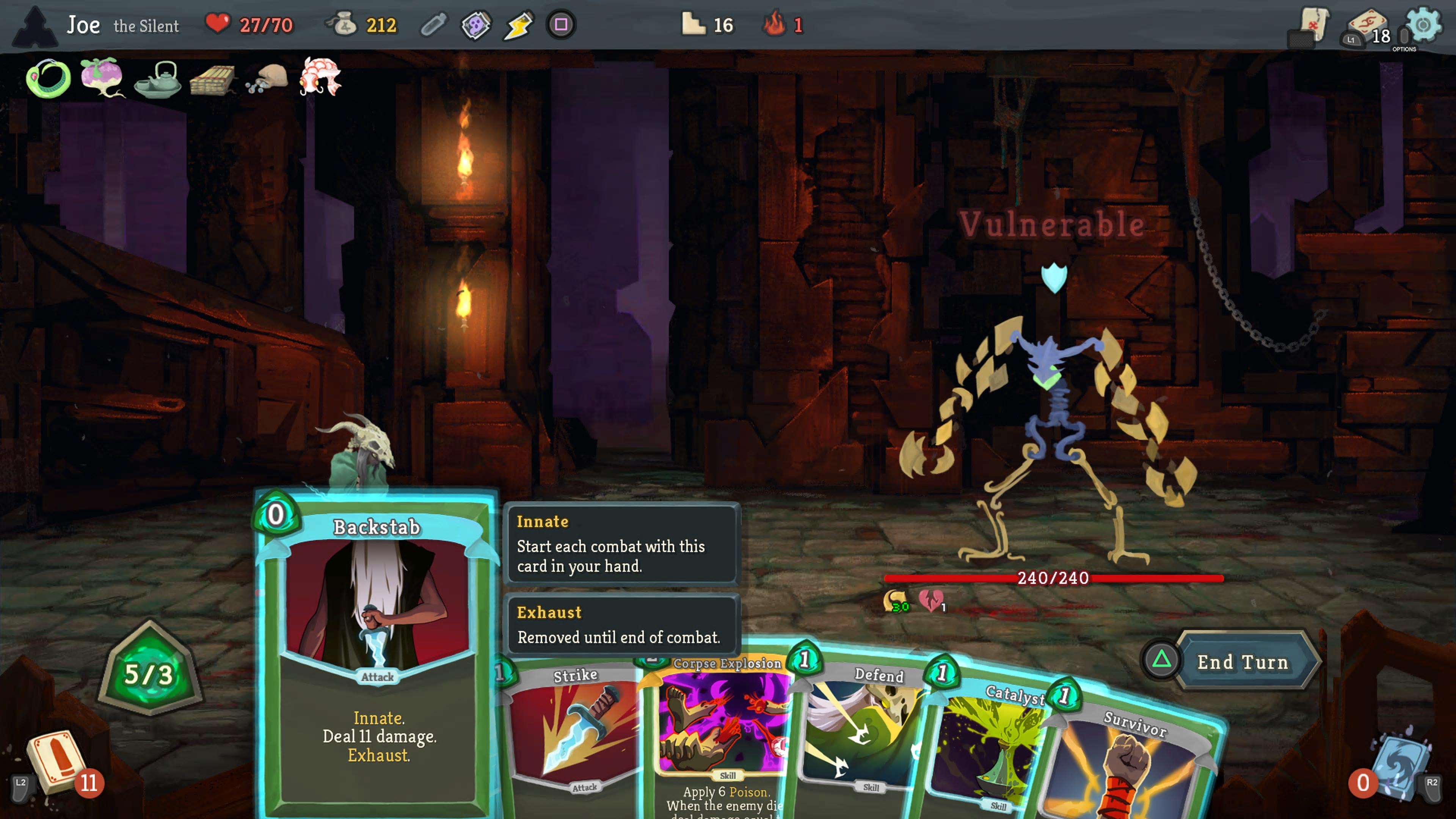
Easy to learn yet challenging to master, Slay the Spire introduces the player to its first character, Ironclad. Ironclad’s deck builds can go several ways, but primarily lean toward a strength build (try to boost your attack strength as high as possible), an exhaust build (use cards for free with the Corruption card and draw/grow your defense with Dark Embrace whenever you use a skill), a barricade build (stack your defense as high as possible, then use a Body Slam Card for offense), or a status deck (combo Fire Breather with Evolve and status creating cards to deal massive damage to all enemies). Initially, none of this matters, but as the game goes on and the challenge is increased, figuring out which deck you want is imperative to surviving a run.


There are five types of cards in Slay the Spire; attacks, skills, power cards, status cards, and curses. And three rarities; common, uncommon, and rare. Attack cards are pretty straightforward, they're the game’s primary way to deal damage to enemies. Skills, the most versatile of the bunch, can do anything from granting the player defense to reducing the enemy’s attack power or even inflicting a status ailment upon them. Power cards also have varying uses. Once they've been played, they’re in play for the remainder of the battle they’re activated in. These cards can do anything from causing damage whenever a status card is drawn to granting the player passive defense every turn. Status cards and Curse cards both bloat the deck, with Curse cards being the more malevolent of the two. Though, if I’m being honest, any wasted card slot can end up killing you (unless you're running a Status deck).

As I discovered synergy between the different card types, I realized the cards I found utterly useless just had a very comfortable home in a different deck type. Once I found that I began experimenting more and more, creating fantastic decks that felt good and engaging to play. A deck at the peak of its synergistic momentum is exciting. As I unlocked cards and watched them trigger the effects of other cards, I formulated the blueprint for decks that would better deal with specific enemies. In combination with relics (passive items that consistently affect your run), a lucky run can make you feel like a strategic mastermind.

Unfortunately, due to the nature of roguelikes, finding synergy doesn't come with every run. Yes, the player can choose from three cards at the end of each combat or sometimes when they enter a “?” room, but as the difficulty of the game increases—specifically when attempting ascension mode—the player’s luck when it comes to choosing cards significantly decreases.


I discovered that my favorite type of deck was a status deck with the Ironclad character. It works like this: you get a Fire Breathing power card (deals 6 damage (10 if upgraded) whenever a status or curse card is drawn). Combo that with an Evolve card (When you draw a status card, draw another (draw 2 cards when upgraded). Then you fill the deck with cards that add status cards during combat, pick up the Mark of Pain relic if you run into it (adds two wound status cards into your deck and gives you one extra energy), and you’re set. Every time you draw, your hand fills up and you do massive damage to all enemies. The problem is that when on higher difficulties, the game doesn't always give you cards that work well together. I understand the idea of working with what you’ve got, but you literally can't sometimes, and that isn't fun. I hate feeling like I wasted my time because of something I couldn't control (in a game, of course. But also being stuck in traffic is the worst). Going in with the idea that you want a specific type of deck will end your run, so you have to keep an open mind. That being said, the game should always give you an option to build some kind of cohesive deck instead of wasting your time. I had gone fifteen runs in a row without a solid deck at one point and lost them all. Once the game gave me half-decent choices for two runs in a row, I won back-to-back runs (not without challenge, mind you).

I also found an issue with how bosses can hard counter some characters' deck types to the point of near uselessness. For instance, Silent (the second character you're introduced to), has a shiv deck, which sees the player add a ton of shivs (no energy, low damage cards) to their hand and use them to do massive damage each turn. That said, the player has to use a bunch of shivs to take down a boss. Death by a thousand cuts. One of the end bosses, Time Eater, has an ability that ends your turn after twelve cards have been used, making a deck like this almost impossible to use (unless you get lucky and find an Envenom card that can help). You can't tell which end boss you'll fight until you get to the third stage, and by that time it may be too late to switch up your deck enough to make an impact.

The best part of Slay the Spire’s multiple characters (I tried the four that were available to me) is how different they are. In addition to different cards, each character starts with a specific relic that affects how you approach each play style. This keeps the game fresh and allows the player to switch to a new style whenever they’re bored of the deck types they've been playing with. Each character also receives exclusive relics throughout each run that are tailored for specific decks. Hours and hours of experimentation are on the table before you feel you have a good grasp on each character. Characters you may have thought were boring start to create more options as you unlock new cards for their potential decks, and then the real fun begins. Getting all the cards unlocked and at your disposal (when you're lucky enough to run into said cards) doesn’t take too long, and in the meantime teaches you the basics of each character. The pacing for the unlocks is enjoyable, and regardless of whether you finish a run or not, your character still gets experience towards unlocking new cards.


One of the toughest challenges in maintaining a long-term interest in a rogue-lite is creating a luck-to-skill balance that continues to scale accordingly. Unfortunately, the late game's ascension mode doesn't quite get this right as the game relies heavily on luck. Other than end-game content, Slay the Spire is a great game to jump into and learn. The characters are all unique and fun. The deck synergy can be a blast. And the challenge is ever present. Any mistake can end your run, so bring your A-game whenever you make a move. If you like strategy, challenge, and the ever-looming fear of death of a roguelike, Slay the Spire is well worth investing in.

The Math

Objective Assessment: 8/10

Bonus: +1 for excellent card synergy. +1 for distinct character decks.

Penalties: -1 for poor end-game balancing. -1 for hard counters against specific decks.

Nerd Coefficient: 8/10

Posted by: Joe DelFranco - Fiction writer and lover of most things video games. On most days you can find him writing at his favorite spot in the little state of Rhode Island.

Monday, November 30, 2015

Microreview [video game]: GALAK-Z: The Dimensional by 17-Bit

Pressing the Right Buttons (If You're the Right Person)


I didn't finish this game. Let's get this stated right from the start because, to some people, not finishing the game means you can't provide a well-rounded opinion of it. If you're one of those people, please stop reading. I wanted to finish it, I did! But there's a point where timeliness and necessity intersect. Would my opinion change about the game if I put in three times as much time as I already have to get to the end credits? In some cases, sure, but I don't think this is the case with GALAK-Z. It's made for replayability. The gameplay is why it exists, not the story or end goal.

GALAK-Z's influences are extremely obvious, right from the start, and they hit a lot of nostalgia buttons for me. It's a blend of arcade gaming, Macross, Voltron, and some Halo. When it starts, it looks like an arcade cabinet booting up. You control a space ship that can transform into a robot. The levels are all randomly generated, with a randomly selected objective, and they're delivered in groups of five episodes (levels) per season. Each season ends with a boss fight and some story narrative. It's all very Saturday morning TV. Nostalgia is what works best in this game.

What works second best is that replayable gameplay loop. In order to finish each episode, there are enemies and environmental hazards everywhere. This is where the Halo influences come in. It looks like a twin-stick shooter, but your ship is more survivable, and so are the enemies. Movement is extremely important, as you can face, shoot, and move in any direction, but you can also jump over shots and enemies. Enemies are numerous and you will die repeatedly. In "Rogue" difficulty (the default), death means you start the season over. Everything you've found and unlocked is wiped clean, with some minor exceptions.

In a Rogue Legacy twist, there's an item shop between episodes and you can find blueprints, which make upgrades available in that item shop. You can also find permanent upgrades that survive death. There is also a currency that you find by destroying enemies and it can give you either more credit in your next life, or another attempt at an episode you failed. In Rogue difficulty, early levels are spent gathering as many upgrades and credits as you can, because failure means you don't lose much. When you're three or four episodes deep, you get a lot more cautious so that you don't lose an entire season over a bad decision. In "Arcade" difficulty, you don't lose an entire season over death, just the current episode you're on. The difficulty hasn't changed, but the punishment for failure is less harsh.

It's this punishment that brings me to my love/hate relationship with GALAK-Z. I love everything that it's doing. It's nailing a lot of little design stuff in games that I think is great. It's a difficult game, and it's a rewarding game, but it hurts to lose so often. I'm a fairly determined person, who wants to see a game to the end, and I'm not sure I've got what it takes to ever finish GALAK-Z. It doesn't feel like it's unfair or completely random, but I've had seasons end in one dumb move. The levels are short so it's not hard to catch back up, but when I do complete a season, it feels less like I'm doing well, and more like I'm getting lucky. Even the Arcade difficulty isn't much of a saving grace because it means you get to beat your head against the same level over and over until you push through, or give up and start a new run in the hopes that you get better upgrades next time.

I never made it more than 15 minutes into any particular run on Rogue Legacy. By contrast, I've finished almost two seasons of GALAK-Z, out of five. GALAK-Z is a lot of fun, but you have to either be great at it, or a glutton for punishment if you expect to get anywhere. You almost have to love GALAK-Z to want to see it through to the end, or else you might not have the commitment it needs to get you there. It's a well thought-out design that is going to press buttons for the right people, and completely turn off a lot of others.

The Math

Baseline Assessment: 7/10

Bonuses: +1 great, 80's anime look and feel, +1 perfect controls

Penalties: -3 high punishment for failure necessitates either great skill or long commitment

Nerd Coefficient: 6/10 (still enjoyable, but the flaws are hard to ignore)

***

POSTED BY: brian, sci-fi/fantasy/video game dork and contributor since 2014

Reference: 17-Bit. GALAK-Z: The Dimensional [17-Bit, 2015] 

Tuesday, February 10, 2015

Sword of the Stars: The Pit vs. Dungeon of the Endless

Superior 4X Successors


4X stands for eXplore, eXpand, eXploit, and eXterminate. I love 4X games. Master of Orion 2? Amazing. Galactic Civilizations 2? Even better. Sins of a Solar Empire? Great game. I'll give almost any 4X game a shot. The good ones are amazing time sinks. But two games I wasn't particularly impressed with were Sword of the Stars and Endless Space. I found Sword of the Stars rather clunky, and Endless Space good looking but boring.

But something strange happened. Kerberos (developer of Sword of the Stars) released Sword of the Stars: The Pit, and Amplitude (developer of Endless Space) released Dungeon of the Endless. These games are not 4Xs, but both are dungeon crawls with Rogue-like qualities. They're both fantastic, considerably better than the games that came before them. So if you're like me and you weren't thrilled with Sword of the Stars or Endless Space, allow me to convince you to give these two a shot.

Sword of the Stars: The Pit

Of the two games, The Pit is the most straight forward. It is also the most Rogue-like. You choose your class (from marine, engineer, scout, and many others if you buy the DLC), and then you're on the surface. The goal is to reach the bottom of The Pit, an alien research facility that might contain the cure to a deadly plague. To get there, you have to use your strength, finesse, brains, and dozens of skills to overcome traps, locked doors and containers, and mountains of enemy monsters.


The Pit is simply a well-made dungeon crawl. It's got a cartoony style, and relies heavily on the random number generator, but its interface is easy to understand and there is a lot of lore to find. It's difficult, but not entirely unforgiving. Once you learn an item or food recipe, it's remembered across playthroughs and the Gold Edition DLC adds stasis chambers, where you can bank items and experience for future playthroughs. Presumably, you go as far as you feel like you can make it on your current run, then bank your best stuff to carry it over to the next run, which would make it easier. I'm entirely too ambitious to have taken advantage of it properly, but it's one of those touches that makes a difficult game less of a shear wall, and more of a steady incline. I haven't reached the bottom of The Pit, but I always feel like I'm one more run away from doing it.

Dungeon of the Endless

Turn-based strategy. Real-time strategy. Tower defense. Rogue-like. These are all qualities that influenced the design of Dungeon of the Endless. You control a team of up to four heroes as they escort a crystal power source up 12 levels. Each level starts at the crystal. You open doors until you find the exit. Each time you open a door, you increment a turn, which both increases your available resources and potentially summons waves of monsters. You can use your heroes to fight the monsters, or any modules you've researched, such as a simple laser turret, or a tear gas module that does damage over time to monsters in that room. Some monsters want to fight heroes, some want to fight modules, and some only want the crystal. Once you find the exit, one of your heroes has to carry the crystal to it, and that's when all of the doors in the dungeon bust open and a flood of monsters tries to stop you from exiting. The game instantly goes from methodical search, to manic dash and carnage.


I may not have done a great job of explaining Dungeon of the Endless, but the tutorial does an even worse job than that. Dungeon of the Endless has a lot going on, and a lot of it could use a better explanation, but all of it works great together to make a complex, unique game. On top of that basic explanation, heroes gain levels and skills and can equip items, modules must be researched and operated, hero abilities used efficiently, power managed, etc. And on top of all of this, you're fighting against the RNG, and you only get two difficulty choices: easy, and too easy, and they are neither. I recommend reading a beginner's guide once you've crashed out a couple of runs, but it is very rewarding to get to the end with a team of four heroes alive.

---

It's likely coincidence that these two fairly dull 4X franchises have spun off some amazing dungeon crawls, but I'm thrilled they did nonetheless. I mostly wrote off Sword of the Stars and Endless Space, but I'm particularly happy I took a chance on these two games. I absolutely recommend them to anyone who's into sci-fi and Rogue-likes. I titled this as "versus" as if these two were competing, and perhaps they are, but it's us, the people who play the games, who win here.

***

POSTED BY: brian, sci-fi/fantasy/video game dork and contributor since 2014